How We Build Accounting Automation for Mount Greenwood
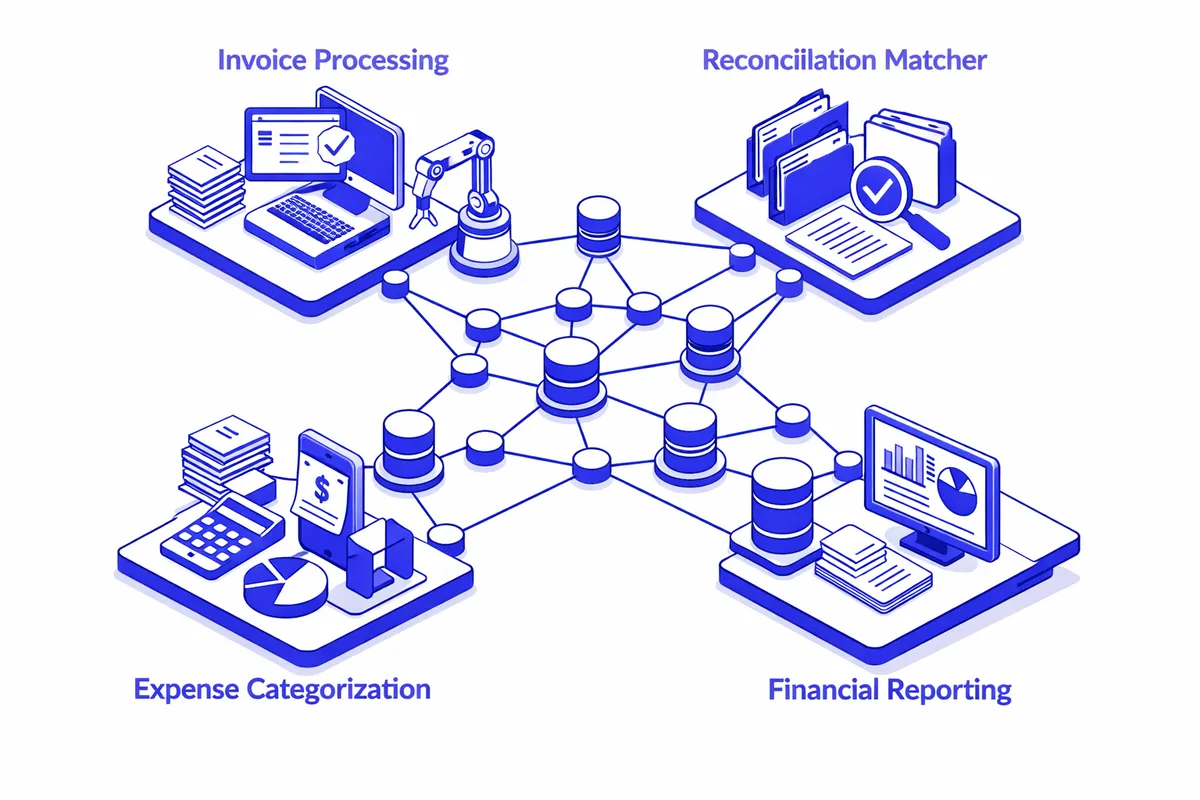
We do not arrive with a product to sell. We arrive with questions. What does your month-end close actually look like, step by step? Where do you spend the most time? Where do errors tend to happen? For a Mount Greenwood contractor, that conversation typically reveals three or four highly repetitive processes: job cost allocation from receipts, payroll journal entries, subcontractor payment tracking, and invoice generation. Each one follows a deterministic rule. None of them requires human judgment in the normal case. All of them can be automated.
We build on the accounting software you already use. For most Mount Greenwood businesses, that means QuickBooks or a similar platform that has been in place for years. We do not ask you to replace it. We build automation workflows on top of it: rules that pull transactions from connected bank and card feeds, categorize them based on the logic your accountant already uses, route exceptions for review, and post clean entries on your schedule.
For contractors working across multiple job sites near Kedzie Avenue or Pulaski Road, we set up project-level cost tracking that aggregates field data automatically. For insurance agencies, we build carrier reconciliation workflows that match your internal records against statement files without requiring manual comparison. For restaurants, we automate the daily revenue audit so that Sunday morning is not an accounting session.
Every automation is tested against three months of historical transactions before it touches live data. We run parallel outputs, comparing automated results against your actual records, until the match rate justifies going live. Your accountant or bookkeeper reviews the exception report, not every transaction.
Industries We Serve in Mount Greenwood
Contractors and trades businesses along the residential corridors near 111th Street and Kedzie Avenue use accounting automation to bring job costing, subcontractor tracking, and invoice generation into a single workflow. When a plumber or electrician is running three jobs simultaneously, the gap between field activity and the accounting record is where errors and billing delays live. Automation closes that gap automatically.
Insurance agencies on Sawyer Avenue and surrounding blocks use accounting automation to handle policy renewal billing, commission reconciliation, and carrier statement matching. The volume of small, regular transactions in insurance administration is exactly the type of work that rules-based automation handles most effectively: the same logic applies every time, and exceptions are rare enough that human review remains meaningful.
Accounting and professional services offices in Mount Greenwood serve a client base that expects precision. Practices that automate their own internal workflows, billing, trust account reconciliation, and expense tracking, demonstrate to clients that they practice what they advise. Automation also frees professional staff time for higher-value advisory work rather than administrative processing.
Family restaurants and neighborhood bars near Mount Greenwood Park automate their daily revenue reconciliation, matching POS system data against payment processor settlements and bank feeds. The restaurant sector's daily transaction volume makes manual reconciliation one of the most time-consuming administrative tasks in any small food-service operation. Automation reduces that to a daily exception review.
Neighborhood retail and florists on commercial corridors near 115th Street use accounting automation to track inventory costs, vendor invoice processing, and seasonal cash flow patterns. Florists face sharp seasonal peaks around holidays and the school calendar events tied to institutions like Brother Rice High School; automated cash flow tracking helps owners see the pattern and plan accordingly.
Community organizations and nonprofits connected to Mount Greenwood's strong civic infrastructure use accounting automation for grant tracking, donation reconciliation, and event revenue posting. These organizations often operate with small administrative staffs handling large transaction volumes during fundraising periods; automation scales to the volume without requiring additional headcount.
What to Expect Working With Us
1. Process inventory before any build. We spend the first engagement mapping every manual accounting step your business runs: where data enters, where it gets transferred, where someone makes a judgment call versus follows a rule. That inventory becomes the automation roadmap and the baseline for measuring what changes after launch.
2. Build order based on pain, not complexity. We sequence automations by where your team loses the most time, not by what is technically easiest to build. If subcontractor invoice tracking takes six hours every month, that gets built and deployed before anything else, even if a more complex workflow is also on the list.
3. Historical data testing, not live experiments. Every automation runs against your real historical transactions before it touches current-period data. We validate outputs against your actual records and do not go live until the match rate confirms the logic is correct.
4. Documented handoff to your accountant. Every workflow we build comes with documentation written for the person who maintains your books, not for a software engineer. Your accountant or bookkeeper can modify rules, add new categories, or extend the automation without coming back to us.