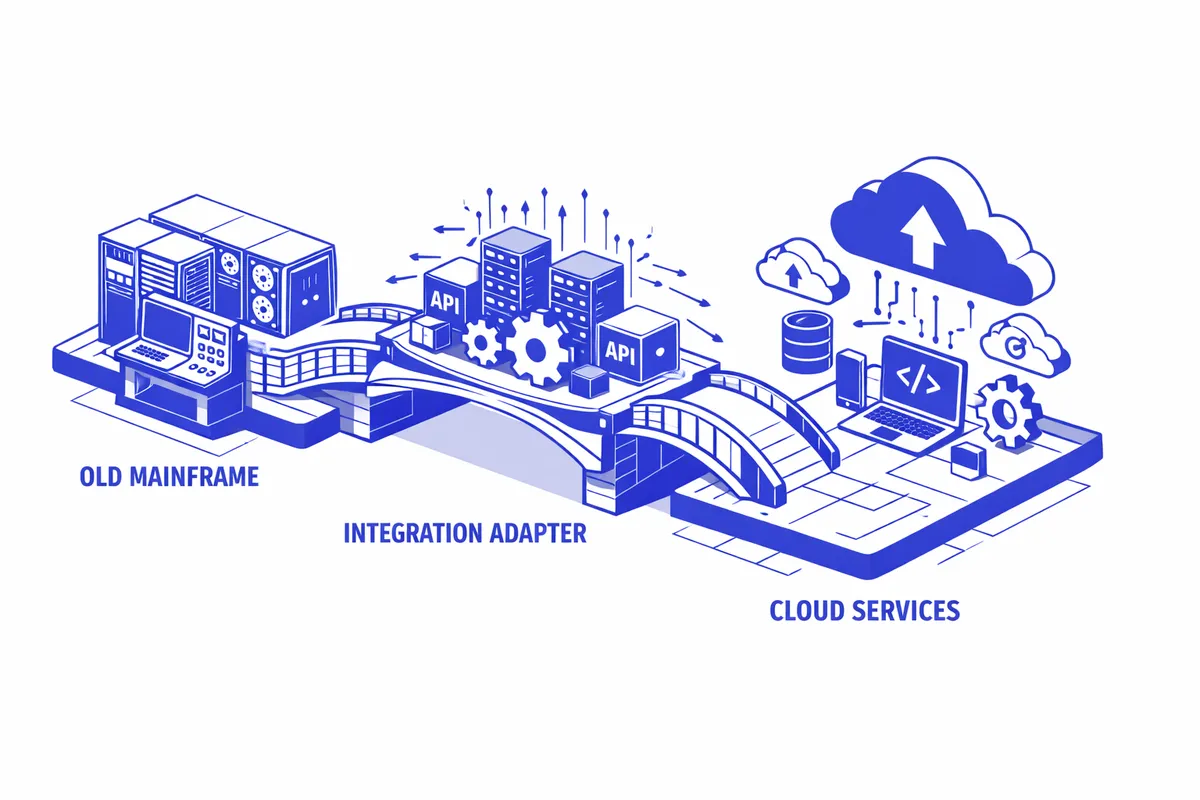
How We Build Legacy System Integration for McKinley Park
The first question is always: what data needs to move, in which direction, and how often? A warehouse near Stearns Quarry needs job completion data to flow to the invoicing system within hours of job close. A contractor needs estimate data to populate the scheduling system automatically when a bid is accepted. A restaurant needs daily sales totals to reach the accounting platform without manual entry. Each of these is a different data flow with a different trigger and a different frequency requirement.
We map the data flows first, then identify the integration method for each pair of systems. Many legacy systems that appear to have no integration capability have an export function, a local database, or an undocumented API that can be accessed with the right tool. We explore every available connection method before recommending any system replacement, because replacement is always more expensive and more disruptive than integration.
Integration tools we use vary by system type. For modern systems with APIs, we use direct connections or middleware platforms like Zapier or Make. For legacy systems with database access, we build direct database readers that extract data at defined intervals. For systems whose only output is a flat file or CSV, we build automated import processes that consume those files and route the data to the target system. For truly isolated systems with no export capability, we assess whether screen-scraping automation or a custom integration adapter is technically feasible before recommending replacement.
Testing for legacy integrations is extensive because legacy systems behave inconsistently at edge cases. We test the integration against realistic data scenarios: missing fields, unusual character sets, date format variations, and the specific quirks of the legacy system's data model. Each edge case either resolves cleanly or surfaces a specific alert rather than a silent data error.
Industries We Serve in McKinley Park
Small warehouse and logistics operators near the Ashland Avenue corridor run job management systems that are often 10 to 20 years old. These systems contain accurate, detailed operational data that management trusts. The integration need is typically connecting that data to modern invoicing, GPS tracking, and customer communication tools. We build connectors that extract job completion data from the legacy system and push it to the current-generation tools without requiring the operator to replace the system that their crew already knows.
Auto service businesses on Western Avenue use shop management platforms like Mitchell or AllData that have significant legacy bases. These platforms track vehicle history, parts usage, and labor hours accurately but do not always connect cleanly to newer payment processing, customer messaging, or accounting tools. We build the bridges between the shop management system and the surrounding modern infrastructure, so technicians continue using the system they know while management gets the data flow they need.
Contractors working residential blocks between Pershing Road and 35th Street often run estimating software, job costing tools, and scheduling systems that do not share a database. An accepted estimate in one system requires manual re-entry into the scheduling system and again into the accounting platform. Legacy integration eliminates those re-entry steps and ensures that a change in one system propagates to the others, reducing the errors that arise when manual re-entry produces divergent records.
Family-run restaurants and catering operations on Archer Avenue use POS systems that may be a generation or two behind the current version, installed by a restaurant supply company that no longer supports the version they run. These legacy POS systems often hold years of transaction data that is valuable for pricing analysis and customer behavior tracking. We extract and connect that data to modern reporting and accounting tools without forcing a POS replacement that would require retraining the entire kitchen and front-of-house staff.
Neighborhood grocers and food retailers near 35th Street use inventory and point-of-sale systems that pre-date the current generation of integrated retail software. The integration need is typically connecting inventory tracking to accounting and to vendor ordering, eliminating the manual step of comparing a physical inventory count to a paper purchase order. We build data bridges that automate the inventory-to-ordering connection regardless of the age of the inventory system.
Family medical and dental practices near the McKinley Park branch of the Chicago Public Library operate with practice management systems and EMRs that were selected years ago and are now surrounded by newer billing, patient communication, and financial tools. Integration between the legacy practice management system and current billing and payment processing eliminates duplicate data entry and creates a cleaner financial record. We work within the vendor constraints of medical software, which often have strict integration requirements for HIPAA compliance.
What to Expect Working With Us
1. System inventory and data flow mapping. We document every system in the business's technical stack, identify the data that needs to move between them, and map the current manual steps that substitute for missing integration. For a McKinley Park warehouse operator, this typically reveals three to five manual re-entry steps per week that are candidates for automation.
2. Integration method assessment. For each system pair, we identify the available integration method: API, database access, flat file export, or custom adapter. We assess the feasibility and cost of each option and recommend the approach with the best balance of reliability and maintenance cost. We do not recommend replacement when integration is viable.
3. Integration build and edge case testing. We build the connectors, configure the data mapping, and test against realistic edge cases specific to the legacy system's quirks. Every integration includes error handling that surfaces problems to the business owner rather than allowing silent failures to compound into data discrepancies.
4. Documentation and handoff. Every integration we build is documented: what data flows where, what triggers the flow, how to monitor for errors, and how to make adjustments if the business process changes. The documentation ensures the business is not dependent on us for every future modification.