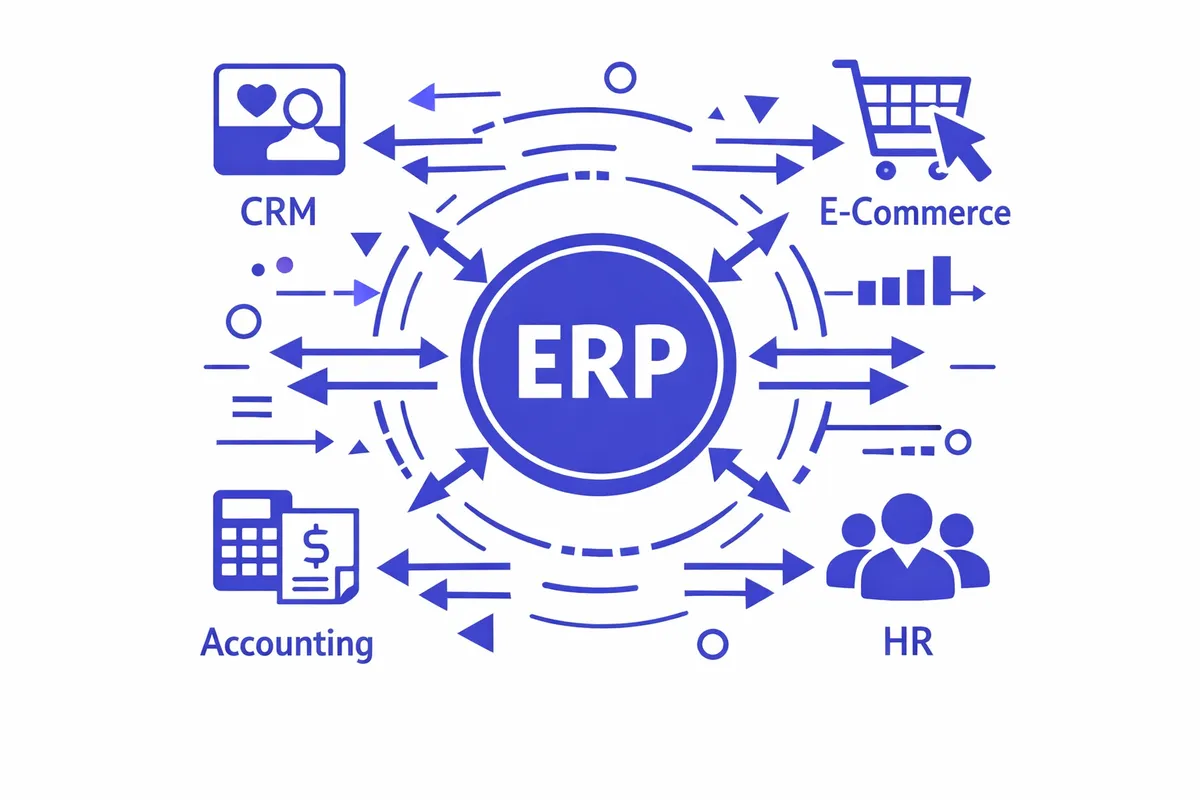
How We Build ERP Integration for McKinley Park
McKinley Park's manufacturing and logistics clients often work with older platforms alongside newer ones. A fabricator that has used QuickBooks for twenty years is not going to replace it because a newer ERP offers native integration. The practical integration work is connecting the ERP they adopted for production management to the QuickBooks they trust for accounting, and building that connection robustly.
We start by auditing the specific platforms in use and assessing the integration options available for each. For many manufacturing platforms, this includes evaluating API quality and any connector ecosystem. For QuickBooks, Odoo, and Acumatica, the API options are well-documented. For industry-specific manufacturing software with limited API access, we design integration around what is available: database access, scheduled file exports, or screen-level automation in cases where no API exists.
Integration architecture for manufacturing businesses emphasizes a specific flow: quote or order in, production or warehouse acknowledgment, fulfillment confirmation, invoice out, payment in. We design the integration to cover this flow end-to-end rather than connecting only part of it, because partial integration often creates new reconciliation problems downstream from the connected point.
Implementation is staged by operational priority. For a McKinley Park manufacturer, stage one might be automating the order-to-invoice flow. Stage two adds inventory sync between warehouse and ERP. Stage three connects purchasing to accounts payable.
Industries We Serve in McKinley Park
Small manufacturers and fabricators near Bubbly Creek and along the Archer Avenue industrial corridor run production management or ERP platforms that are not connected to accounting. We connect order intake, production tracking, and inventory to QuickBooks or your accounting platform so financial reporting reflects current production activity without manual entry.
Warehouse and logistics operations on Western Avenue and Pershing Road run warehouse management systems alongside ERP or accounting tools with no data bridge between them. We connect inventory position, fulfillment activity, and shipping costs to the financial system and to any customer-facing order tracking channels.
Contractors and field service businesses operating from McKinley Park manage job estimates, scheduling, dispatch, and billing in tools that are rarely connected to accounting. We connect job management to QuickBooks or your accounting platform so completed jobs generate invoices automatically and labor costs flow to the general ledger.
Small distributors and wholesale operations along Ashland Avenue that handle orders from multiple customers across multiple product lines need the connection between their order management or ERP and accounting to work without manual reconciliation. We build that connection with specific attention to multi-customer invoicing and accounts receivable tracking.
Auto service and auto parts businesses near McKinley Park's commercial strips often run dealer management or shop management platforms alongside general accounting tools. We connect parts inventory, repair order management, and billing to the accounting system so financial reporting is current.
Family restaurants and food service operations on 35th Street and Archer Avenue that have grown beyond cash register management need POS-to-accounting integration, payroll platform connection to the general ledger, and vendor invoice processing that does not require manual entry.
What to Expect Working With Us
1. Systems audit. We document every platform your business currently uses, assess integration options for each, and identify where the manual data transfers are generating the most operational burden. For manufacturing clients, we specifically map the order-to-cash and purchase-to-pay flows.
2. Integration design. We produce a written architecture document covering each connection, data flow direction, error handling, and monitoring. We will be specific about what is technically possible for your exact platforms before any development begins.
3. Phased build. We implement the highest-priority integration first, typically within six to ten weeks. Subsequent integrations build on the same infrastructure.
4. Monitoring and support. Every integration includes automated monitoring so your team knows when syncs complete and when errors occur. Post-launch warranty period and optional maintenance retainers are included in every engagement.