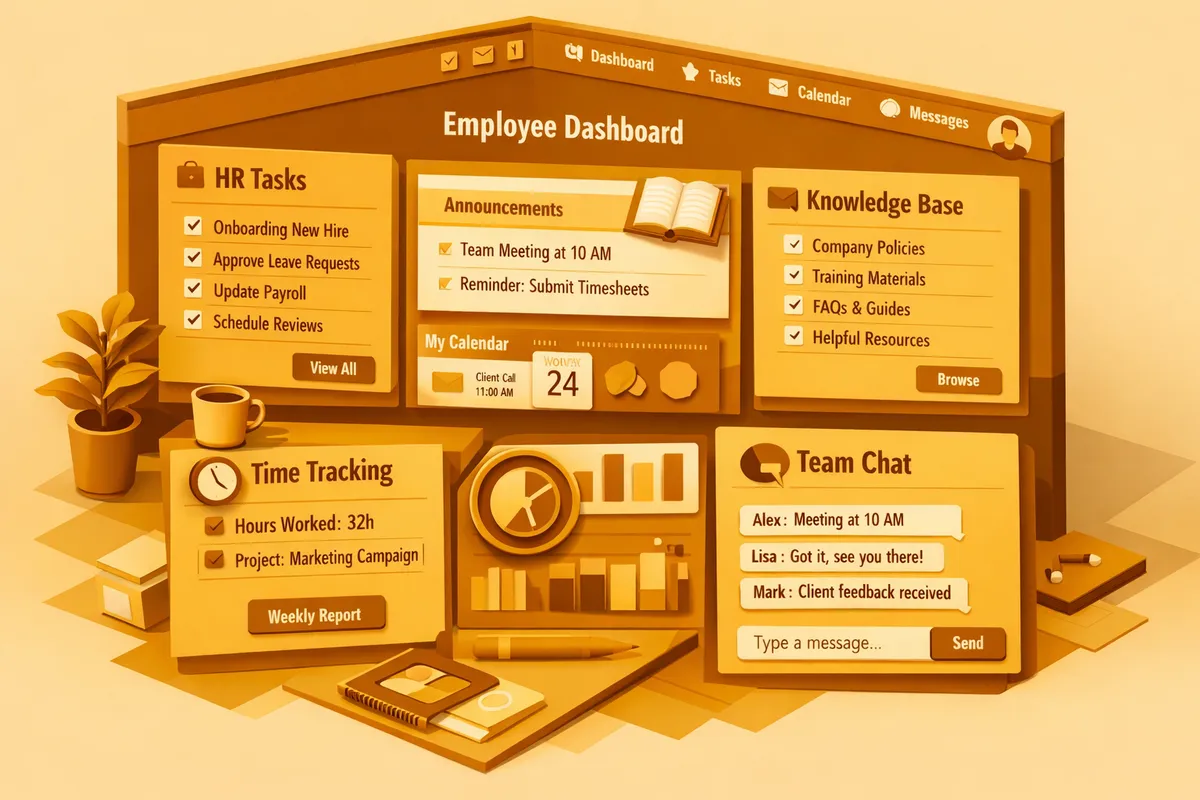
How We Build Employee Portals for McKinley Park
We start with the workforce composition. A restaurant kitchen crew has different needs than a warehouse loading team or a contractor's field crew. The restaurant kitchen needs daily schedule publishing, a bilingual interface, and a simple shift swap request system. The warehouse needs time clock integration, forklift certification tracking, and a policy acknowledgment system. The contractor crew needs job site assignment visibility, safety documentation, and pay stub access.
Each portal is built around these operational realities. We do not adapt a generic HR platform. We identify the five to seven features that eliminate the most management friction and build a portal around those. The result is a system the workforce actually uses, not a comprehensive platform with 40 features that the owner explains in orientation and no one touches again.
Bilingual functionality is not optional for McKinley Park. We build every employee-facing element in Spanish and English, with language preference set at the user level. A worker who prefers Spanish sees Spanish. A supervisor managing a mixed team sees what they need. We verify that automated notifications, policy documents, and interface labels are accurate in both languages, not machine-translated.
The build includes integration with any existing payroll or time-tracking software the business uses. For a restaurant on Archer Avenue already using a POS with payroll modules, the portal connects to that data rather than duplicating it. For a contractor without any digital HR infrastructure, we build the foundational layer from scratch. The timeline is four to six weeks for a standard small business portal, longer for operations with complex shift patterns or multiple locations.
Industries We Serve in McKinley Park
Restaurant and food service operations on Archer Avenue manage kitchen and front-of-house crews that require daily schedule posting, bilingual policy documents, and a straightforward shift swap system. An employee portal replaces the paper schedule posted on the back kitchen wall and the group text chain for coverage requests. New hire onboarding paperwork goes digital, with acknowledgment tracking so the owner has a record that each employee received and confirmed each required document.
Small warehouses and logistics operations near the Ashland Avenue industrial corridor manage workers whose compliance documentation matters for both internal purposes and customer contracts. Forklift operator certifications, safety training acknowledgments, drug testing records. An employee portal centralizes these records, sends automated renewal reminders before certifications expire, and provides the documented evidence required for insurance and customer audits.
Auto service businesses along Western Avenue employ technicians and service advisors whose schedules change weekly based on appointment volume. An employee portal publishes the week's schedule in advance, accepts time-off requests formally so there is a record of each approval, and stores the technician certification documents that the shop needs for liability purposes. When a wage dispute or unemployment claim arises, the portal record is the evidence.
Neighborhood grocery and convenience retailers near 35th Street manage part-time staff with variable weekly hours. An employee portal handles the schedule publication that Chicago's predictive scheduling rules require, tracks the hours each employee has worked against their availability, and gives workers a clear channel for requesting changes rather than calling the manager at 6 AM on a Sunday morning.
Family medical and dental practices near the McKinley Park branch of the Chicago Public Library manage a small but compliance-sensitive workforce: HIPAA training completion records, background check documentation, DEA licensing for physicians, and continuing education requirements for clinical staff. An employee portal tracks all of these with automated renewal alerts and stores the completion documentation in a format that satisfies audit requirements.
Contractors working residential bungalow blocks between Pershing Road and Western Avenue employ field crews that are rarely in the office. An employee portal gives field workers mobile access to job site assignments, safety documentation, and their pay stub history without requiring them to come in. It also gives the owner a single place to verify that safety briefings have been acknowledged before workers arrive on a job site.
What to Expect Working With Us
1. Workforce and compliance audit. We start by understanding who your employees are, how they are currently managed, and what compliance obligations apply to your operation. For a McKinley Park employer covered by Chicago's Fair Workweek Ordinance, the schedule posting functionality is non-optional. For a contractor, the field documentation layer is the priority. We build the compliance requirements into the portal from the start rather than retrofitting them.
2. Portal design and bilingual content build. We configure the portal interface, build out the document library, and create the initial policy and onboarding content in both Spanish and English. We do not hand you a blank portal and ask you to populate it. We build the content structure and draft the initial documents in a form that is ready to use at launch.
3. System integration and data migration. We connect the portal to your existing payroll or time-tracking tools. If you have existing employee records in a spreadsheet or paper files, we help structure the initial data import so the system starts with your actual employee roster rather than requiring manual entry.
4. Staff launch and training. We train supervisors first, then run a rollout session for employees. For a McKinley Park workforce that is primarily bilingual, rollout training is available in Spanish. We provide a simple reference guide workers can keep on their phones for the first few weeks.