How We Build Document Management for McKinley Park
We start at the dock door, the front counter, or the back office where the paper actually accumulates. Before we configure anything, we sit with you and watch a normal day: what forms come in, who touches them, where they end up. A warehouse near Pershing Road has a different paper flow than a family medical practice off Western Avenue, and the system has to match the real one, not an idealized one.
From there we design the capture method. For high-volume operations we set up scanning stations and mobile capture so a driver or a counter clerk can digitize a document in the moment without breaking stride. We use AI to read each document, pull the key fields, classify it by type, and file it where it belongs. An invoice lands under the right vendor. A repair order attaches to the right vehicle. A permit files under the right job address. The McKinley Park operator does not become a data-entry clerk.
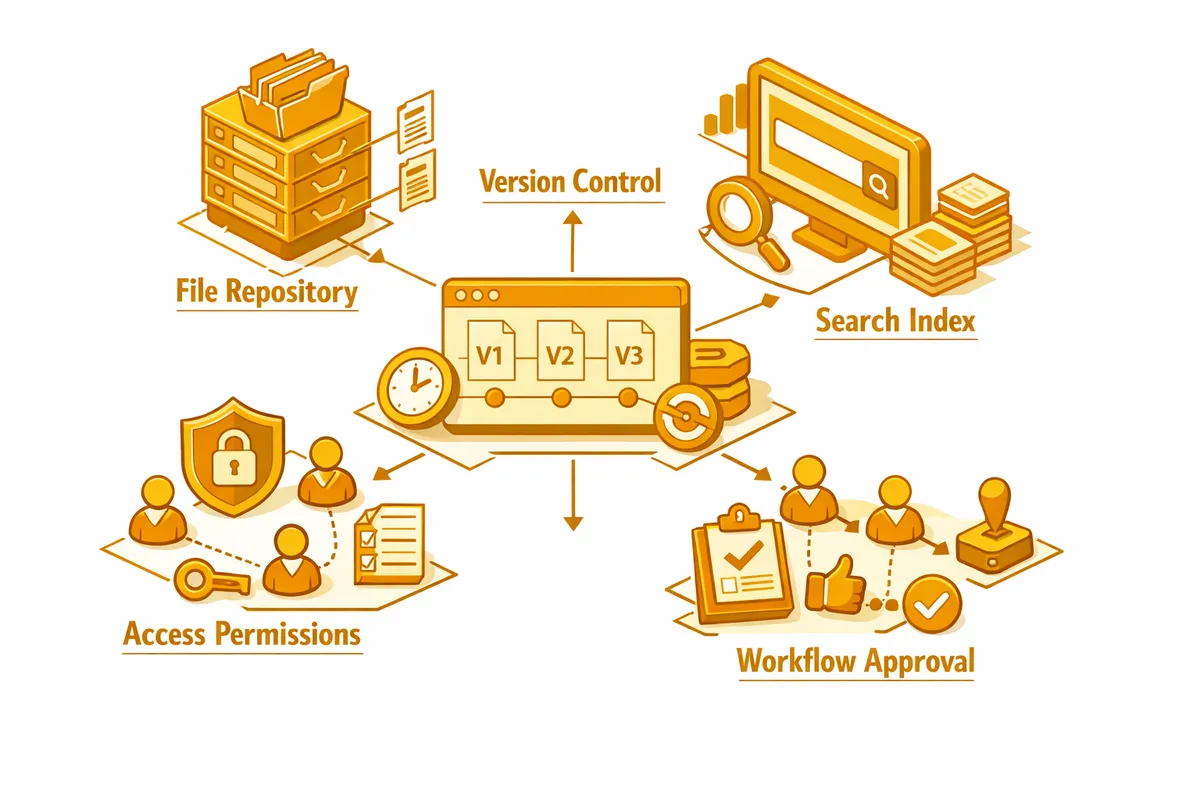
We then build the retrieval side around how your team thinks. Search by customer name, by date range, by job number, by address. We set retention rules so records that have to be kept for tax or compliance reasons stay put, and we wire in automated backup so a flood near Bubbly Creek or a hard-drive failure never costs you your history. The result is a system that runs quietly in the background of a working business on Archer Avenue or Ashland Avenue.
Industries We Serve in McKinley Park
Warehouses and logistics firms along the Pershing Road corridor lean on document management to control the flood of manifests, bills of lading, proof-of-delivery slips, and carrier invoices that a freight operation produces daily. We build automated capture at the dock so paperwork is digitized and indexed by shipment the moment it changes hands, which turns a billing dispute or a customer audit into a thirty-second search instead of a box hunt.
Auto service and repair shops clustered near Archer Avenue use document management to keep repair orders, parts receipts, warranty claims, and inspection records tied to each vehicle and customer. When a car comes back six months later, the full history is one lookup away. The system also keeps insurance and fleet-account paperwork organized so the shop can respond to a claims adjuster without losing a bay to filing.
Family-run restaurants near 35th Street and McKinley Park itself rely on document management for health inspection reports, supplier agreements, equipment warranties, payroll records, and the lease documents that a multigenerational business accumulates over decades. Everything is searchable in one place, so an owner handing the operation to the next generation hands over an organized record instead of a closet.
Neighborhood grocers along Western Avenue and Ashland Avenue put document management to work on vendor invoices, distributor contracts, refrigeration service logs, and license renewals. With AI classification sorting paperwork as it arrives, a grocer can reconcile a delivery, check a contract term, or pull a permit for an inspector without stepping away from the front of the store.
Family medical practices serving the bungalow blocks around the Chicago Public Library McKinley Park branch use document management to organize intake forms, referral letters, insurance correspondence, and consent paperwork under strict retention and access rules. Charts and administrative records become searchable and secure, which cuts the front-desk time spent locating a single document for a returning patient.
Contractors and trades working throughout McKinley Park depend on document management to keep permits, signed change orders, lien waivers, subcontractor agreements, and inspection sign-offs organized by project address. When a job near Stearns Quarry hits a dispute or a final inspection, the contractor produces the exact signed document on the spot rather than reconstructing the paper trail from a truck cab.
What to Expect Working With Us
1. Paper walk-through. We spend a working day in your space tracing how documents enter, move, and get stored. For a McKinley Park business this usually surfaces three or four pile-up points nobody had named, and those become the first things we fix.
2. Capture setup. We install the scanning stations and mobile capture tools that fit your volume, then train the AI to read your specific document types: your invoice formats, your work orders, your permit layouts. Filing becomes automatic from day one.
3. Retrieval and retention build. We configure search around the terms your team actually uses and set retention rules tied to tax and licensing cycles, including the late-winter renewal crunch that hits Southwest Side businesses. Automated backup is built in, not bolted on.
4. Handoff and tuning. We train your staff on the live system, watch it run for a few weeks, and adjust the classification and search as real documents flow through. You end with a system your counter clerk can run, not one that needs us on call.