How We Build Business Intelligence for McKinley Park
We start with the two or three questions that keep the business owner up at night. Not "what data do we have?" but "what would you know right now if you could know anything about your business?" For a McKinley Park manufacturer, the answer is often some version of: am I making money on the jobs I think I am making money on, and which customers are actually profitable? For a contractor, it is usually: where is my money tied up right now, and which job types produce the best return on my crew's time?
Those two or three questions define the entire BI build. We are not trying to instrument every corner of the business; we are trying to answer the questions that matter most, as quickly as possible, with the data that already exists in the owner's accounting and operational systems.
Source systems for McKinley Park businesses typically include QuickBooks or QuickBooks Enterprise for accounting, job management software like Jobber or ServiceTitan for contractor and service operations, and basic inventory or order management tools for manufacturing and distribution. Some businesses on the Archer Avenue corridor are still running significant portions of their operations on spreadsheets and paper-based job tickets. We work with whatever system is in place, including hybrid approaches where part of the data needs to be entered manually until the business is ready to invest in source system improvements.
Pipeline construction for manufacturing clients focuses on connecting production records to job costing to accounts receivable: a flow that tells the owner what a job cost to produce, what it was billed at, and whether and when it was collected. That three-part view, which most small manufacturers cannot assemble easily from their current tools, is the core of a useful production analytics system.
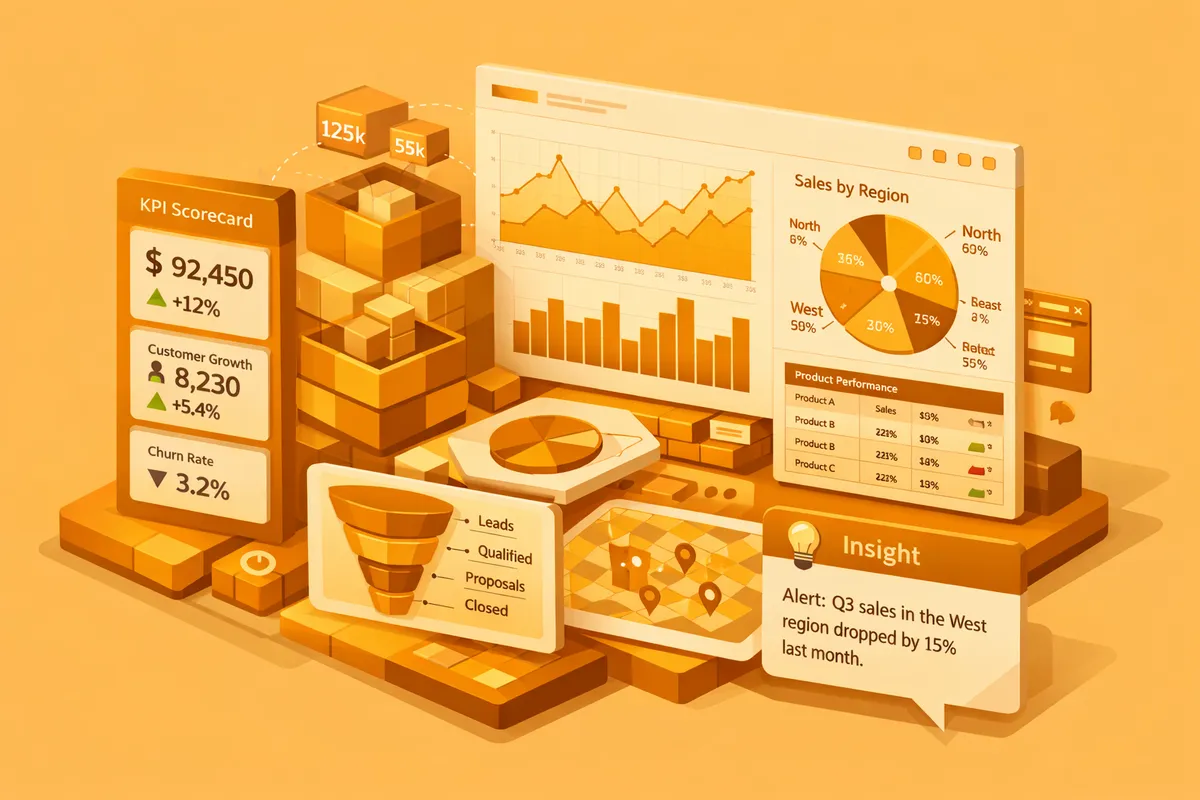
We build dashboards that load fast, display clearly on the owner's phone as well as a desktop monitor, and require no training to read. A McKinley Park business owner checking his dashboard on a Tuesday morning before the crew arrives should be able to see what he needs in under five minutes.
Industries We Serve in McKinley Park
Small manufacturers and fabricators near the industrial corridor along Bubbly Creek build their first production dashboards to track job profitability by order type, material cost trends, and labor efficiency by crew. For a metal fabricator or custom millwork shop, the margin variation between jobs that look similar on the surface is often substantial; BI surfaces that variation and turns pricing intuition into pricing data.
Logistics and warehousing operators on Archer Avenue and Western Avenue run margins that depend on throughput, labor cost per unit handled, and customer mix. A dashboard that shows weekly volume by customer, labor hours per pallet, and billing lag gives a warehouse operator the visibility to renegotiate rates with low-margin customers and protect capacity for high-margin ones.
Family-run restaurants and food businesses along the Archer Avenue corridor, where the neighborhood's Latino and Polish dining culture produces a dense commercial strip, typically have no analytics beyond their POS system's default reports. BI that connects POS data to labor scheduling and food cost creates a weekly profitability view that tells an owner which days and dayparts are making money and which are covering labor costs but not much more.
Auto service and repair shops scattered across the neighborhood near 35th Street and Pershing Road manage a combination of parts inventory, labor hours, and customer return rates that benefit from straightforward BI. Which technicians are most productive? Which service categories produce the strongest margins? Which customers come back and which are one-time? These are answerable questions once the shop management software is connected to an analytics layer.
General contractors and trade contractors operating from McKinley Park throughout the Southwest Side need project-level profitability reporting that their basic accounting software does not provide. A BI system that connects job costing to project schedules to accounts receivable tells a contractor which job types and which customers produce the best financial outcomes, and when in the project cycle problems typically emerge.
Neighborhood service businesses including landscaping, cleaning, and home services companies operating along the residential streets near McKinley Park have customer relationships that span years and revenue patterns that vary with the seasons. BI that surfaces customer lifetime value, service frequency, and seasonal revenue distribution gives service business owners the information to make retention investment decisions.
What to Expect Working With Us
1. Business owner discovery conversation. We sit down with the owner or operator, not a consultant or accountant, and ask what they would want to know about their business if they could know anything. This conversation is focused and practical. It takes sixty to ninety minutes and produces a clear list of the metrics that will actually change decisions. For McKinley Park business owners who have never worked with BI before, we guide the conversation to surface questions that data can actually answer.
2. Source system inventory and connection plan. We document every system where your operational data lives, from QuickBooks to job management apps to POS systems, and design the simplest connection path for each. We are explicit about which connections are automated and which require a brief manual step. We set expectations about timeline and effort before building anything.
3. First dashboard delivery in two to three weeks. We prioritize getting something useful in front of you quickly. A McKinley Park manufacturer does not need to wait eight weeks for a comprehensive BI system; they need to see their job margin data as soon as possible. We build the highest-priority view first, review it with you, refine it based on your feedback, and then build the next layer. You are using real dashboards while the rest of the system is being built.
4. Training and independence. We show you how to read the dashboards and make adjustments as your business evolves. The goal is that after our engagement, you run this system yourself. When you add a new product line or customer type, you know how to update the dashboard. You do not need to call us for every change.