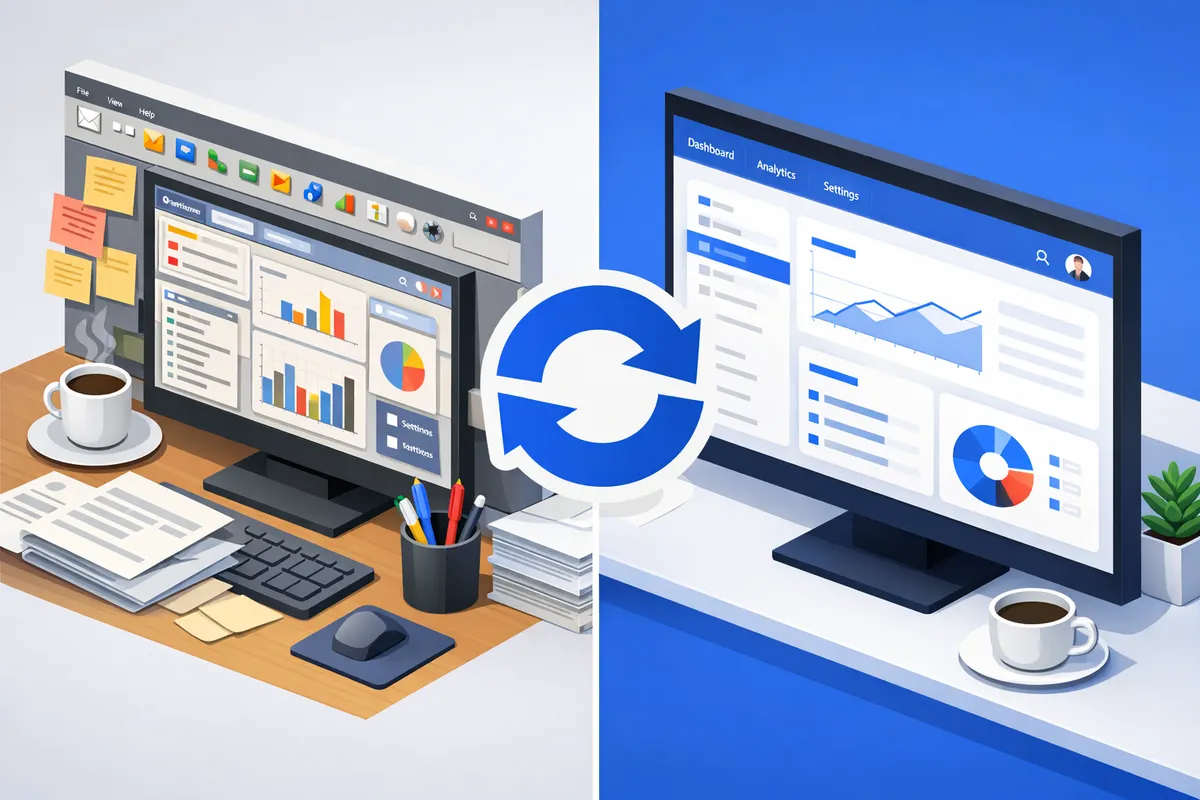
How We Build Website Redesigns for the Loop
Loop redesigns begin with competitive positioning. Before any visual work, we analyze how the top-ranking competitors for your specific Loop-area terms present themselves digitally: what information they lead with, how they structure service and practice area pages, and where their sites create friction that a well-built redesign can exploit.
For professional services firms, information architecture is the primary investment. The site must surface practice area depth and attorney or consultant credentials without burying the conversion path. We design around the decision process of the specific prospect a Loop firm needs to reach: corporate counsel, CFO, or procurement lead who already knows the category and is evaluating firm-specific fit. That process is faster and less exploratory than a consumer decision, which means the site must front-load proof and make contact feel low-friction.
For Loop retail, hospitality, and entertainment businesses, the design emphasis shifts to speed and immediacy. Wacker Drive and Michigan Avenue visitors make decisions in minutes, often while already nearby. The site must answer the key questions in under 30 seconds on a phone: location, hours, parking, reservation availability. Core Web Vitals performance and mobile load time are hard requirements, not optimizations.
SEO migration is executed with precision for every Loop redesign because these sites typically carry years of local search equity for high-value commercial terms. Protecting "litigation attorney Loop Chicago" or "financial advisor LaSalle Street" rankings through the redesign transition is a named deliverable.
Industries We Serve in the Loop
Law firms and legal practices anchored to LaSalle Street, Clark Street, and Randolph Street use their websites to establish credibility before any client conversation begins. The redesign priorities are clear: practice area pages with sufficient depth to rank for specific legal queries, attorney profiles that communicate both credentials and character, client testimony or outcome signals that differentiate the firm from equally credentialed competitors, and a contact path designed for the corporate client who will not fill out a lengthy intake form. A firm whose Board of Trade Building address signals institutional standing needs a website that signals the same.
Financial services and wealth management firms operating near the Chicago Board of Trade Building and along LaSalle Street serve clients who evaluate digital presence as a proxy for operational quality. A wealth management firm whose website was built before mobile-first indexing became standard is telling those high-net-worth clients something about its relationship to operational standards. A redesign addresses site performance, secure client portal access, content architecture that communicates investment philosophy, and team pages that build the personal confidence required for wealth management relationships.
Consulting and professional services firms competing for enterprise engagements from their Loop offices need websites that communicate sector expertise without requiring a prospect to read three pages to find it. The redesign emphasis is case study architecture, service line clarity, and team credential presentation. A Wacker Drive consulting practice pitching against national firms needs its website to eliminate any doubt about capability in the first 60 seconds of a visit.
Hotels and hospitality businesses serving the Loop's combination of corporate travelers and Millennium Park tourists need websites built for two different decision modes: the corporate travel manager booking blocks for a conference at a hotel near the Art Institute, and the leisure traveler comparing hotels on Michigan Avenue the night before a trip. The redesign addresses both: direct booking integration that converts against OTA competition, visual presentation that communicates the property's specific Loop character, and local context pages that earn search visibility for "hotel near Willis Tower" and similar queries.
Restaurants and food and beverage businesses on Randolph Street and the broader Loop entertainment corridor compete for office lunch traffic, pre-theater dinner, and visiting family dining. The website needs to perform a narrow set of tasks excellently: communicate the menu and atmosphere quickly, integrate with OpenTable or comparable reservation platforms cleanly, and load instantly on the phone of a visitor who found the restaurant while walking past the Chicago Theatre. Secondary priorities include private dining and event space pages for the corporate event market that drives significant Loop restaurant revenue.
Nonprofit and cultural institutions operating near the Chicago Cultural Center and throughout the Loop carry missions that their websites often underserve. Grant funders, corporate partners, and individual donors evaluate organizational competence through digital presence before committing. A redesign for a Loop cultural nonprofit addresses donation path completion, program and impact storytelling, corporate partnership conversion, and WCAG 2.1 AA accessibility compliance appropriate for organizations serving the full public.
What to Expect Working With Us
1. Discovery and competitive audit. We benchmark your current site against the specific Loop competitors ranking above you in Google for your target terms. For a LaSalle Street law firm, this means auditing the sites of the top-ranking local practices, identifying where they earn credibility signals and where their sites create friction. This frames the redesign investment against a measurable competitive gap.
2. Information architecture and content strategy. We design the site structure around the user tasks that define success for your Loop business. Every page exists because a prospective client or customer needs to complete a specific task there. Content gaps are identified: practice areas without dedicated pages, missing case studies, bios that are too thin to build confidence. Content strategy specifies what needs to be written or rewritten before development begins.
3. Visual design and prototype review. We develop the full visual experience in Figma, producing mobile and desktop prototypes that reflect your Loop positioning. A LaSalle Street financial firm should not look like a Logan Square startup. Design reviews are collaborative, and we develop until the visual execution matches the institutional character of your Loop practice.
4. Development, launch, and SEO migration. Performance is a hard requirement: under two-second mobile load time, Core Web Vitals compliance, structured data implementation. SEO migration protects existing search equity through coordinated 301 redirects, meta data optimization, and Search Console verification. Launch is planned for a low-traffic period and executed with conversion tracking continuity.