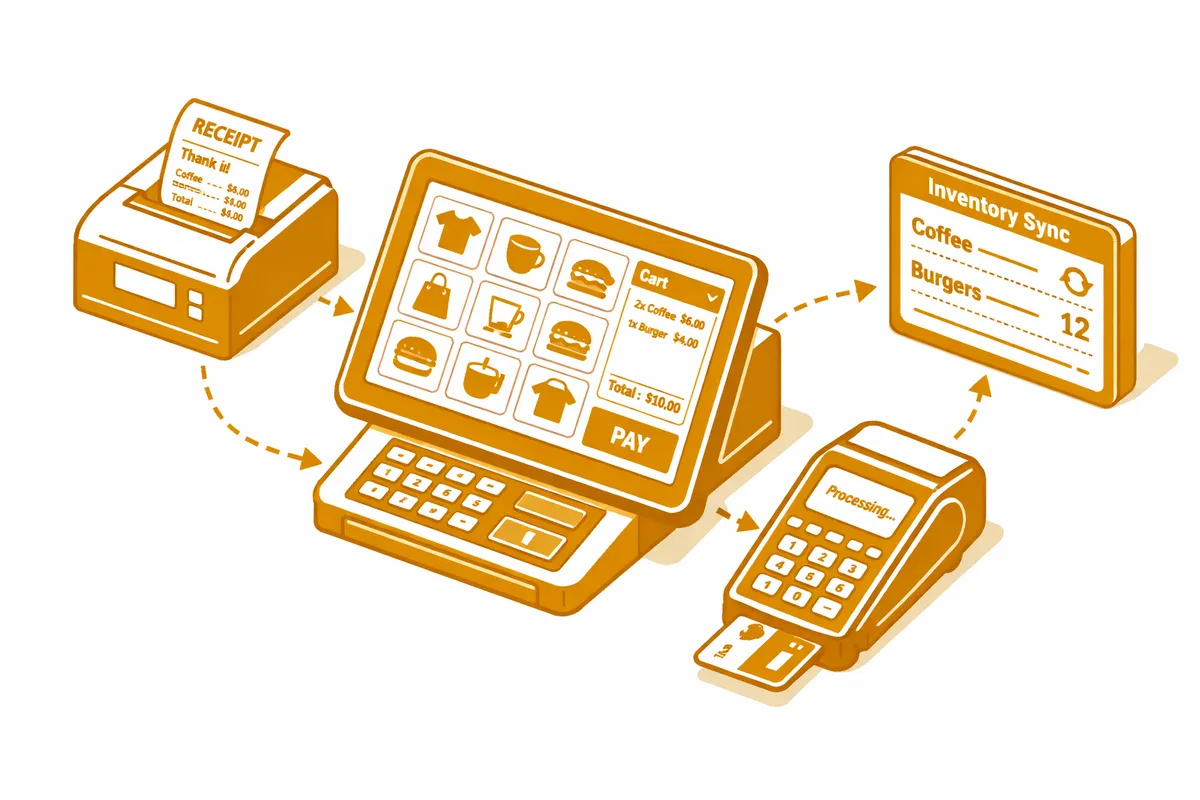
How We Build POS Systems for the Loop
POS implementation for Loop businesses begins with an operations assessment. We need to understand your transaction types, peak volume periods, staffing model, and back-office integration requirements before recommending a specific system or configuration. A LaSalle Street lobby café with a single station and a focused menu needs a fundamentally different system than a full-service hotel restaurant on Michigan Avenue with table management, room charge capability, and a beverage program that spans breakfast through late-night.
Hardware selection is more consequential than most operators realize. Loop environments are often physically constrained: narrow counter spaces in lobby cafés, historical building constraints that limit POS terminal placement options, outdoor service areas on Michigan Avenue patios that require weatherized hardware. We evaluate hardware options against your specific physical environment before the system design is finalized.
Menu architecture in a Loop POS requires thinking about how menus will be used under peak volume pressure. A pre-theater dinner rush on Randolph Street is not the time for staff to navigate five menu levels to add a modification. We structure menus to minimize button presses for the highest-frequency orders while preserving the full menu depth for edge cases. For hotels, menu architecture also needs to accommodate room service, pool service, and restaurant service from a common menu database with different pricing and presentation logic for each service mode.
Integration with property management systems, accounting software, and reservation platforms is typically a requirement rather than an option for Loop hotel and restaurant operations. We design and build those integrations as part of the POS implementation rather than treating them as add-on projects that follow the core deployment.
Industries We Serve in the Loop
Hotels and full-service hospitality properties along Michigan Avenue deploy POS systems that integrate directly with their property management software. When a guest charges a restaurant meal to their room from a Millennium Park-facing dining room, the charge appears on the folio instantly. The F&B POS, the room service system, the lobby bar, and the event catering all route through a single system that produces integrated daily F&B revenue reporting.
The restaurants, bars, and cafes that serve the Randolph Street theater district and the Chicago Theatre need POS systems specifically engineered for two-hour volume cycles with long quiet periods between. Quick-service capability for the pre-show rush, table service capability for the dinner service window, and real-time inventory tracking so the bar knows it is running low on a wine before the server is mid-pour at a table. We have built POS configurations for theater-adjacent hospitality operations that handle the volume rhythm without requiring the operator to change POS systems between service periods.
Retail operations on State Street need POS systems with robust inventory management, multi-location visibility, loyalty program integration, and the payment processing breadth that a high-traffic retail corridor demands. The holiday season on State Street brings payment processing volume that stress-tests every system; we configure and test specifically for peak load before it arrives.
Lobby and building amenity food service in the LaSalle Street and Wacker Drive office tower corridor serves a captive corporate audience that values speed above everything. Mobile order ahead, QR code payment, and near-zero wait times for repeat orders from regulars are POS capabilities that differentiate the lobby café that keeps the building tenants from walking to the Millennium Park food vendors on their lunch break.
Event venues and conference facilities near the Chicago Cultural Center on Randolph Street manage bar, catering, and retail POS across event spaces that configure differently for each booking. A POS system for an event venue needs to be fast to reconfigure, intuitive for temporary event staff who have not used it before, and able to produce event-specific revenue reports that the sales team can share with clients.
Museum café and cultural institution food service near the Art Institute of Chicago on Michigan Avenue serves a mixed audience of local visitors, tourism groups, and school field trips with different transaction patterns. Group billing, ticket bundling with dining packages, and multilingual payment interfaces are POS requirements that generic systems rarely implement correctly for arts institution contexts.
What to Expect Working With Us
1. Operations and volume assessment. We spend time at your location during representative operating periods, including peak volume, before designing any system. A Tuesday lunch rush on LaSalle Street tells us more about your POS requirements than a thirty-minute stakeholder interview. We count transactions, time service cycles, and observe where the current system creates friction for staff.
2. System design and hardware specification. Based on the operations assessment, we design the complete system: software platform, hardware configuration, menu architecture, integration requirements, and network infrastructure. You review and approve the design before any equipment is ordered. Hardware selection for Loop environments often requires site visits to measure counter dimensions and assess power and network access points.
3. Pre-deployment testing, including peak volume simulation. Before deploying in your live environment, we test the complete system at simulated peak volume. For a State Street retailer, that means running the full holiday transaction load through the system in a test environment. For a theater-district restaurant, it means simulating the pre-show rush with a full menu. We resolve any performance issues in testing rather than during your busiest service.
4. Parallel operation and staff training. New POS systems deploy in parallel with the existing system for at least one full operational cycle. Staff train on the new system before the cutover date so they arrive at the first live service already comfortable with the interface. We staff the deployment team during the first live peak service to resolve issues immediately.