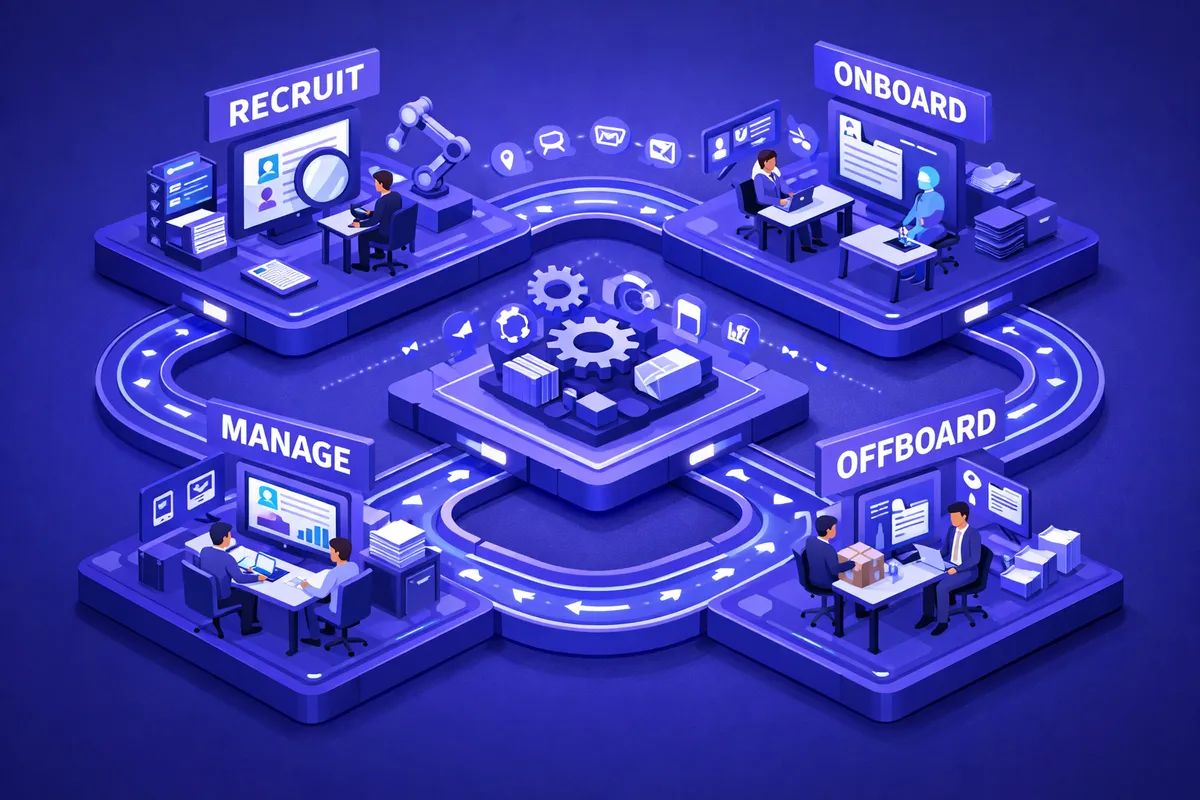
How We Build HR Automation for the Loop
We begin by mapping your current HR process flows. Onboarding is the highest-value starting point for most Loop firms, because onboarding has the most steps, involves the most departments, and has the highest cost when it runs slowly. We trace every step in your current onboarding process from offer acceptance to fully provisioned first day: what happens, who does it, what triggers it, what it depends on, and how long each step takes in practice versus in theory.
For a LaSalle Street law firm, that map typically reveals a process involving HR, conflicts counsel, finance, IT, facilities, and practice group administration, with each handoff requiring a separate email chain to initiate. The total elapsed time from offer acceptance to first productive day may be two to three weeks. The automated version completes the same sequence in two to three days because each step triggers the next automatically rather than waiting for a human to notice the previous step is done.
We build automations using a combination of your existing HRIS platform, workflow automation tools, and in some cases lightweight custom applications for workflows that off-the-shelf tools cannot implement cleanly. For firms running Workday, Rippling, or BambooHR, we build automations inside those platforms wherever possible, adding custom logic where the platform's native capabilities fall short. We do not replace platforms that are working; we extend them.
Document management is a critical component of HR automation for regulated industries. Law firm employment files must be retained according to specific schedules. Financial services firms have employee record requirements under FINRA and SEC rules. We build document automation that routes, stores, and retains employment documents according to the applicable retention schedule, with access controls that limit document access by role.
Industries We Serve in the Loop
Law firms on LaSalle Street automate attorney onboarding, annual performance review workflows, mandatory CLE tracking, bar admission renewal reminders, conflict check integration for new lateral hires, and partner compensation calculation cycles. The compliance dimension of legal HR is substantial: state bar requirements, ARDC registration, and mandatory reporting obligations all require tracking that is currently manual at most firms.
Near the Board of Trade Building, financial services and investment management firms automate FINRA U4/U5 amendment workflows, continuing education tracking for registered representatives, annual compliance training completion, securities license renewal reminders, and employee investment transaction preclearance workflows. Missing a FINRA CE deadline or a required annual attestation is not an administrative oversight; it is a regulatory event. Automation makes those deadlines impossible to miss.
Hotels and hospitality operators along Michigan Avenue near Millennium Park automate new employee onboarding for seasonal staff, scheduled performance reviews tied to anniversary dates, tip credit documentation for front-of-house staff, required food handler certification renewal, and liquor law training for bar and server staff. High turnover in hospitality means the onboarding and offboarding cycles run continuously; automation is the only way to maintain consistency without proportionally increasing HR headcount.
Commercial real estate and property management firms on Wacker Drive automate facility technician certification tracking, building engineer license renewals, required OSHA training completion, tenant service request assignment, and seasonal maintenance crew onboarding for summer and winter building operations cycles.
Professional associations near the Chicago Cultural Center manage member-facing credentialing and volunteer HR separately from internal staff HR. We automate both: internal employee onboarding and review cycles on one side, and member certification renewal, volunteer coordinator matching, and board member onboarding on the other. The workflows are distinct but both benefit from automation.
Consulting firms in Loop office towers automate utilization reporting, project assignment workflows, annual review scheduling tied to project completion, and the administrative components of partner track progression. For professional services firms where human capital is the product, HR process efficiency directly affects margin.
What to Expect Working With Us
1. Process mapping and automation priority scoring. We document your current HR workflows in detail and score each for automation value: time consumed, error frequency, compliance risk, and implementation complexity. This scoring shapes the build sequence so the highest-value automations launch first. For most Loop firms, onboarding is the first build because it is the highest-frequency process with the most cross-functional steps.
2. Platform assessment and integration design. We evaluate your existing HRIS and workflow tools before recommending any additional platform. Most Loop firms have underutilized automation capabilities in their existing HRIS; we build those first. Where gaps exist, we recommend the lightest-weight tool that meets the requirement rather than defaulting to enterprise platforms that add cost and complexity.
3. Compliance validation with your legal or HR counsel. For regulated industries, we review the automated workflows with your employment counsel or compliance team before launch. Document retention schedules, mandatory training attestation formats, and state-specific employment law requirements are validated before the automation goes live.
4. Rollout and iteration through your first full HR cycle. We run the automations through your first full HR cycle after launch, whether that is a monthly payroll close, a quarterly performance review cycle, or a full calendar year for annual processes. The first cycle surfaces edge cases that did not appear in testing: an employee on leave during onboarding, a transfer that triggers unusual document requirements. We resolve those cases and refine the workflows accordingly.