How We Build Document Management Systems for the Loop
Every document management engagement for a Loop firm begins with an intake process that maps the organization's document universe. For a law firm, that means cataloging every matter type, every document category within each matter type, how many active matters exist, where documents currently live across desktop folders, network drives, practice management software, and email, and what the professional responsibility and regulatory requirements are for each document category. For a financial services firm, the intake maps product types, client document categories, and the specific recordkeeping rules that govern each. We do not design the system until we understand the full scope of what it needs to contain.
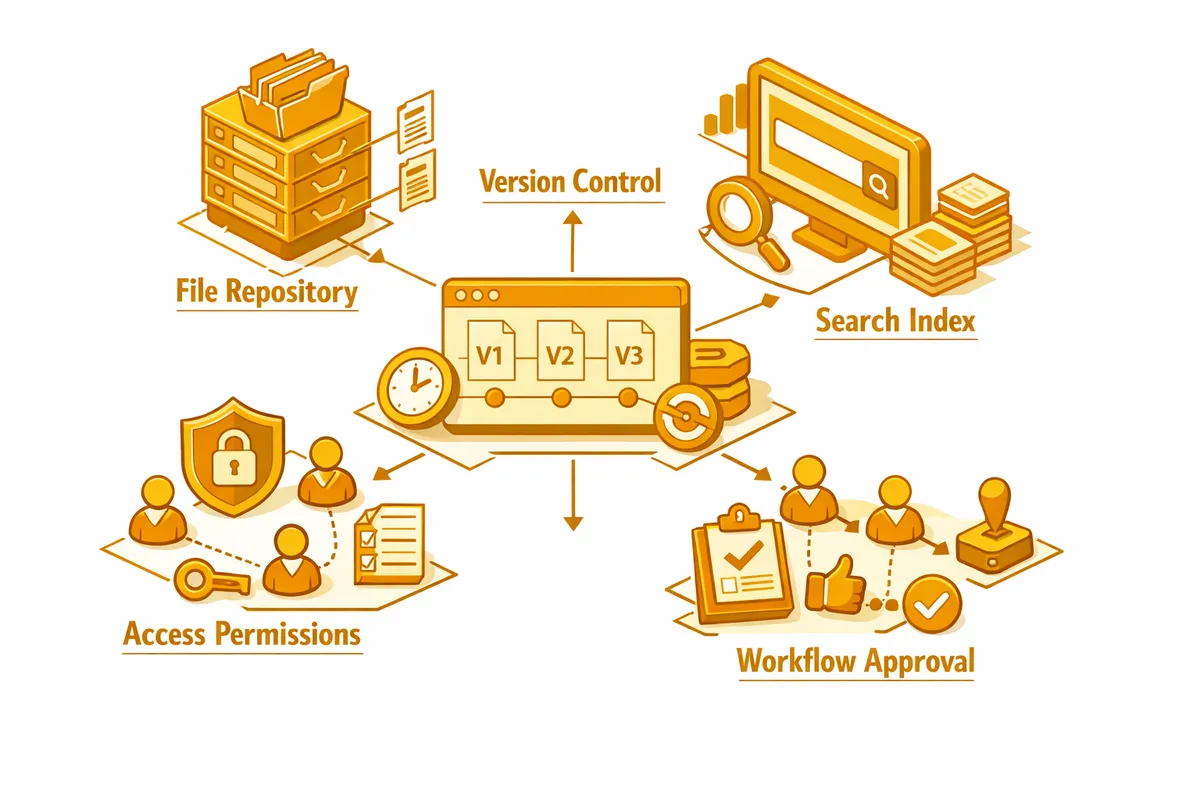
From the intake, we design the taxonomy. A litigation firm on LaSalle Street needs a matter-centric taxonomy: each client and matter is a container, and every document in the system belongs to a client, a matter, and a document type within that matter. The metadata schema lets staff find any document by client name, matter number, document type, author, date, or any combination of these attributes in seconds. Version control tracks the full history of every draft, marks the current version, and lets attorneys compare versions to understand what changed. Access controls are structured around matter teams, so documents for one client's commercial litigation are not accessible to the team working a different client's estate.
For financial services firms, the architecture is product- and client-centric. Client agreements, account documents, and regulatory filings are organized around the client relationship. Retention policies are configured to enforce the specific holding periods that SEC and FINRA rules require for each document category, automatically flagging documents for review when retention periods expire and preventing deletion of documents under legal hold.
Industries We Serve in the Loop
Law firms and solo practitioners on LaSalle Street and throughout the Loop need matter-centric document management with version control for contract drafts, access controls structured around client and matter teams, conflicts checking support, and rapid document production for litigation and due diligence. Professional responsibility requires adequate supervision and complete file management. A properly structured document system is part of meeting that standard.
Financial services and investment firms on Wacker Drive and Madison Street face SEC and FINRA recordkeeping requirements for client communications, agreements, disclosures, and trade-related documents. A document management system with retention policy enforcement, legal hold support, and complete audit trails is not optional for registered investment advisers or broker-dealers. It is a regulatory requirement.
Consulting and professional services firms operating from the Loop's high-rise offices need engagement-centric document management with version control for deliverables, clear document ownership across project teams, and rapid retrieval for client presentations and internal reviews. Firms coordinating multiple concurrent engagements across different client organizations need documents organized so any team member can find anything without relying on institutional memory.
Commercial real estate offices managing transactions from State Street and Wacker Drive need transaction-centric document management for due diligence packages, lease abstracts, title documents, and closing binders. Each transaction is a container. Every document in the transaction is tagged and searchable. The full transaction record is preserved and accessible long after closing for future reference and dispute resolution.
Corporate headquarters and regional offices based in Willis Tower, the Board of Trade Building, and other Loop high-rises manage contracts, HR records, compliance documentation, and operational materials across large teams. Department-level document management with role-based access controls, retention policies aligned to each document category's legal requirements, and integration with corporate systems reduces administrative overhead and compliance risk.
Professional associations and nonprofit organizations headquartered in the Loop manage governance documents, member records, grant files, and regulatory filings. A document management system organized around organizational structure and document function lets small staff teams operate with the document discipline that larger organizations take for granted.
What to Expect Working With Us
1. Discovery and compliance mapping. We catalog your document types, storage locations, volume, access requirements, and regulatory obligations. For Loop law firms and financial services firms, this includes a compliance review that maps your current document practices against applicable professional responsibility and regulatory standards and identifies gaps.
2. Taxonomy and architecture design. We design the classification structure, metadata schema, access control model, version control configuration, and retention policy framework specific to your organization and industry. You review and approve the full architecture before implementation begins.
3. Implementation and migration. We build the system and migrate your existing documents into the new structure, applying consistent metadata and organization during the migration rather than carrying existing inconsistencies forward. Core implementations for your highest-priority document types are live within eight to fourteen weeks.
4. Training and ongoing support. Post-launch training for your Loop team, adoption monitoring, and a warranty period covering system stability. Optional maintenance retainers for taxonomy updates, retention policy changes, and integration maintenance as your document environment evolves.