How We Build Customer Portals for the Loop
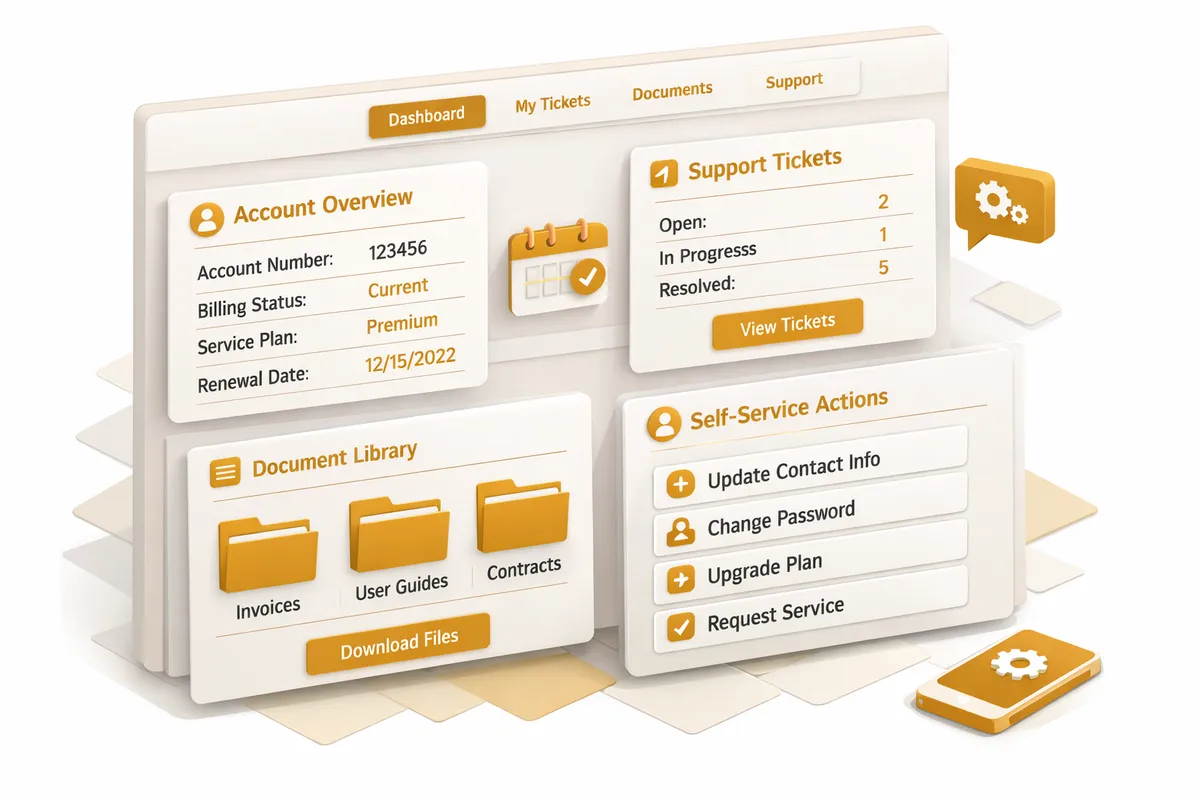
Client portal design for Loop professional services firms begins with a fundamental question: what should clients be able to do without calling? The answer varies by firm type but the design principle is consistent. We identify every category of request that reaches your relationship management team that requires no judgment to fulfill, only data retrieval. That list becomes the portal's functional scope.
For a law firm on LaSalle Street, the portal scope typically includes matter status access, invoice review and payment, document access and signature workflows, and communication logging. For an investment adviser near Wacker Drive, it includes account statements, performance reports, tax documents, and portfolio commentary. For a commercial real estate firm managing the Wacker Drive corridor, it includes lease documents, rent payment history, maintenance request submission and tracking, and annual CAM reconciliation statements.
Security architecture for Loop portals is built to the standards required by the data they protect. Law firm portals handle attorney-client privileged communications and confidential matter information. Investment adviser portals handle non-public financial data and regulatory documents. Commercial real estate portals handle confidential lease terms. Every portal we build for the Loop includes encryption at rest and in transit, multi-factor authentication, role-based access controls that limit each user to their own data, session management that meets industry security standards, and audit logging that captures every access and download event.
We design portal user experiences specifically for the client profile each firm serves. The general counsel at a Fortune 500 company accessing their outside counsel's portal on a mobile device during a flight has different usability expectations than a retail investor logging in from a home computer. We calibrate the interface to the actual user, not to a generic portal template.
Industries We Serve in the Loop
Law firms along LaSalle Street build client portals that provide corporate clients with real-time matter status, access to filed documents and correspondence, invoice review and online payment, and a direct communication channel to the handling attorneys. For firms that manage high volumes of routine matters, like insurance defense practices or commercial collections, portals reduce the administrative overhead of matter updates dramatically.
Investment management and registered investment advisers near the Board of Trade use investor portals as the primary channel for account statements, performance reports, capital call and distribution notices, and regulatory documents including ADV updates and Form CRS. For private equity and real estate fund managers, the portal is also the capital account and LP reporting platform where limited partners access their individual allocations and quarterly NAV statements.
The commercial real estate tenants and investors who work with property management firms on Wacker Drive access lease documents, rent histories, maintenance request status, and CAM reconciliation statements through tenant and investor portals. For large tenants managing multiple locations within a portfolio, a portal that consolidates all their properties in a single view replaces a fragmented email and phone relationship with a structured self-service interface.
Hotels and conference facilities along Michigan Avenue near Millennium Park build group booking portals for corporate clients and event planners who manage recurring reservations. A corporate travel manager handling sixty room nights per month across multiple properties can access booking history, manage upcoming reservations, and retrieve invoices without involving the hotel's sales team for each transaction.
Professional associations near the Chicago Cultural Center provide member portals for continuing education tracking, membership renewal, certification documentation, dues payment history, and event registration. Member portals reduce the administrative load on association staff while improving member engagement by making every membership touchpoint more convenient.
Consulting and advisory firms in Loop office towers use client portals for project status reporting, deliverable sharing, invoice access, and collaborative document review. A management consulting engagement that produces a stream of research and deliverables over six months benefits from a structured portal where the client accesses the work product, provides feedback, and tracks project milestones without requiring a weekly status call.
What to Expect Working With Us
1. Client journey mapping and access scope design. We start by documenting every type of information and action your clients should be able to access through the portal. This mapping exercise defines the scope and prevents building a portal that covers 60 percent of what clients need and still requires them to call for the other 40 percent. The goal is a meaningful reduction in client-facing requests, not a partial solution.
2. Security architecture design and compliance review. For every portal touching sensitive financial, legal, or real estate data, we design the security architecture before writing any application code and review it with your compliance or legal team. Authentication, encryption, access scoping, and audit logging are designed to the requirements of your specific data, not to a generic secure application standard.
3. User experience design calibrated to your client base. We design portal interfaces based on who your clients are and how they will use the portal. For a law firm whose clients are general counsels at large corporations, the interface must be efficient and professional. For an investment adviser whose clients include individual high-net-worth investors, the design must be accessible to people who are not financial professionals. The portal represents your firm to your clients; it must reflect your standards.
4. Integration with your internal systems and phased rollout. Portal data comes from your internal systems: matter management, portfolio accounting, lease administration. We build the integration layer that keeps portal data current automatically and handle the launch with a phased rollout: test with internal staff, then invite a pilot group of clients, then full rollout. The phased approach surfaces client experience issues before they affect your entire book.