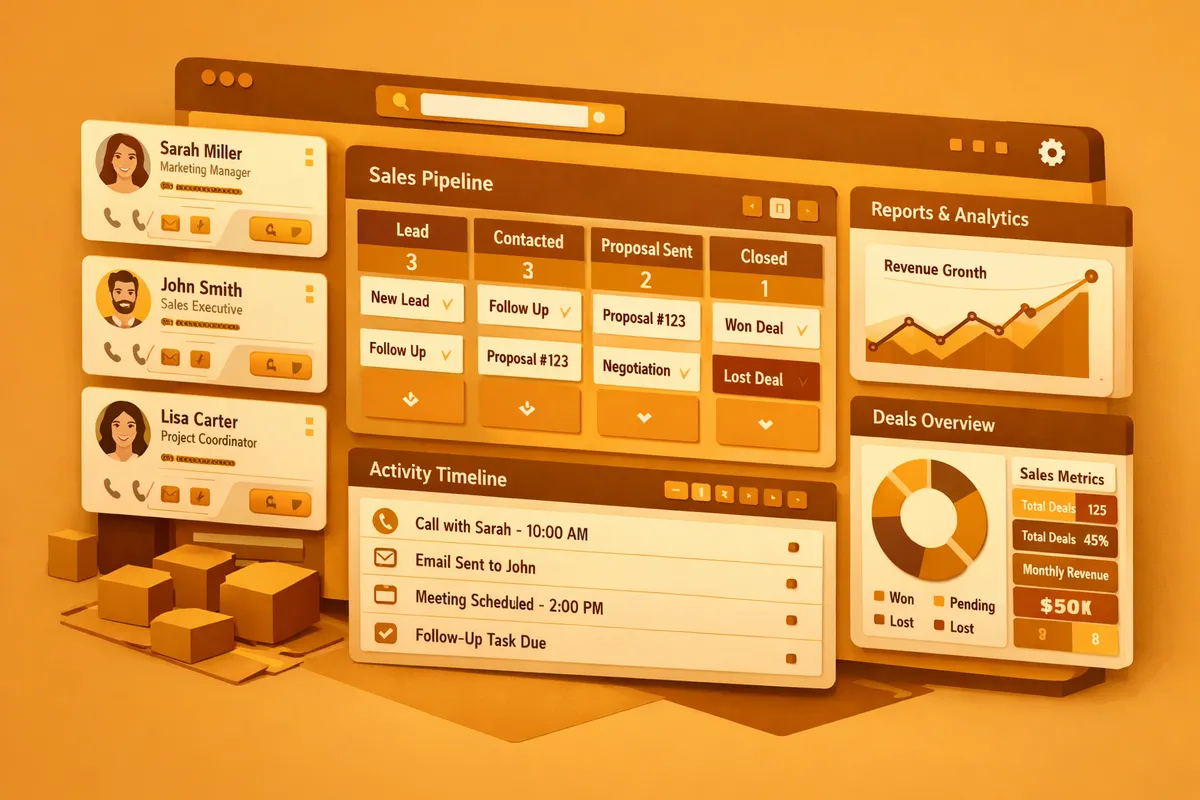
How We Build Custom CRM for the Loop
Discovery for Loop professional services firms begins with the people who actually manage the firm's most important relationships. For a LaSalle Street law firm, that means spending time with practice group leaders and relationship partners, not just the IT director or the administrator who manages the current system. We document how matters originate, how the firm tracks client contact frequency, how referral source relationships are cultivated, and what reporting the managing partner actually reviews versus what the current system technically provides.
From discovery, we design a data model that fits the firm's actual relationship structure. For a law firm, the core objects are likely clients, matters, contacts, billing attorneys, and referral sources, with relationship objects linking them in ways that reflect the firm's specific business model. For a financial services firm, the model centers on client households, accounts, advisors, and compliance activities. For a consulting firm, it centers on client organizations, engagements, client stakeholders, and the internal teams delivering the work.
We build integrations with the systems Loop firms already depend on. For law firms, that often means integration with billing software. For financial services firms, it means integration with portfolio management and compliance systems. For consulting firms, it means integration with project management and time-tracking tools. The CRM becomes the relationship intelligence layer on top of the operational systems that manage the actual work, not a replacement for those systems.
Industries We Serve in the Loop
Law firms on LaSalle Street need relationship management built around clients, matters, contacts, billing attorneys, and referral sources rather than leads and opportunities. Matter tracking, contact frequency monitoring, referral source analytics, and partner-level reporting on the health of client relationships all require a data model that generic CRMs cannot provide without expensive distortion.
Financial services and wealth management firms along Wacker Drive need client relationship management organized around households, accounts, fiduciary obligations, and the referral networks that generate new clients. Compliance requirements and audit trails add architecture requirements that make off-the-shelf CRMs inadequate without substantial modification.
Management consulting firms operating between Randolph Street and Michigan Avenue need engagement relationship management that tracks client organizations, key stakeholders, active and historical engagements, and the internal delivery teams assigned to each client. Identifying at-risk clients and tracking relationship health across a consulting firm's full portfolio requires data structures that generic CRMs do not support natively.
Professional associations based near the Chicago Cultural Center manage member relationships organized around committees, certifications, events, and sponsorships. The renewal cycle, the lapsed-member reengagement workflow, and the sponsor relationship pipeline each require distinct data models that membership management software handles operationally but CRM intelligence platforms cannot touch.
Commercial real estate and brokerage firms working the Loop's dense office and retail corridor track tenant relationships, lease timelines, broker networks, and property ownership contacts that change on acquisition cycles. The relationship model for a commercial real estate firm spans property, tenant, landlord, and broker objects in ways that generic CRMs model only awkwardly.
Hotels and hospitality businesses near Millennium Park manage corporate account relationships, meeting planner relationships, and group booking history in ways that hospitality property management systems handle operationally but cannot support as relationship intelligence. Custom CRM fills the gap between the hotel's PMS data and the relationship knowledge its sales team needs.
What to Expect Working With Us
1. Discovery. Two to three weeks of workshops with your relationship managers, practice group leaders, or business development staff. We document every workflow, data requirement, and integration dependency before architecture begins.
2. Architecture and design. We design the data model, user interface approach, integration architecture, and phased delivery plan specific to your firm's relationship structure. You review and approve before development starts.
3. Implementation. We build in phases. Your team has a working system within eight to ten weeks, with subsequent phases adding reporting depth, integrations, and workflow automation without disrupting the core system.
4. Training and iteration. Post-launch adoption tracking, structured training for relationship managers and administrators, and optional maintenance retainers for feature additions and integration updates as your firm's needs evolve.