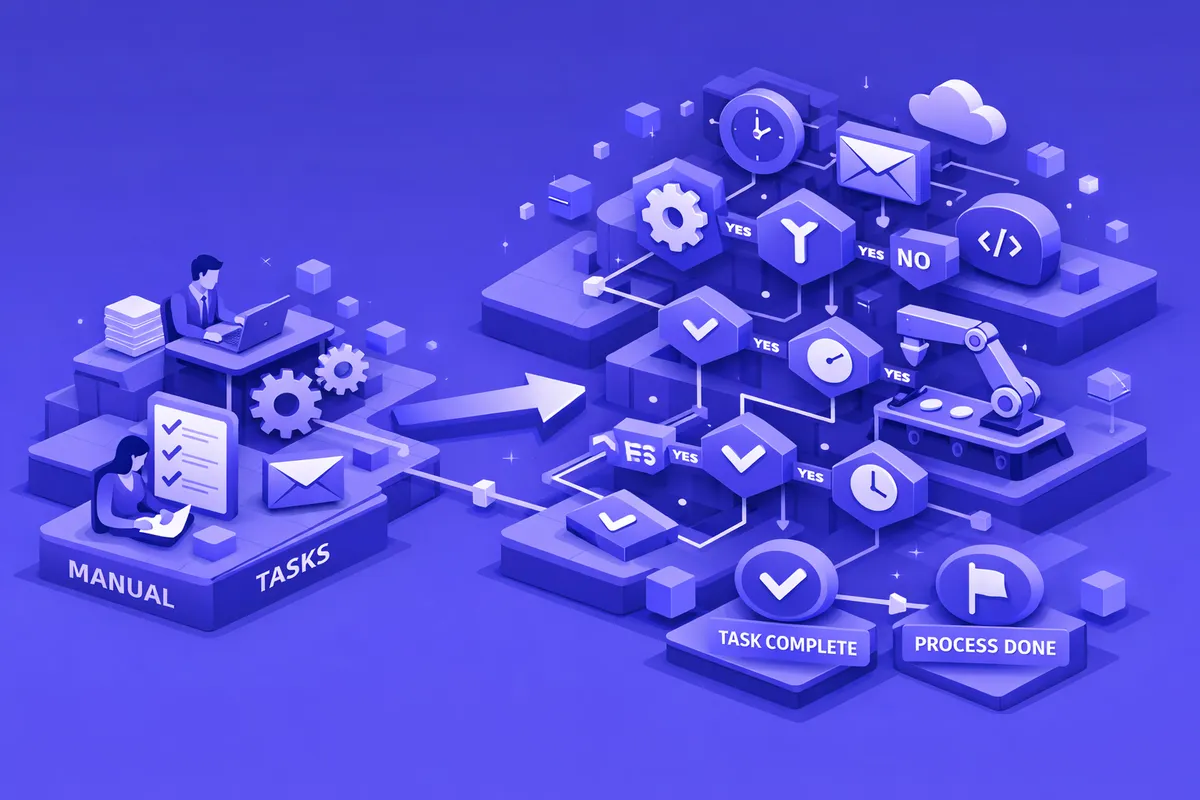
How We Build Business Process Automation for the Loop
Every engagement begins with a structured discovery process. We interview the staff members who execute your manual workflows, map the software tools involved, and quantify the time each process consumes weekly. For most Loop firms, this reveals three to five high-impact automation opportunities that were previously invisible because they had been accepted as standard operating procedure.
The discovery output is a prioritized automation roadmap with explicit ROI projections. For a law firm on LaSalle Street where associates spend six hours per week on client intake processing, we can calculate the billable-hour cost before building anything. For a consulting firm where a senior analyst spends half a day compiling weekly status reports, the ROI calculation is equally concrete. We present the numbers before any project begins so your decision to proceed is based on documented evidence, not a promise.
Implementation is phased. We build and deploy the highest-priority automation first, validate that it is performing correctly and delivering the projected time savings, then move to the next. Most Loop firms have a first production automation delivering value within six weeks of engagement start. We work within the security and compliance requirements common to Loop professional service environments, including data handling protocols appropriate for attorney-client communications, financial data, and other sensitive information categories.
Industries We Serve in the Loop
Law firms on LaSalle Street benefit from automation of client intake workflows, conflict check processing, new matter opening sequences, billing reminder campaigns, court deadline tracking communications, and document delivery acknowledgment processes that currently require paralegal or legal assistant time.
Banks and financial services firms along Wacker Drive and Madison Street benefit from automation of report compilation and distribution, compliance documentation workflows, client statement delivery, account review scheduling, and internal audit preparation processes that can move from manual to automated without changing the underlying data or decision logic.
Consulting and professional services firms throughout the Loop benefit from automation of proposal generation workflows, project kickoff sequences, weekly status report compilation, client satisfaction survey delivery, and contract renewal reminder campaigns that free senior staff from administrative orchestration.
Commercial real estate firms on Michigan Avenue and throughout the central business district benefit from automation of property listing syndication, prospect follow-up sequences, lease renewal reminder workflows, maintenance request routing, and tenant communication distributions that currently require manual attention from brokers or property managers.
Professional associations and trade organizations near the Chicago Cultural Center and Millennium Park benefit from automation of membership renewal campaigns, event registration workflows, member communication sequences, committee coordination updates, and continuing education tracking notifications.
Hotels and hospitality operations in the Loop corridor benefit from automation of reservation confirmation sequences, pre-arrival communication workflows, post-stay review request campaigns, group booking follow-up, and loyalty program communication sequences that extend guest engagement without requiring front desk staff time.
What to Expect Working With Us
1. Discovery and process mapping. Two weeks of structured interviews with your team, documentation of current workflows, identification of the software systems involved, and quantification of time consumed per process per week. You receive a clear picture of your current automation opportunity before any project begins.
2. Prioritized automation roadmap. We present a ranked list of automation opportunities with explicit time savings projections and ROI calculations for each. You select where to begin based on your business priorities, resource availability, and risk tolerance for change.
3. Phased implementation. We build automations in sequence, deploying each before building the next. First automation in production within six weeks. Each subsequent automation follows the same build-validate-deploy cycle. You see results before committing to the full roadmap.
4. Performance measurement and reporting. We establish baseline metrics before each automation launches: time consumed, error frequency, and cycle time. Monthly reporting compares post-automation performance to the baseline. You see precisely how much staff time has been redirected and what accuracy improvements have been delivered.