How We Build Business Intelligence for the Loop
Business intelligence for Loop firms begins with the question your leadership actually asks. Not "what data do we have?" but "what decisions do you make regularly, and what information would make those decisions better?" For a boutique consulting firm in a Wacker Drive tower, the key question might be: which engagements are profitable and which are destroying value we do not see until the project closes? For a commercial real estate operator on Randolph Street, the question might be: which properties in our portfolio are underperforming on NOI relative to their market comparables?
We conduct structured interviews with the decision-makers who will use the dashboards: managing partners, CFOs, asset managers, hotel general managers, association executive directors. We document their current data sources, their reporting cadence, and the specific questions they are asking that their current reports cannot answer. This becomes the BI specification.
Data pipeline design comes next. We identify every source system, map the fields we need, and build the extraction and transformation logic that brings data into the analytics layer on the appropriate schedule. For some Loop firms, that means nightly batch extraction from legacy systems that do not support real-time feeds. For others, it means streaming connections to modern SaaS platforms that update in near real-time. The dashboard experience we build is only as good as the data pipeline underneath it.
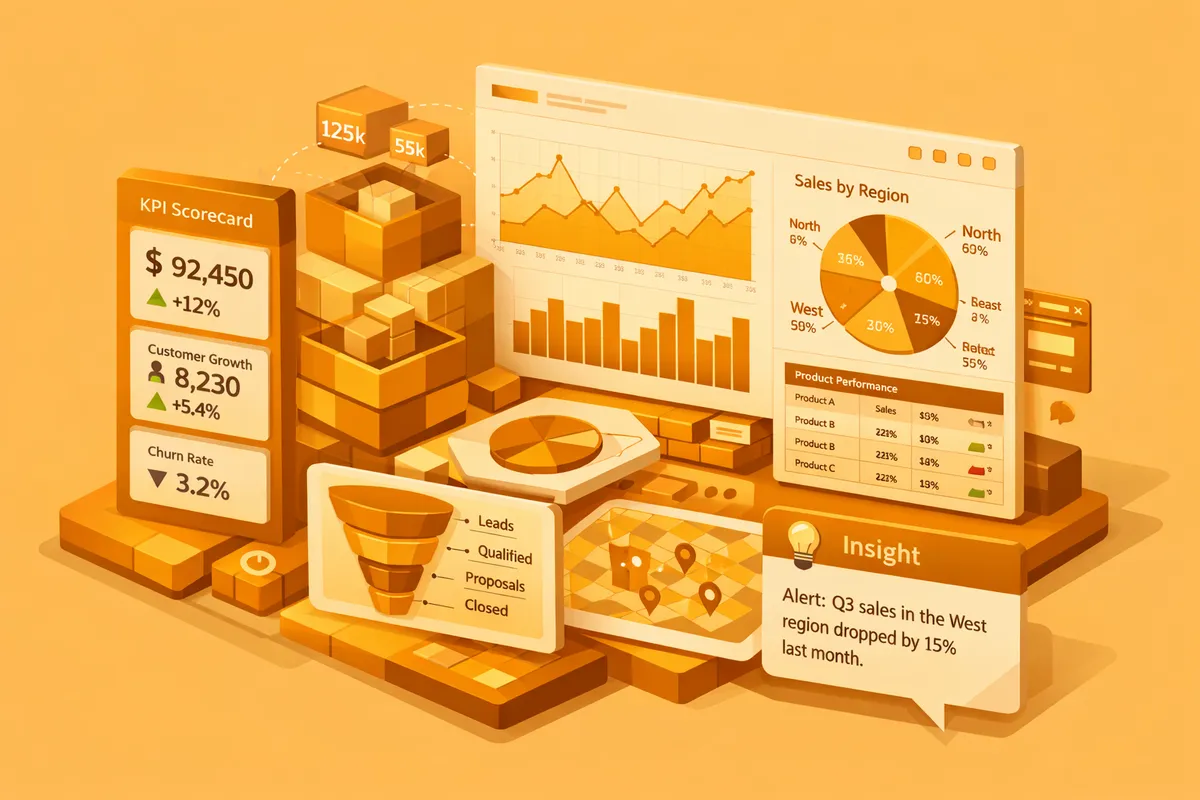
Dashboard design follows the principle that every element on a page must support a specific decision. We do not build dashboards that display data because it exists. We build dashboards that surface the metrics that drive the decisions your leadership makes regularly, with visualizations chosen specifically for how those metrics are best understood.
Industries We Serve in the Loop
Law firms along LaSalle Street use BI dashboards to track matter profitability, billing realization rates, partner utilization, and client concentration. When a managing partner can see in real time that a major practice group's realization rate has dropped three points over the last two quarters, the conversation about associate billing discipline or rate adjustment happens with data rather than intuition.
Near the Board of Trade Building, investment management and financial advisory firms build BI around AUM flows, fee revenue by client segment, portfolio performance attribution, and sales pipeline velocity. The compliance-sensitive nature of financial data means BI architectures for these firms include role-based access controls so the head of client services sees client-facing metrics while the compliance team sees risk and concentration data.
Commercial real estate firms on Wacker Drive use BI to track portfolio NOI, occupancy trends, lease expiration exposure, and maintenance cost ratios across their entire building inventory. When a portfolio manager can compare NOI per square foot across twenty properties on a single screen, capital allocation decisions move from annual planning exercises to ongoing portfolio optimization.
The hospitality operations along Michigan Avenue near Millennium Park deploy BI to manage revenue per available room, channel mix, group booking pace, and food and beverage contribution. Hotel GMs review occupancy forecast accuracy weekly; BI dashboards surfacing booking pace against prior year provide the forward visibility that revenue management requires.
Professional associations near the Chicago Cultural Center on Randolph Street use BI to track membership retention cohorts, event attendance trends, sponsorship revenue by category, and programmatic content engagement. Association leadership makes budget decisions based on member behavior data rather than anecdotal feedback from committee chairs.
Consulting and professional services firms in the Loop's high-rises build BI around pipeline health, proposal win rates, project margin by client and engagement type, and utilization by level. For a management consulting firm where economic performance is the central operating concern, real-time visibility into these metrics transforms the weekly leadership conversation.
What to Expect Working With Us
1. Decision audit with your leadership team. We begin by cataloging the decisions your leadership makes regularly, the data they currently use to make them, and the questions they cannot currently answer. For a law firm on LaSalle Street, this audit typically surfaces five to eight decisions made monthly that are currently made on incomplete information. That gap defines the BI scope.
2. Data source inventory and pipeline design. We map every system that holds data relevant to your decision set and design the extraction, transformation, and loading pipeline for each. Source system quality varies significantly in the Loop; some clients have modern SaaS platforms with clean APIs and others have legacy systems with inconsistent data. We address data quality issues during pipeline design rather than after dashboards are live.
3. Iterative dashboard builds with user review at each stage. We build in two-week sprints and review working dashboards with the intended users at the end of each sprint. This prevents the common failure mode of building a technically correct dashboard that nobody uses because it does not match how the users actually think about the business.
4. Training and self-service enablement. We train your team not just to read the dashboards we built but to build their own views and reports within the BI platform. The goal is analytical self-sufficiency, not an ongoing dependency on us for every new report. Your CFO should be able to add a new metric to their dashboard on a Tuesday afternoon without submitting a ticket.