Your Cart (0)

Your cart is empty

Loop, Chicago

AI Customer Service in Loop

AI Customer Service for businesses in Loop, Chicago. We know the neighborhood, the customers, and what it takes to compete locally.

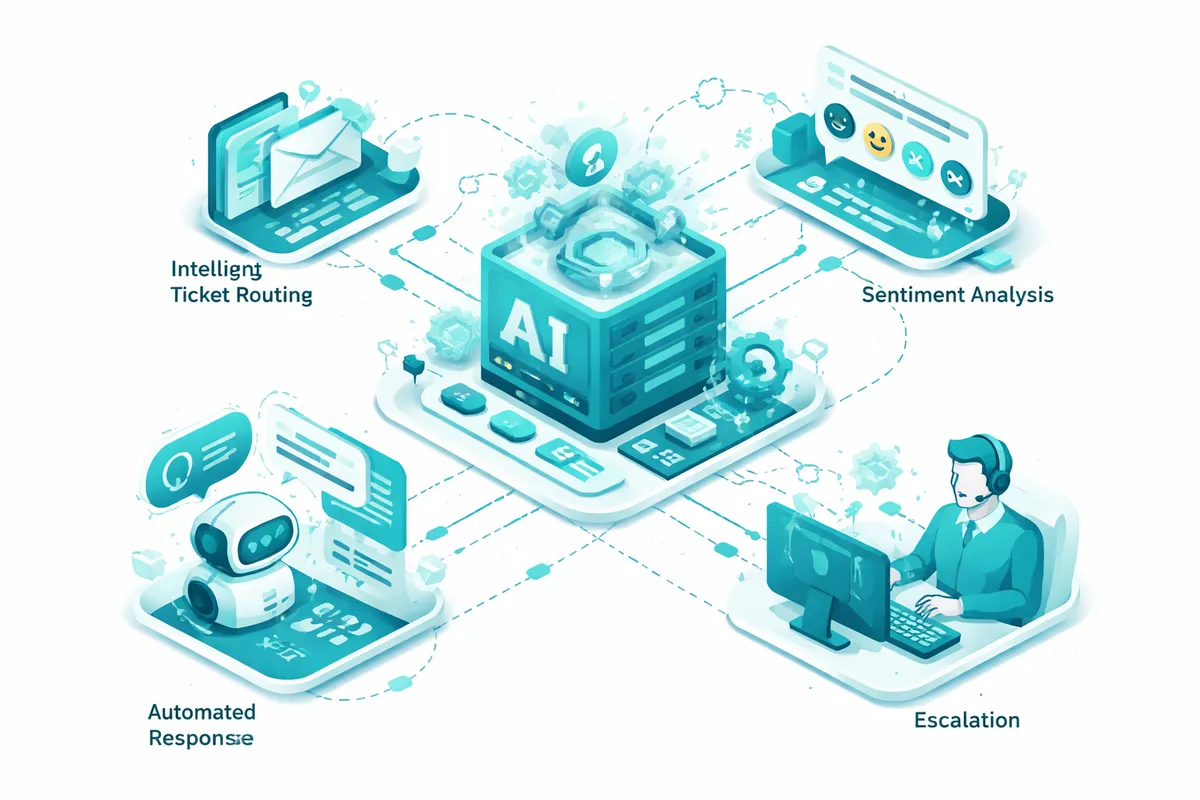
AI Customer Service in Loop service illustration

AI Customer Service for Loop Industries

Financial Services on LaSalle Street

Financial services client inquiries follow predictable categories: account balance checks, transaction history requests, document access, meeting scheduling, and compliance-related questions. AI customer service handles these routine inquiries by connecting to the firm's data systems and providing real-time, accurate responses.

The AI accesses the portfolio management system to answer balance and performance questions. It retrieves transaction histories from the accounting platform. It locates and delivers requested documents from the document management system. It checks advisor calendars and schedules meetings based on both party's availability. For compliance-sensitive inquiries, the AI provides pre-approved responses that satisfy regulatory requirements while flagging any question that falls outside the approved response framework for human review.

For a mid-size LaSalle Street advisory firm with 400 client relationships, AI customer service typically handles 60% to 70% of incoming client inquiries without human intervention, freeing the advisor team to focus on portfolio management and strategic client conversations rather than administrative service requests.

Retail on State Street

Retail customer service inquiries divide between pre-purchase questions (product availability, sizing, store hours, location directions) and post-purchase requests (order status, returns, exchanges, warranty claims). AI handles both categories effectively.

Pre-purchase AI connects to the inventory management system and provides real-time product availability, suggests alternatives for out-of-stock items, provides sizing guidance based on the retailer's fit data, and helps customers navigate to the nearest location. For State Street retailers that serve both walk-in and online customers, the AI provides consistent product information across both channels.

Post-purchase AI tracks order status, initiates return and exchange processes, generates shipping labels, and resolves straightforward warranty claims by verifying purchase dates and applying the warranty policy automatically. For the high-volume State Street retailer processing thousands of transactions per week, AI reduces the customer service queue by handling the routine post-purchase inquiries that currently consume most of the support team's time.

Professional Services on Wacker Drive

Professional services client inquiries typically involve project status requests, document delivery, scheduling, and billing questions. AI customer service connects to the firm's project management, document management, and billing systems to provide real-time responses.

A client asking about project status receives a summary pulled from the project management platform. A client requesting a document gets it delivered from the document management system after security verification. A client with a billing question receives invoice details and payment status from the accounting system. The AI handles these informational requests instantly, reducing the burden on project managers and administrative staff who currently interrupt their work to respond to routine client inquiries throughout the day.

Property Management in The Loop

Property management generates one of the highest volumes of customer service interactions relative to staff size. Tenants need answers about building operations, maintenance, amenities, lease terms, billing, and community rules. AI customer service handles the majority of these inquiries while providing the property management team with tools to handle complex situations more efficiently.

The AI connects to the building management system for real-time information about amenity availability, building access procedures, and scheduled maintenance. It connects to the accounting system to answer billing questions and provide payment history. It connects to the maintenance tracking system to log requests, assign priority, and provide status updates. For the Wacker Drive property management company, AI reduces front desk workload by 60% to 70%, enabling the team to focus on the complex tenant situations that require human judgment and relationship management.

How We Deploy AI Customer Service for Loop Businesses

1. Service interaction audit. We analyze your current customer service interactions by category, frequency, complexity, and resolution pattern. This audit quantifies exactly how many inquiries follow predictable patterns (AI-resolvable) versus how many require human expertise. For most Loop businesses, 55% to 75% of interactions are AI-resolvable.

2. Knowledge base and system integration. We build the AI's knowledge base from your existing documentation, FAQs, policies, and procedures, then connect it to your operational systems (CRM, inventory, billing, scheduling, maintenance tracking) so the AI can access real-time data when answering inquiries. The AI does not guess at answers. It retrieves accurate information from the same systems your human staff uses.

3. AI training and testing. We train the AI on your specific business context, terminology, and customer interaction patterns. Testing happens with historical inquiries to verify that the AI resolves them accurately. We tune the confidence threshold so the AI only handles inquiries it can resolve correctly, escalating anything uncertain to human staff rather than providing incorrect responses.

4. Channel deployment. We deploy AI customer service across the channels your customers prefer: website chat, email, SMS, phone, or messaging platforms. For Loop businesses serving multiple customer types, different channels may serve different audiences. Business clients might prefer email and phone. Residential tenants might prefer chat and SMS. The AI operates consistently across all channels.

5. Human handoff optimization. We design the escalation process so that when the AI routes an inquiry to a human team member, the handoff includes full conversation context, customer history, and the AI's assessment of the inquiry type and urgency. The human never starts from scratch. For complex inquiries, this context transfer alone saves significant resolution time.

6. Continuous learning and improvement. The AI learns from every interaction, including the ones it escalates to humans. When a human resolves an inquiry that the AI could not handle, the resolution becomes training data that expands the AI's capability. Over time, the AI resolves a higher percentage of inquiries and escalates fewer to human staff.

Frequently Asked Questions

For routine inquiries where the answer exists in your systems and documentation, AI is more consistently accurate than human staff because it accesses the same data every time without memory gaps, fatigue, or misinterpretation. Accuracy rates for well-configured AI customer service systems typically range from 92% to 97% on routine inquiries. The AI is configured to escalate any inquiry where its confidence falls below a threshold rather than providing a potentially incorrect response. You control where that threshold sits.

We recommend transparency. Most AI customer service interactions begin with a clear statement that the customer is interacting with an AI assistant and can request a human agent at any time. Our experience with Loop businesses shows that customers prefer fast, accurate AI responses over waiting for human staff to become available for routine inquiries. The option to escalate to a human is always available and never requires the customer to repeat information they already provided.

We configure strict boundaries around sensitive topics. The AI provides pre-approved responses for common compliance-related questions and immediately escalates anything outside those boundaries. For LaSalle Street financial firms, the AI will not provide investment advice, discuss specific portfolio strategies, or share information that requires advisor authorization. For legal practices, the AI will not provide legal advice or discuss case-specific details. The escalation to a qualified human is immediate and includes full context about the inquiry.

The service audit and knowledge base build complete in two to three weeks. System integration and AI training take two to three additional weeks. Initial deployment with monitoring typically happens in week five or six. Full optimization with continuous learning takes an additional four to eight weeks. Most Loop businesses have a functional AI customer service system handling routine inquiries within six weeks of project start.

Implementation projects range from $10,000 to $40,000 depending on the number of systems to integrate, the complexity of the knowledge base, and the number of channels to deploy. Monthly platform and management fees typically run $800 to $3,000. For a property management company handling 340 inquiries per week, the investment pays for itself within two to three months through reduced staffing requirements and improved resolution times. For a financial services firm, the ROI comes from freeing advisor time for revenue-generating client conversations.

Yes. AI customer service scales instantly with demand. During convention weeks when McCormick Place fills the Loop with visitors, or during holiday shopping surges on State Street, the AI handles the increased inquiry volume without degradation in response time or quality. Human staff manage the complex inquiries while AI absorbs the surge in routine questions. This elasticity is one of the primary advantages over purely human customer service teams that cannot scale up and down with demand. [Learn more about our AI customer service solutions across Chicago](/chicago/ai-customer-service) [Explore our work in The Loop](/chicago/loop)

Ready to get started in Loop?

Let's talk about ai customer service for your Loop business.