How We Build Accounting Automation for the Loop
Every accounting automation engagement begins with a process map. We do not assume we understand your workflows from a conversation. We sit with your team in your offices, whether that is a controller's suite in a LaSalle Street high-rise or a finance team embedded in a Randolph Street property management firm, and we trace every manual step in your monthly close cycle from first data pull to final report. Most finance teams discover two things from this exercise: the process takes significantly longer than anyone estimated, and a larger share of it involves no judgment at all.
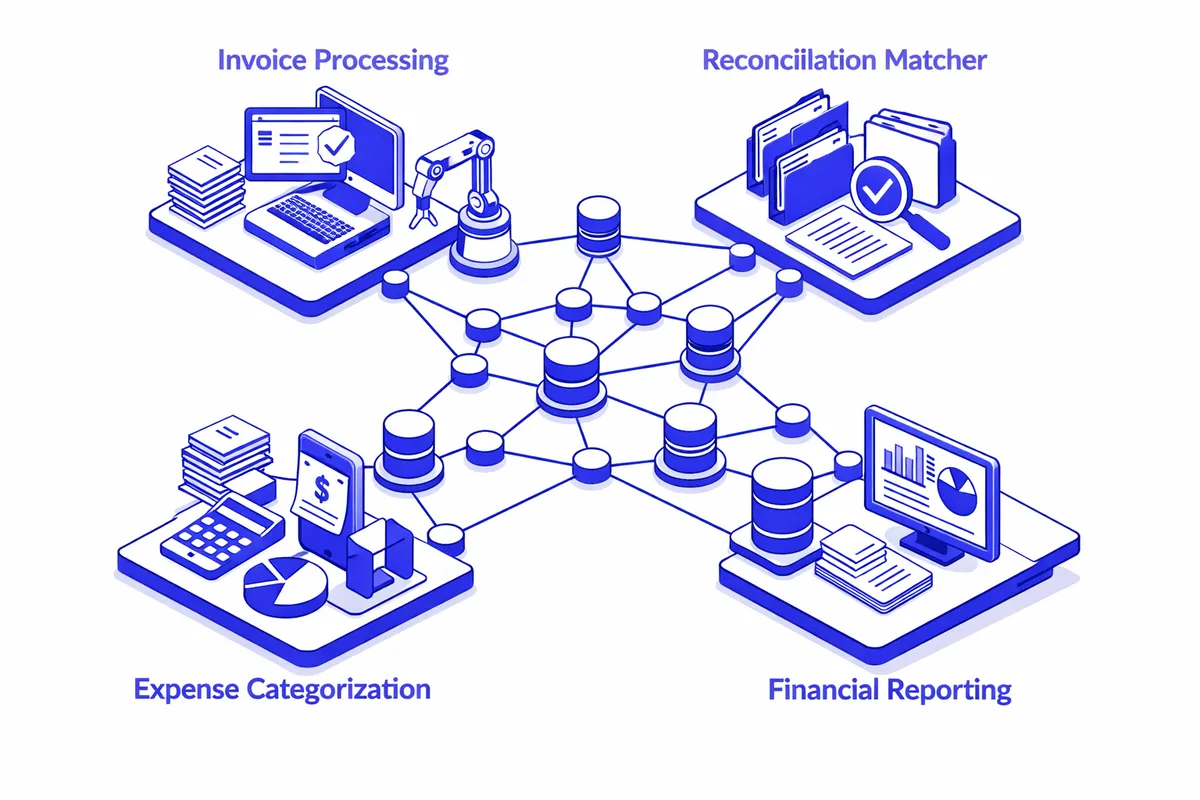
From the process map, we identify automation candidates: tasks that follow a deterministic rule and do not require human interpretation. Bank feed reconciliation. Invoice routing and approval. Intercompany transfers. Payroll journal entries. Expense categorization based on vendor and amount. Recurring lease payment posting. For most Loop businesses, 60 to 75 percent of the manual close cycle falls into this category.
We then build the automation layer using tools that connect directly to your existing accounting software, whether that is QuickBooks, NetSuite, Sage Intacct, or a specialized platform used by financial services firms. We do not replace your system of record. We build workflows on top of it that move data automatically, trigger approvals through the right channels, and flag exceptions for human review rather than letting them sit unnoticed in a queue.
Testing happens with real historical data before we touch live transactions. For a commercial real estate firm on Wacker Drive managing an active portfolio, testing against three months of historical lease transactions lets us validate the automation logic without any risk to current period financials.
Industries We Serve in the Loop
Law firms and legal partnerships throughout the LaSalle Street corridor use accounting automation to streamline trust accounting, client matter billing reconciliation, and partner compensation calculations. The three-way reconciliation between billing software, trust accounts, and general ledger is one of the most time-intensive and error-sensitive processes in legal finance. Automated rule-based reconciliation runs the same steps in minutes and flags any variance immediately.
The property management firms and REITs operating along commercial real estate corridors on Wacker Drive deploy automation to handle rent roll postings, utility billing allocations, and monthly owner reporting packages. When a portfolio includes properties with different ownership structures and reporting requirements, manual processes create inconsistency. Automated templates enforce consistency across the portfolio regardless of volume.
Financial services firms near the Board of Trade Building, where transaction volumes are high and reconciliation windows are tight, use accounting automation to handle position reconciliation, fee calculation, and regulatory reporting preparation. These firms often have proprietary trading or portfolio systems that do not natively integrate with accounting software; automation bridges that gap without requiring expensive custom development from the trading system vendor.
Directly across from Millennium Park, hotels and hospitality operators on Michigan Avenue automate their daily revenue audit cycle, the nightly process of reconciling PMS system revenue against payment processor settlements against general ledger postings. Done manually, this process takes two to three hours every morning. Automated, it takes minutes and produces a variance report that only requires review when something does not match.
Professional associations and nonprofit organizations near the Chicago Cultural Center on Randolph Street use accounting automation to handle membership dues posting, event revenue reconciliation, and grant reporting. Association accounting involves a large number of small transactions that individually require no judgment but collectively take significant staff time to process accurately.
Consulting and professional services firms in the Loop's office towers automate their project accounting: time and expense posting from project management tools into financial systems, billing cycle generation, and revenue recognition based on milestone completion. These firms typically use four or five different software tools that do not talk to each other natively; automation creates the connective tissue.
What to Expect Working With Us
1. Process mapping before any builds. We spend the first week documenting your current close cycle in precise detail. Every manual step, every handoff, every spreadsheet that exists because two systems do not connect. This map becomes the project scope and the baseline against which we measure time savings after launch.
2. Priority sequencing based on your close calendar. Not all automations deliver equal value at equal cost to build. We sequence the build based on your specific close calendar and where the highest labor concentration sits. A commercial real estate firm with mid-month owner distributions gets those automations built and tested first, before the next cycle runs.
3. Parallel testing with historical data. Every automation runs against three months of historical transactions before touching live data. We compare automated outputs against your actuals to validate accuracy. You do not flip a switch and trust the machine; you watch it prove itself.
4. Controller-level handoff and documentation. We do not leave you with a black box. Every automation is documented at the workflow level so your controller or accounting team can maintain, modify, or extend it without coming back to us. We also train your team on monitoring the automations and interpreting the exception reports they generate.