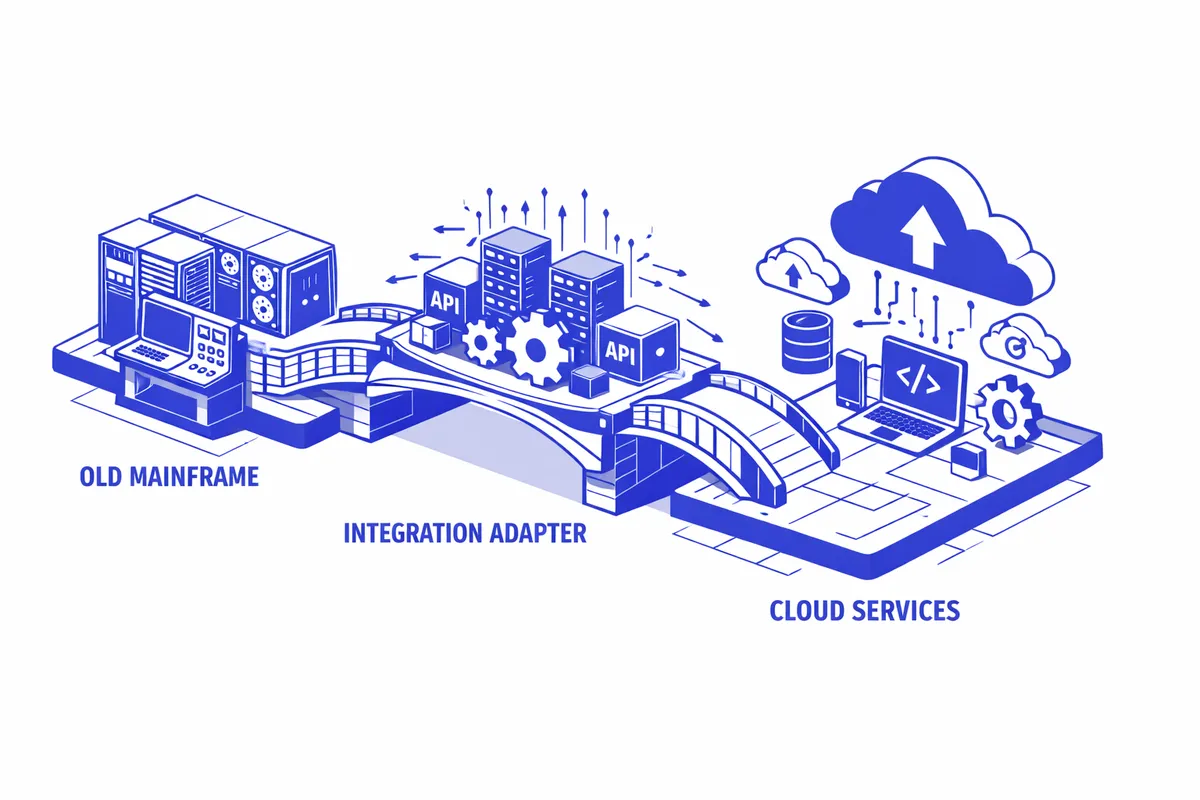
Our Legacy System Integration Services in Logan Square
We work with a range of legacy integration scenarios:
- Legacy system discovery, documentation, and integration capability assessment
- API wrapper development: wrapping legacy systems in a modern API so other tools can connect to them
- Database-level integration for direct access to legacy data
- File-based and batch integration for systems that output reports or data files
- Robotic process automation for legacy systems that can only be accessed through their user interface
- Middleware development that translates between legacy data formats and modern standards
- Integration with modern accounting platforms, CRM systems, analytics tools, and e-commerce platforms
- Data migration from legacy systems to modern platforms with validation and reconciliation
- Cloud-to-legacy integration for businesses adopting cloud tools that need to work alongside existing on-premises systems
- Modern web or mobile interfaces built on top of legacy system data
- Reconciliation monitoring to catch data discrepancies between integrated systems
- Documentation of legacy system data structures and integration architecture for your team
Industries We Serve in Logan Square
Food and Beverage Producers. Growing food brands in Logan Square often have production tracking, ordering, and inventory systems that were built for their early-stage operation and now cannot connect to the accounting, distribution, or analytics tools the business needs at its current scale. We integrate these custom and legacy platforms without requiring a rebuild.
Restaurants and Hospitality. Older POS systems, custom reservation platforms, and proprietary inventory tools are common in established Logan Square restaurants. Integration connects these systems to modern accounting, reporting, and marketing platforms so data flows automatically rather than being re-entered manually.
Nonprofits and Community Organizations. The Logan Square community has a strong nonprofit presence, and nonprofit organizations frequently run older case management, donor management, and administrative platforms that hold years of critical data but cannot connect to modern reporting or grant management tools. We build integrations that extract and connect this data without disrupting the systems your staff depends on daily.
Retail and Specialty Businesses. Independent retailers running older inventory and point-of-sale systems often have data that is valuable for purchasing decisions, customer analytics, and financial reporting but locked in a format that modern business intelligence tools cannot read. Integration makes that data useful without replacing the system that generates it.
Manufacturing and Production. The light manufacturing and production operations in Logan Square's adjacent industrial corridors often run custom or older production management systems that work well for production control but cannot feed the ERP, analytics, or supply chain visibility tools the business is adopting.
What to Expect
Legacy System Assessment. We spend time understanding what your legacy system actually does: how it stores data, what exports it can produce, whether it has any API or database connectivity, and what integration constraints exist. This assessment determines which integration approaches are feasible and estimates the complexity of each.
Integration Architecture. We design the integration architecture and document it clearly before development begins. For legacy integrations, where the path forward is often not obvious, the architecture phase is the highest-leverage investment. A well-designed integration is maintainable and extensible. A poorly designed one creates new problems while solving the original ones.
Build, Test, and Monitor. We build with reconciliation monitoring from the start. Data discrepancies between legacy and modern systems surface immediately rather than accumulating silently. Testing covers edge cases in the legacy system's behavior that documentation often does not capture.