How We Build Inventory Management for Little Village
We begin with an inventory process audit at your actual location. We document what you track today, where tracking breaks down, what decisions get made without good data, and what operational problems recur because inventory visibility is incomplete. For a boutique on 26th Street, that might uncover that stock counts are accurate on the floor but wrong in the back room, with no reliable way to know when a restock is needed until a customer asks for something that is not available. For a wholesaler, it might reveal that customer orders get promised based on incoming shipment schedules that are not actually reliable.
Requirements flow directly from the audit into system design. We define the product hierarchy, variant logic, channel integrations, reorder rules, and reporting needs based on what you actually do. For a quinceañera boutique with size, color, and style variants plus rental inventory, the product model is substantially more complex than a generic retail template. For a grocery with perishables and lot codes, FIFO enforcement and expiration tracking are baseline requirements. We build for your specific catalog rather than fitting you into a platform's standard mold.
Integration is core. Most Little Village retailers need their inventory system integrated with their POS, their e-commerce platform if they run one, their accounting software, and often their supplier ordering workflow. We build those integrations so data flows cleanly across systems rather than requiring manual double-entry. For wholesalers, we often integrate with customer ordering portals or EDI systems depending on the scale of the wholesale operation.
We set up demand forecasting using your actual historical sales data. Machine learning models trained on generic retail data miss the specific patterns in La Villita. Models trained on your data understand your quinceañera peaks, your Day of the Dead surge, your back-to-school cycle, and the specific product mix that drives your revenue. Reorder points, safety stock levels, and purchase order recommendations all get tuned to what actually happens in your business.
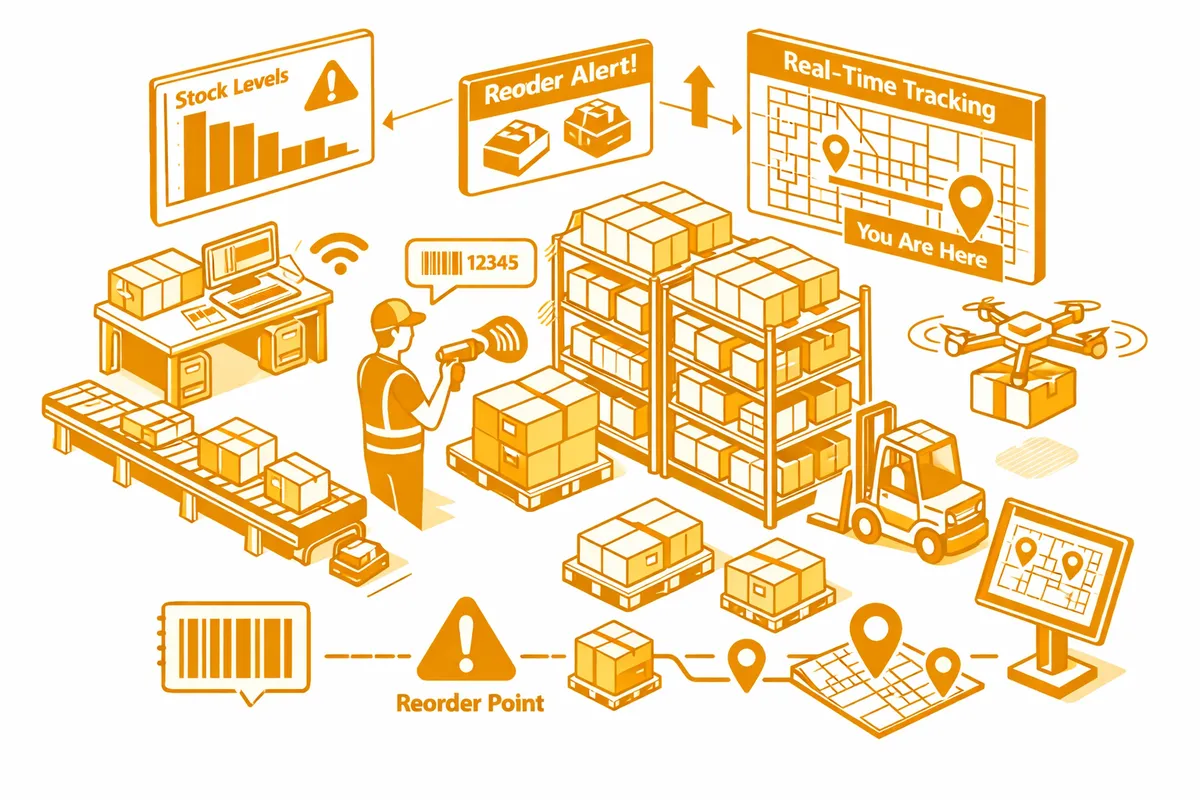
Mobile scanning, where volume justifies it, makes physical inventory management practical. Handheld or phone-based scanners for cycle counts, receiving, and picking save hours per week versus manual entry and dramatically reduce errors. For Discount Mall vendors and smaller operators, a phone-based scanning app is often the right scale. For larger wholesale warehouses, dedicated handheld scanners integrated with the system are worth the hardware cost.
Reporting is designed around the decisions you actually make. Inventory turnover by category and season, dead stock identification, reorder performance against supplier lead times, and cross-channel sales analysis all get built into dashboards that your team can use without needing to be trained on analytics tools. Reports that support actual decisions are the point, not reports that look impressive but sit unread.
Industries We Serve in Little Village
Clothing and quinceañera boutiques along 26th Street carrying deep size and style runs, rental inventory, and complex variant logic benefit most from custom inventory with season-tuned forecasting. We build product models that handle the real-world complexity of formal wear retail.
Grocery and specialty food retailers across La Villita stocking perishable goods, imported products with variable supplier availability, and culturally specific products need FIFO enforcement, expiration tracking, and supplier-specific lead time modeling built into the system.
Discount Mall vendors operating inside the Albany and 26th complex need inventory systems that handle their individual vendor operations while coordinating with the Mall's overall structure. We build compact systems scaled to vendor operations rather than pushing them into enterprise tools they do not need.
Wholesale distributors serving retailers across Chicago and the Midwest from Little Village warehouses need inventory systems that handle both wholesale and retail channels, tiered customer pricing, reserved stock for incoming orders, and integration with downstream customer ordering workflows.
Home goods and specialty retailers across the corridor selling bedding, housewares, and gift items need inventory with bundle pricing, seasonal forecasting, and cross-channel sync between physical and online sales. Integration with Shopify or similar platforms handles the e-commerce side cleanly.
Family-owned businesses in generational transition benefit from inventory systems that capture the institutional knowledge held by the founding generation while making operations legible to family members now running day-to-day work. Custom systems often play a role in making the transition sustainable.
What to Expect Working With Us
1. Inventory process audit. We document your current state, identify gaps and pain points, and produce clear requirements before design begins. This happens at your location, not over phone calls.
2. System design and scoping. Architecture, integrations, and phased delivery roadmap with a firm timeline and budget. Your operations and finance teams can plan against it.
3. Build and integration. We build the system and integrate with your POS, e-commerce, accounting software, and supplier systems. Testing uses your actual product catalog and operational scenarios before any live data migrates.
4. Launch and optimize. We launch with your team, provide training, and monitor early cycles to confirm performance meets design goals. Ongoing optimization adjusts forecasting parameters, adds integrations, and expands capabilities as your operation grows.