How We Build Document Management for Little Village
Every engagement begins with an intake process that maps what documents actually exist, where they live, and what the business needs to be able to do with them. For a 26th Street family business, this often means documenting documents that have never been formally organized: supplier contracts kept in a desk drawer, employee files split across a filing cabinet and a shared drive, lease documents scanned to a personal email account. We map the full picture before designing the system.
From that intake we design a taxonomy built for the business type. For an immigration legal services office, the taxonomy is client-centric: every client is a container, and every document in the system belongs to a client, a case, and a document type within that case. Metadata fields let staff find any document by client name, case number, document type, filing date, or status in seconds. For a family retail business, the taxonomy organizes around business functions: supplier documents, lease and facilities records, regulatory and license files, HR records, and financial documentation. Every folder structure and metadata schema is designed to match how the business actually operates, not a generic template.
Bilingual document support is built in from the start for Little Village clients. Metadata fields support Spanish and English values. Document naming conventions are designed to work in both languages. Where a business operates with Spanish-language supplier contracts or Spanish-language employee documents, the system handles those files with the same search and retrieval capability as English-language records. We do not treat Spanish-language documents as secondary or require translation before filing.
Industries We Serve in Little Village
Immigration legal services and notary offices in Little Village handle client files under time pressure and with consequences for missing documents that are more serious than in most practice areas. We build client-centric document systems with completeness tracking, deadline visibility, and rapid file production for hearings, appeals, and submissions. Every document in a client file is tagged and searchable. Incomplete files surface before deadlines, not after.
Family grocers and food importers along 26th Street and Cermak Road manage supplier contracts, import documentation, health inspection records, and equipment service agreements. A document system organized around business function and supplier relationship lets the next generation of owners pick up a filing system that was designed for retrieval rather than just accumulation.
Auto dealers and repair shops near Kedzie Avenue and California Avenue generate documents across sales, service, warranty, and regulatory categories. A system that organizes repair orders, title documents, dealer license records, and vendor contracts by type, date, and vehicle makes retrieval fast whether the need is a customer dispute, an insurance claim, or a state inspection.
Quinceanera retailers and event services along the Little Village commercial corridor manage vendor contracts, booking agreements, client files, and payment records across events that book months in advance. A document system built around the event timeline keeps contracts, deposits, and correspondence organized by client and event date so nothing falls through during the busy spring season.
Community health clinics and medical practices serving the Little Village and Piotrowski Park area operate under HIPAA requirements that demand access controls, audit trails, and retention policies built around the medical record lifecycle. We build document systems for small and mid-size practices that enforce the record integrity HIPAA requires without the overhead of enterprise healthcare software.
Small manufacturers and importers operating near the Little Village industrial fringe manage customs documentation, supplier agreements, quality records, and regulatory filings across multiple jurisdictions. A system that organizes import documents by shipment and supplier, and tracks regulatory filing deadlines, replaces the scattered filing approach that creates gaps at the worst moments: customs holds, contract renewals, and audits.
What to Expect Working With Us
1. Discovery and document mapping. We walk through your current document storage across physical files, shared drives, email, and any other locations to build a complete picture of what exists and what the business needs to retrieve. For bilingual operations, we document which file categories exist in Spanish, English, or both.
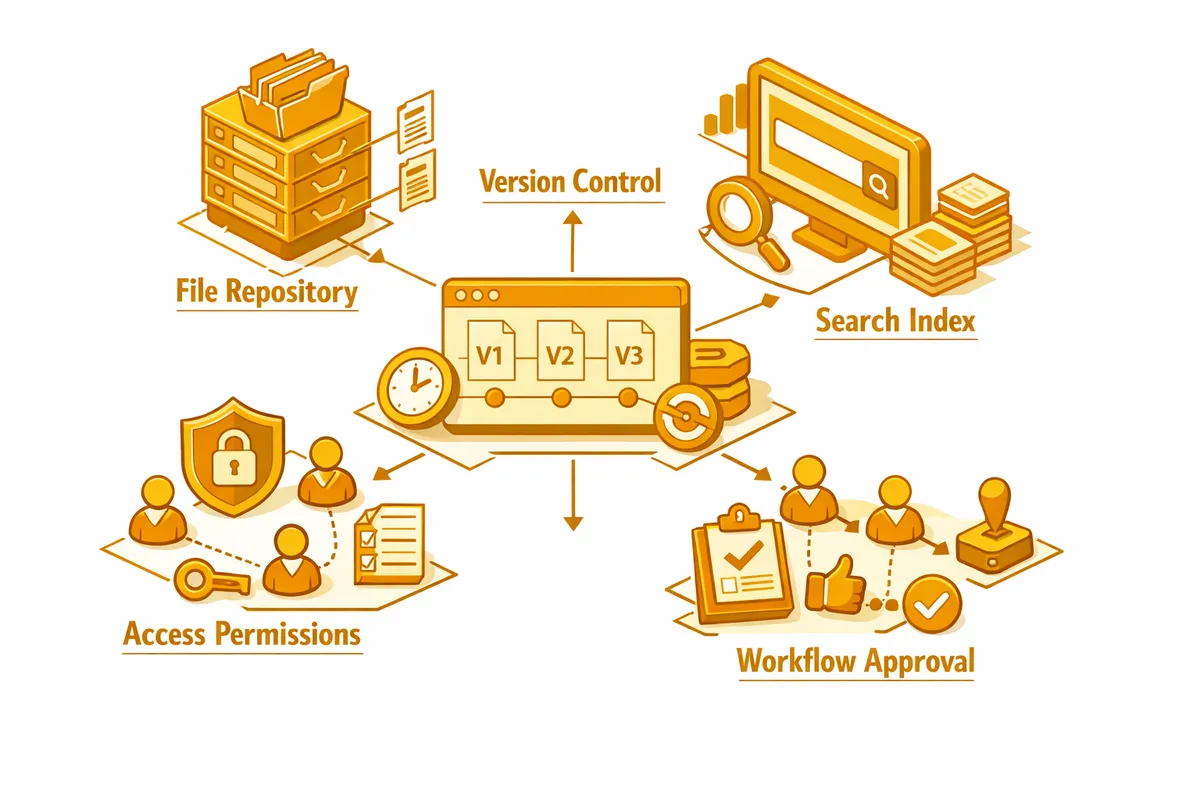
2. Taxonomy and system design. We design the classification structure, metadata schema, access controls, and retention policy framework specific to your business type and regulatory environment. Little Village clients operating in both languages receive a bilingual-ready metadata design. You approve the full architecture before implementation begins.
3. Implementation and migration. We build the system and migrate your existing documents into the new structure, applying consistent metadata during migration rather than carrying existing inconsistencies forward. Your highest-priority document categories are operational first, typically within eight to twelve weeks.
4. Training and ongoing support. Post-launch training for your team, including Spanish-language training support where needed, adoption monitoring, and a warranty period covering system stability. Optional maintenance retainers for taxonomy updates and system changes as your business evolves.