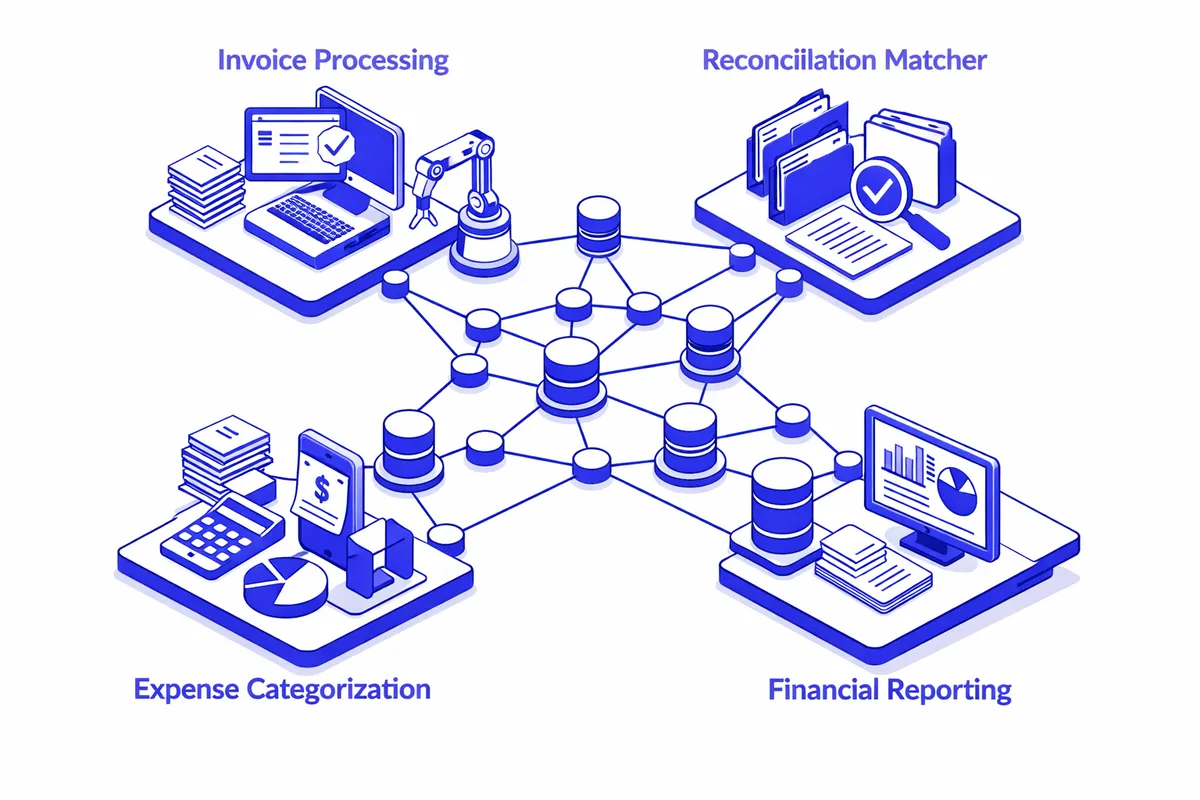
How We Build Accounting Automation for Little Village
Every engagement starts with a bilingual process map. We do not assume an English-only workflow just because accounting software defaults to it. We sit with the owner or office manager, trace every step from first transaction to final report, and build automation rules that match how the business actually categorizes spending. For businesses operating in Spanish day-to-day on Cermak Road or along California Avenue, we build category names and vendor rules that reflect the actual business, not a generic chart of accounts.
The technical layer connects to whatever accounting platform is already in use. Most Little Village businesses run QuickBooks; some of the older retail operations use spreadsheets or legacy point-of-sale systems that export CSV files. We build automation that meets them where they are, pulling data from existing systems rather than requiring a software migration that disrupts daily operations on the corridor.
For the layaway and deposit-heavy businesses that characterize the quinceanera and event retail market along 26th Street, we build specific workflows: deposit intake, liability posting, deposit application at order completion, and revenue recognition at service date. Each step happens automatically based on rules the owner sets once. When a customer pays off a layaway, the posting happens without anyone touching the accounting system manually.
Testing uses six months of historical transactions before anything touches live books. For a restaurant near La Villita Park, that means running automated bank reconciliation against real historical statements and comparing outputs to the prior reconciliations done manually. When the outputs match consistently, we go live.
Industries We Serve in Little Village
Mexican restaurants and panaderias along 26th Street use accounting automation to reconcile daily cash and card deposits against POS system reports, post food costs automatically from vendor invoices, and generate weekly profitability summaries without manual spreadsheet work. The high transaction volume and thin margins of food service make accurate daily accounting essential, and automation delivers it without adding bookkeeping staff.
Quinceanera and event retailers throughout the Little Village corridor deploy automation to manage layaway liability tracking, multi-date deposit recognition, and vendor payment scheduling. These businesses carry significant outstanding customer obligations at any given time. Automated liability dashboards give owners a real-time view of what is owed without requiring a manual count of paper contracts and deposit slips.
Auto shops and auto body operations on Pulaski Road and California Avenue automate parts inventory cost posting, insurance claim receivables tracking, and labor billing reconciliation. The combination of parts, labor, and third-party payer complexity makes auto service one of the most time-intensive manual accounting environments. Automation reduces the monthly close from days to hours.
Family grocers and specialty food retailers near Kedzie Avenue and Cermak Road use accounting automation to handle vendor payment runs, food cost allocation, and shrinkage tracking. Grocery margins run thin enough that a single miscategorized expense can distort profitability reports significantly. Automated categorization based on vendor identity eliminates that recurring problem.
Immigration legal services and community clinics operating near Our Lady of Tepeyac and the Little Village Chamber of Commerce use automation for grant disbursement tracking, restricted fund accounting, and bilingual financial reporting. These organizations file with multiple funders who require different report formats. Automation generates the required formats from a single data source without duplicating data entry.
Contractors and construction trades serving the residential and commercial renovation market throughout Little Village automate job costing: labor and materials posted by project, subcontractor invoice tracking, and progress billing against project milestones. Project accounting done manually across a multi-job pipeline is where contractor books most often go wrong. Automated job costing keeps each project's financials current without requiring weekend reconciliation after the job closes.
What to Expect Working With Us
1. Bilingual process mapping first. We document your current accounting workflow in the language your business actually runs in. For Little Village operations that mix Spanish and English across staff and systems, the process map reflects that reality. We identify automation candidates based on your actual workflow, not a generic template.
2. Build priority based on your pain points. The first automation targets the process that saves the most time or carries the most risk if done manually. For a quinceanera retailer, that is usually layaway liability management. For a restaurant on 26th Street, it is daily deposit reconciliation. We sequence builds around your close calendar and your highest-cost manual processes.
3. Historical data testing before live transactions. Every automation runs against six months of real historical data before touching current books. We compare outputs to what was posted manually and document any variance. You see exactly what the system would have done before it does it with live data.
4. Owner-level training and documentation. We provide workflow documentation that your bookkeeper, a family member handling the books, or your outside accountant can follow without coming back to us. For Little Village businesses, that documentation is available in Spanish on request.