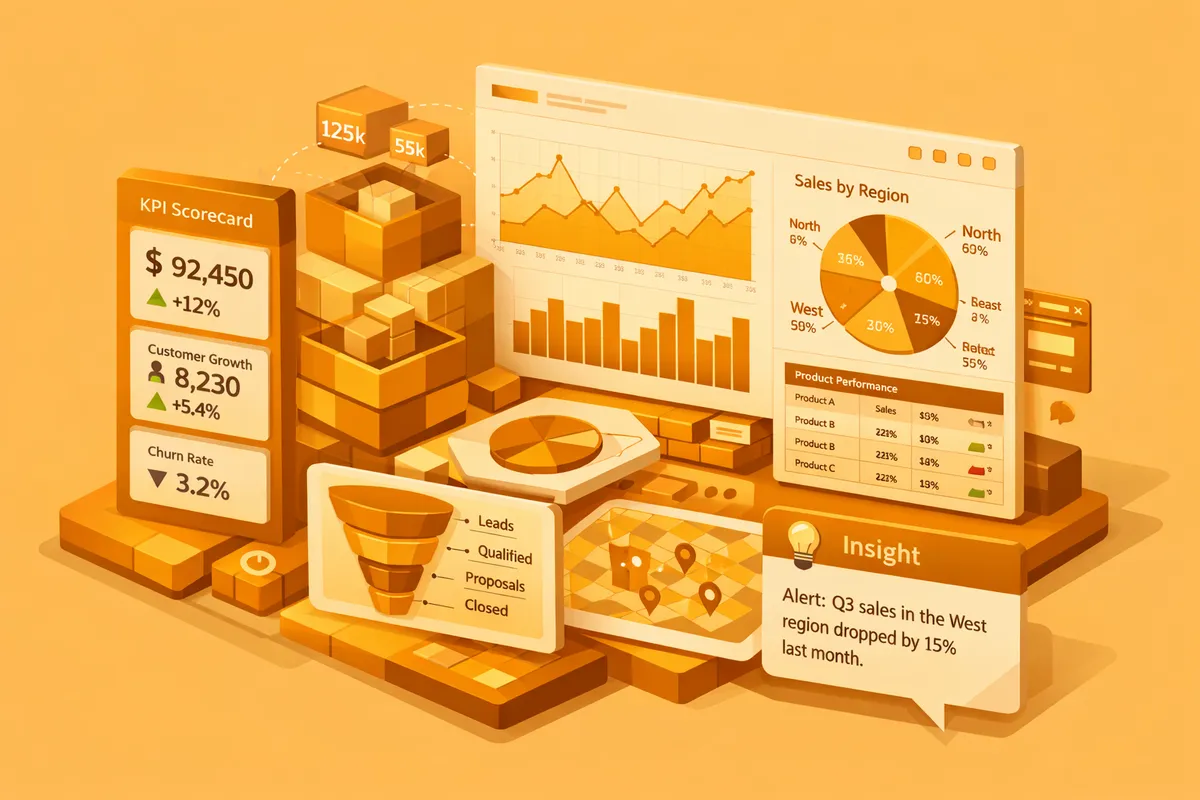
How We Build Business Intelligence for Lincoln Square
We begin with a data architecture assessment. We inventory your current data sources, assess their quality and completeness, and identify the specific business questions your organization needs to answer. The BI system is built to answer those questions, not to visualize every piece of data available.
We select the appropriate BI platform for your scale and needs. For most Lincoln Square small businesses, Google Looker Studio provides a capable and cost-effective foundation. For businesses with larger data volumes or more complex analytical needs, Power BI or Metabase may be more appropriate. We do not recommend enterprise platforms like Tableau or Looker when the business scale does not justify their complexity and cost.
We build the data model that connects your sources. This involves creating the connections from each source system to the BI platform, building the transformations that produce clean, consistent data, and defining the relationships between data sets that enable cross-source analysis. A customer who appears in your booking system, your email marketing tool, and your POS needs to be the same customer across all three sources for the analysis to be meaningful.
We build the dashboard layer on top of the data model: the specific visualizations, trend charts, comparison tables, and alert rules that answer your business questions clearly. We test every visualization against historical data to confirm it produces accurate results before delivering the system.
Industries We Serve in Lincoln Square
Independent restaurants and cafes on Lincoln Avenue and Lawrence Avenue use BI to analyze revenue by daypart, day, and season; compare catering versus dine-in margin; track average check size by server, shift, and reservation type; and identify the menu configurations and table turn strategies that maximize revenue per service.
Music schools and arts education businesses near the Old Town School of Folk Music use BI to analyze enrollment by instrument, age group, and lead source; track family retention across academic years; compare instructor utilization and revenue per instructor; and identify the enrollment patterns that predict long-term student persistence.
Fitness and wellness studios on Western Avenue use BI to analyze membership lifecycle from trial to active to lapsed; identify the class attendance patterns that correlate with high retention; compare revenue per member across membership types; and track instructor performance by class attendance, member feedback, and retention rates.
Boutique retail and specialty shops along Lincoln Avenue use BI to analyze inventory turn by product category and season; track customer purchase frequency and lifetime value by acquisition channel; compare in-store versus online channel performance; and identify the product combinations and price points that maximize both transaction value and repeat visits.
Multi-location or multi-service businesses operating across Lincoln Square and into adjacent Ravenswood, North Center, and Andersonville use BI to compare performance across locations, identify the service lines that deserve additional investment, and track the geographic distribution of customers to inform expansion decisions.
Event and cultural businesses near Welles Park and Giddings Plaza use BI to analyze ticket revenue by event type, time of year, and audience segment; track marketing channel effectiveness for audience development; compare the costs and revenues of different event formats; and identify the audience segments that provide the most reliable attendance base.
What to Expect Working With Us
1. Business questions and data inventory. We document the specific decisions your business needs to make better: where to invest, what to change, what to protect. We inventory your data sources and assess their quality and completeness. We produce a BI specification that maps specific business questions to data sources and visualization approaches.
2. Data model and pipeline construction. We build the data infrastructure: connections to each source system, transformation pipelines that produce clean and consistent data, the unified data model that enables cross-source analysis. We validate data accuracy at this stage before building any visualizations.
3. Dashboard design and delivery. We build the dashboards and reports specified in the business requirements document, present the initial designs for your review, incorporate feedback, and deliver the finalized system. We include documentation of the data model, the dashboard logic, and the refresh schedules.
4. Training and adoption support. We train you and any team members who will use the BI system regularly. We establish the review rhythms: which dashboards to check daily, which to review weekly, which to analyze monthly. We provide sixty days of post-delivery support to address questions and make adjustments based on how the system is used in practice.