How We Build Document Management Systems for Lakeview
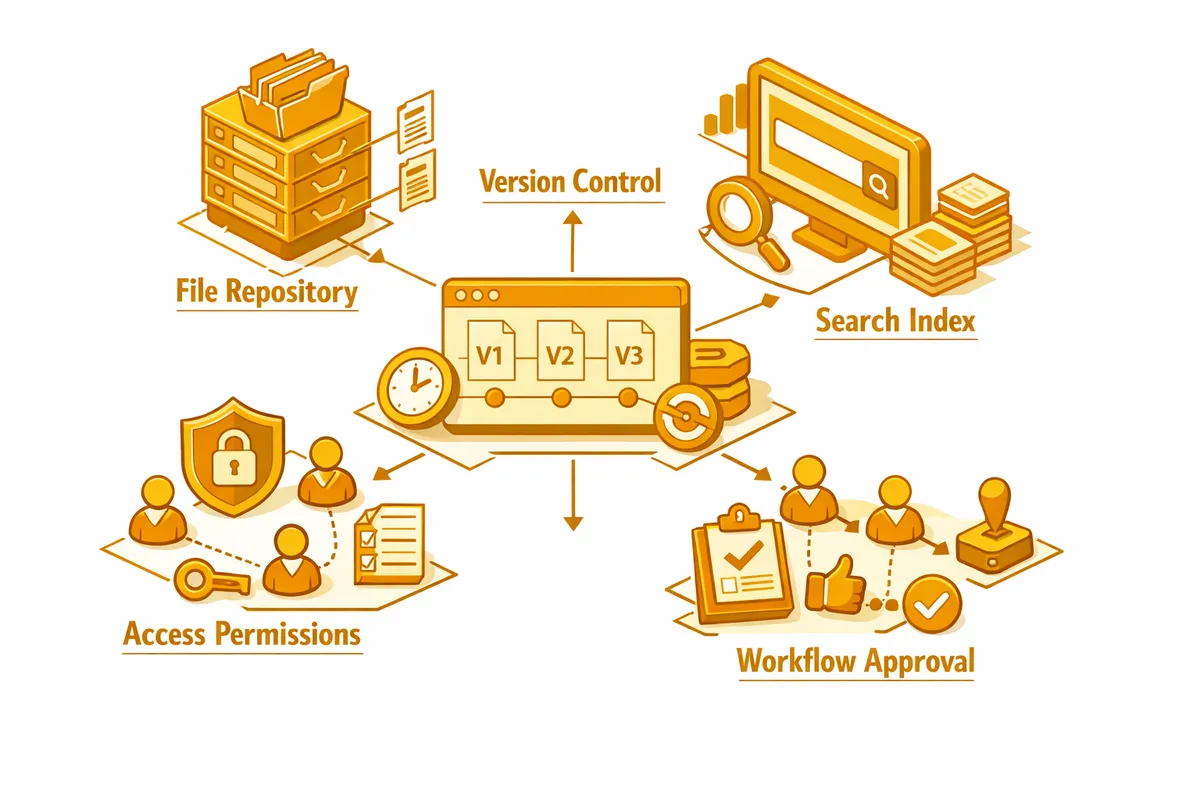
Discovery for a document management engagement begins with a document audit: cataloging every type of document your Lakeview business creates and receives, how many documents of each type exist, where they currently live, who needs access, and what compliance requirements govern their storage, access, and retention. For a Lakeview therapy practice, that audit typically reveals clinical records, intake forms, billing records, and insurance correspondence stored in multiple locations with inconsistent naming conventions and no systematic access controls. The audit makes visible the scope of the problem before we design the solution.
From the audit, we design the document taxonomy. This is the organizational structure that makes documents findable: the categories, sub-categories, and metadata fields that let your team search for a document by client name, matter type, document type, date range, or any other relevant attribute and find it in seconds rather than minutes. For a Lakeview healthcare practice, the taxonomy is built around patients and document types within each patient's record. For a law office, it is built around clients and matters. For a property management company, it is built around properties and units. The taxonomy is specific to your business model, not generic to your industry.
Access controls follow the taxonomy. In a Lakeview therapy practice, clinical notes should be accessible to the treating clinician and the practice owner, not to billing staff. In a law office, documents for one client's estate planning matter should not be accessible to attorneys working on an unrelated matter for a different client. In a property management company, maintenance staff should access maintenance records without access to lease agreements or financial records. We design and implement access control structures that match your actual organizational roles and your compliance requirements.
Industries We Serve in Lakeview
Healthcare and mental health practices throughout Lakeview, from solo therapists on Sheridan Road to multi-provider specialty clinics, need HIPAA-compliant document management with patient-centric organization, access controls limiting record visibility to authorized clinical staff, complete access audit logs, and retention policies that enforce HIPAA's requirements for different record types automatically rather than relying on staff memory.
Legal offices and solo practitioners on Broadway, Lincoln Avenue, and throughout the neighborhood need matter-centric document management with version control for contract and document drafts, access controls preventing cross-matter document exposure, and the ability to quickly produce any document associated with any client or matter for reference or production in a proceeding.
Financial advisors and wealth management professionals serving Lakeview's professional population need regulatory-compliant document storage for client agreements, disclosures, correspondence, and account documents, with retention policies aligned with SEC and FINRA record-keeping requirements and retrieval capabilities that make periodic compliance audits manageable.
Property managers and landlords managing Lakeview's dense rental market need property-centric document management for lease agreements, move-in and move-out inspection reports, maintenance records, and correspondence, with the ability to quickly produce any document associated with any property or unit in response to tenant disputes or regulatory inquiries.
Boutiques and service businesses with less regulatory complexity but significant operational document volume, including vendor contracts, employee records, insurance documents, and marketing materials, benefit from centralized, searchable document storage that eliminates the scattered shared drives and email threads that accumulate as businesses grow.
What to Expect Working With Us
1. Discovery and audit. We catalog your document types, volumes, storage locations, access requirements, and compliance obligations. For Lakeview healthcare and legal practices, this includes a compliance review that identifies gaps between your current document practices and applicable regulatory standards.
2. Taxonomy and architecture design. We design the document classification structure, metadata schema, access control model, and retention policy framework specific to your Lakeview business type. You review and approve the architecture before any implementation begins.
3. Implementation and migration. We build the system and migrate your existing documents into the new structure, reorganizing and tagging them as part of the migration rather than carrying existing chaos into the new environment. Core implementations serving your highest-priority document types are live within eight to fourteen weeks.
4. Training and ongoing support. Post-launch user training for your Lakeview team, adoption monitoring, and a warranty period. Optional maintenance retainers for policy updates, taxonomy changes, and integration maintenance as your document environment evolves.