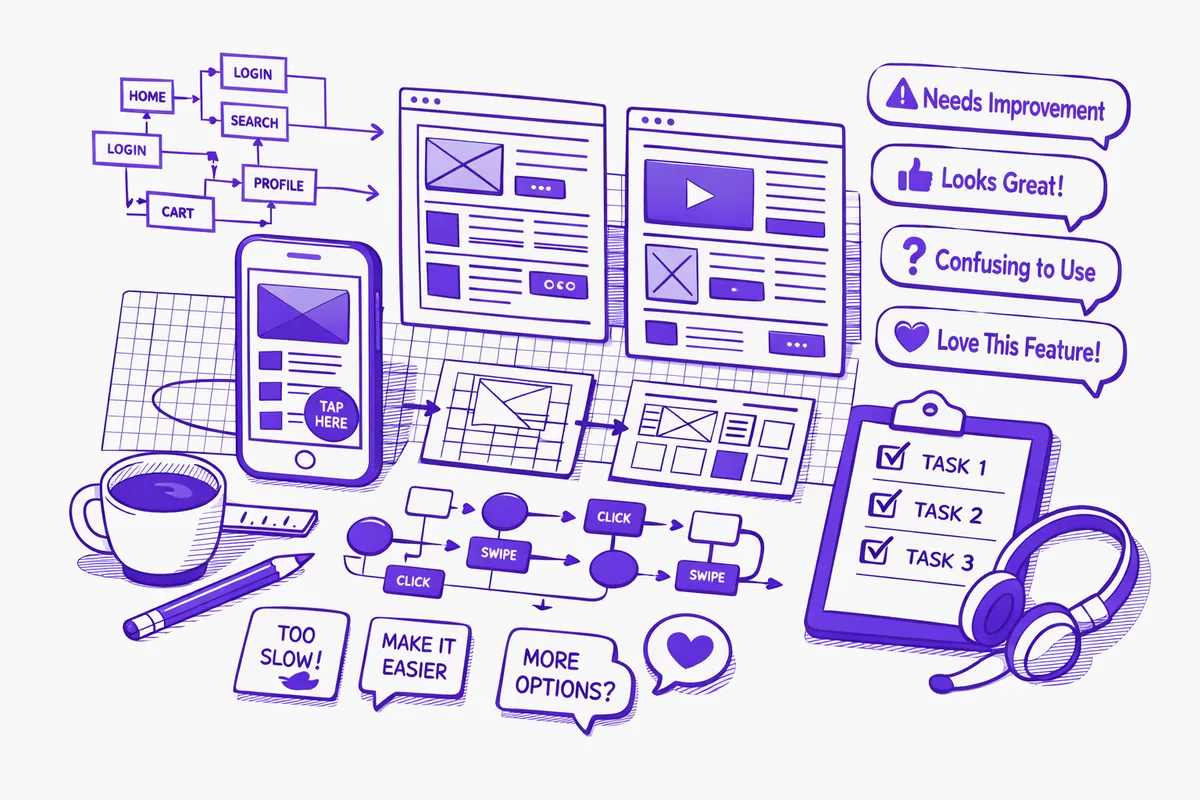
How We Build UI/UX Design for Irving Park
Irving Park's user population is not a single demographic. The neighborhood spans working-class and middle-class households, multiple immigrant communities with varying levels of English-language digital literacy, and longtime residents who may be less comfortable with digital interfaces alongside young families who expect seamless mobile experiences. Designing for this range means conducting research across the actual user population, not assuming that the loudest voices in early feedback represent all users.
Our process for Irving Park clients starts with the specific operational context. A contractor scheduling tool gets designed for the customer making the call from a house on the block between Pulaski Road and Milwaukee Avenue, not for a hypothetical user in a product persona document. A medical practice patient portal gets tested with real patients from the Irving Park United Methodist Church neighborhood and the families near Athletic Field Park who represent the practice's actual patient population. This specificity is what distinguishes design that works from design that looks good in a Figma prototype and fails in the field.
We bring particular attention to mobile design for Irving Park's service-sector businesses. The parents scheduling pediatric appointments do it on their phones between school pickup and dinner. The homeowners requesting contractor estimates are photographing the problem area and sending it through a mobile interface while standing in their basement or yard. The customers ordering from the specialty food shop are doing it on lunch breaks. Irving Park's economic profile means that mobile is often the primary device, not a secondary surface designed down from desktop. We design mobile-first when the research shows that is where users live.
Industries We Serve in Irving Park
Family Medical and Dental Practices. The pediatric, family medicine, and dental practices near Montrose Avenue and Irving Park Road serve a residential patient population that evaluates practices partly on how easy the digital experience is to navigate. We design patient portals, appointment scheduling flows, and follow-up communication interfaces that strengthen the patient relationship rather than creating friction in it.
Preschools and Early Childhood Programs. Irving Park's preschool and early childhood education providers serve parents making high-stakes enrollment decisions. We design enrollment platforms, parent communication tools, and daily update interfaces that communicate the warmth and reliability of the programs they represent, and that work for parents managing multiple children's schedules on a phone.
Home Services and Contractors. The contractors, electricians, plumbers, and home service providers operating through Irving Park's residential corridors need scheduling, estimate, and communication tools that serve both their operations and their customer's expectations. We design tools for the actual workflow of a field services business, not the idealized workflow of a software product manager's imagination.
Specialty Food and Independent Retail. The specialty food shops and independent retailers along Irving Park Road serve regulars who know the inventory and new customers discovering the business for the first time. We design online ordering systems, loyalty interfaces, and discovery experiences that serve both audiences without making either feel like an afterthought.
Auto Service and Trades. Irving Park's auto service shops and trade businesses have customer relationships that span years and multiple vehicles. We design appointment scheduling, service history, and customer communication tools that reflect the durability of those relationships and make it easier for customers to return without having to re-explain their history.
Community Organizations and Nonprofits. The community organizations serving Irving Park's diverse population, including the groups that use Independence Park and Horner Park as community anchors, need digital tools that work across literacy levels, languages, and device types. We design accessible, inclusive interfaces for community-facing platforms that do not leave any part of the community behind.
What to Expect Working With Us
1. Discovery and User Research. We begin with the people who will use the product. For Irving Park clients, this means recruiting research participants from the neighborhood's actual demographics: the patients of a Montrose Avenue practice, the parents of children enrolled at an Irving Park preschool, the customers of a specialty food shop on Irving Park Road. We map existing journeys, identify friction, and establish what users actually need before any design decisions are made.
2. Information Architecture and Wireframing. Structure comes before visual design. We define how content and features are organized, then build wireframes that establish layout and flow at low fidelity. For Irving Park businesses serving a range of digital literacy levels, this phase often surfaces navigation decisions that would have been wrong if made by assumption. Wireframes are tested with real users before advancing.
3. High-Fidelity Design and Prototyping. Precise visual design in Figma, including interactive prototypes that Irving Park stakeholders and test users can navigate as if they were using the finished product. Design systems are created to ensure consistency across every screen and surface, with components documented for the development team.
4. Testing, Iteration, and Handoff. We test prototypes with real participants matching the Irving Park user profile before finalizing designs. Findings are incorporated, and the final handoff includes annotated Figma components, interaction specifications, and developer documentation sufficient to build what was designed, not an approximation of it.