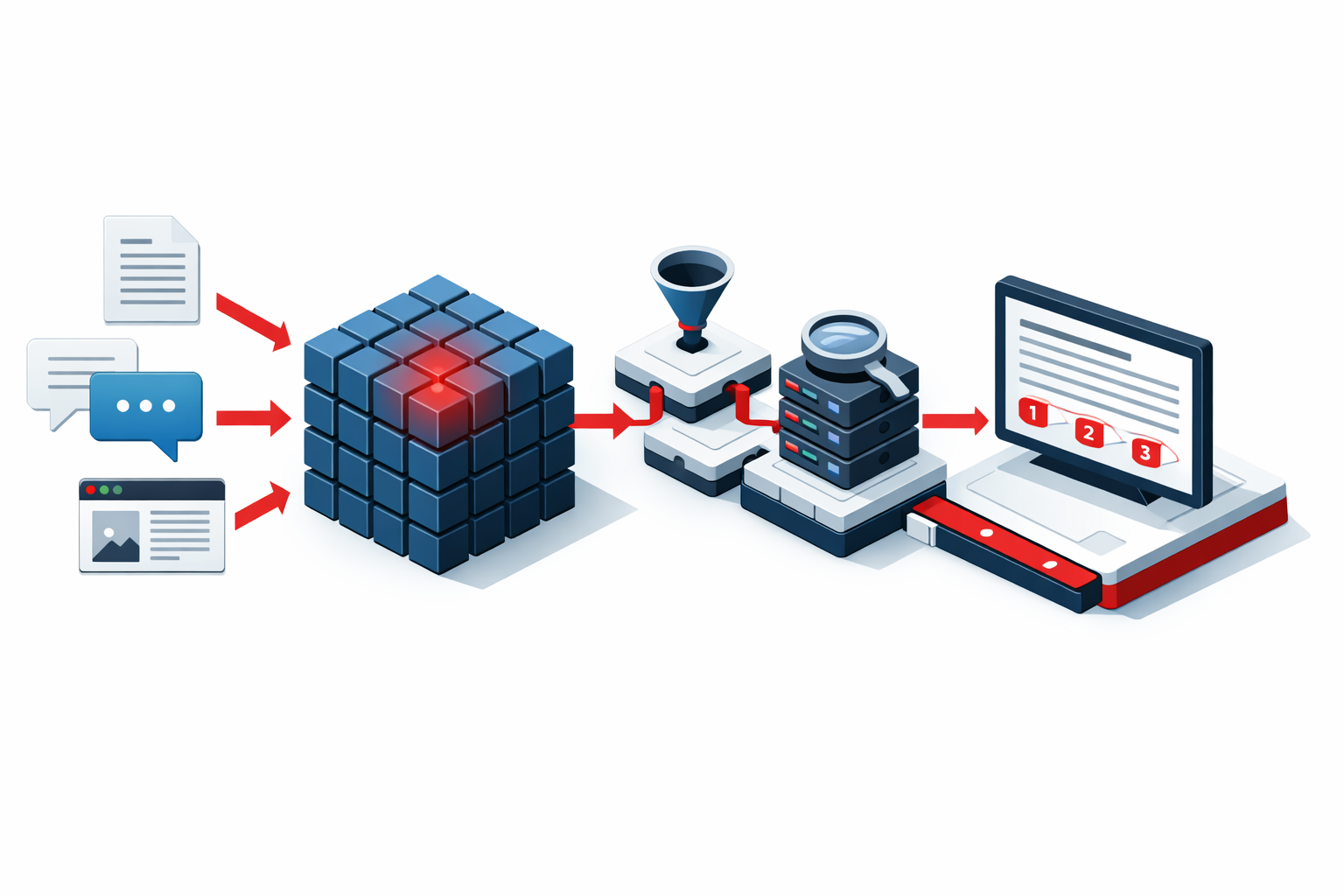
How We Build RAG Systems for Irving Park
We begin by auditing the institutional knowledge that exists and that is most valuable to make accessible. For a medical practice, that audit covers billing and insurance documentation, treatment protocols, patient communication policies, and clinical reference materials. For a contractor, it covers project specifications by type, material standards, subcontractor agreements, and client communication protocols. For a preschool, it covers curriculum documentation, family communication policies, enrollment procedures, and program history. We assess what is currently documented, what important knowledge exists only in staff expertise, and what the highest-priority knowledge areas are for the specific business.
Knowledge preparation is the most significant phase of RAG development. Documents need to be in formats the system can process. Information that exists only as staff knowledge needs to be documented. Inconsistencies in existing documentation need to be resolved so the system does not surface contradictory answers to the same question. For Irving Park businesses with years of accumulated documentation, this phase involves organizing and cleaning what already exists. For businesses with less formal documentation, it involves working with experienced staff to capture knowledge that has never been written down.
We build the retrieval system that searches through the prepared knowledge base to find the documents and passages most relevant to a given query. Retrieval quality determines how often the system finds the right information to answer a question. We tune retrieval for the specific language patterns and terminology of each business so that questions asked in natural language produce accurate retrieval from specialized documents.
The synthesis layer generates responses from retrieved information in natural language. Rather than returning raw document excerpts, the system produces answers that are conversational, appropriately detailed, and specifically relevant to the question asked. A new receptionist who asks "how do we handle a patient who disputes a copayment charge" gets a clear, step-by-step answer drawn from the practice's actual billing policies rather than a generic answer or an irrelevant document excerpt.
Industries We Serve in Irving Park
Medical and dental practices on Pulaski Road and Irving Park Road use RAG systems to make billing procedures, insurance protocols, patient communication policies, and clinical reference materials accessible to all staff on demand. New receptionist onboarding time shortens because knowledge that was previously transmitted through weeks of shadowing is now accessible through direct query. Billing errors reduce because the correct procedure is always one question away.
Home services contractors and general contractors on Montrose Avenue use RAG systems to make project specification knowledge, material standards, subcontractor performance history, and client communication protocols accessible to all team members. New subcontractors and project managers access accumulated knowledge about how specific job types should be executed without relying entirely on the owner's availability for guidance.
Preschools and childcare centers near Athletic Field Park and Independence Park use RAG systems to make curriculum documentation, family communication policies, enrollment procedures, and program history accessible to all staff. New staff members access the school's documented approach to specific situations rather than asking the director to interrupt their work to answer questions that should be handled independently.
Auto service shops along Elston Avenue and Pulaski Road use RAG systems to make technical reference documentation, parts specification databases, warranty policy procedures, and customer communication protocols accessible to technicians and service advisors on demand. Technicians working on unfamiliar vehicle types query the system rather than interrupting other staff for guidance.
Specialty food shops and retailers along Milwaukee Avenue use RAG systems to make product knowledge documentation, supplier information, pricing policies, and customer service protocols accessible to all staff. Newer staff handle customer questions about products confidently because they can access detailed product knowledge through the system during the conversation.
Professional service firms operating throughout Irving Park use RAG systems to make client engagement documentation, service methodology references, regulatory reference materials, and firm policies accessible to all practitioners. Staff who need to recall how the firm handled a specific situation in a previous engagement can retrieve that information rather than searching through email archives.
What to Expect Working With Us
1. Knowledge audit and documentation planning. We assess what institutional knowledge the business holds, where it currently lives, how complete and accessible it is, and what the highest-priority knowledge areas are for RAG development. We produce a documentation plan that covers both organizing existing materials and capturing knowledge that is not yet documented.
2. Knowledge base preparation and organization. We work with the business to prepare the knowledge base for RAG development: organizing existing documents, resolving inconsistencies, capturing undocumented knowledge through staff interviews, and structuring information in formats the system can process effectively.
3. RAG system development and testing. We build the retrieval and synthesis system, test it against representative questions the business's staff would ask, evaluate response accuracy and relevance, and refine both retrieval and synthesis quality before deployment.
4. Deployment, staff training, and ongoing knowledge maintenance. We deploy the system and train staff on how to use it effectively. We establish a process for adding new knowledge as the business evolves and for correcting any inaccuracies the system produces in the first months of operation. Most RAG systems need knowledge updates monthly as policies, procedures, and business information change.