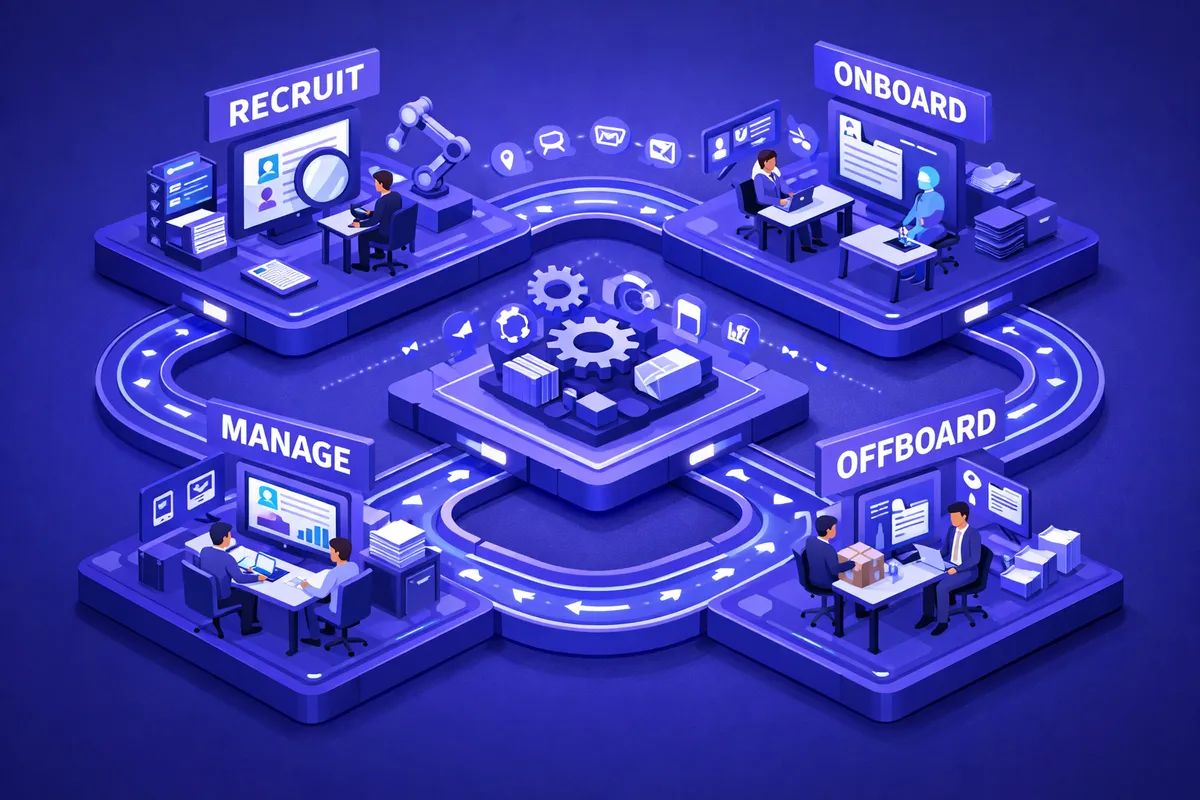
How We Build HR Automation for Irving Park
We start by sitting with the business owner, not in a conference room but in the actual environment where the work happens. For a contractor operating out of a shop near Elston Avenue, that might mean walking through their current hiring and onboarding workflow from the moment someone calls about a position to the moment they're on a jobsite with tools in hand. We document every step, every paper form, every text message used to confirm a schedule, every spreadsheet tab that tracks who has their safety certifications current.
From that audit we identify the three or four processes where time is being lost and risk is accumulating. Usually it is: new hire paperwork taking too long, scheduling communicated through informal channels that create he-said-she-said disputes, time tracking done manually and reconciled at the end of the pay period, and compliance documentation stored in ways that make audits painful. We build automation workflows that replace those four pressure points first.
For Irving Park's medical and dental practices, we pay particular attention to credentialing and license renewal tracking. These practices cannot put a hygienist or an MA on the schedule if their certifications have lapsed, and tracking renewal dates across a staff of eight to twelve requires a system, not a mental note. We configure automated alerts tied to expiration dates so the practice manager knows sixty days out, not the morning of.
For contractors and construction trades, we integrate time tracking with prevailing wage documentation requirements so that compliance reporting is a byproduct of normal clock-in behavior rather than a separate administrative task.
Industries We Serve in Irving Park
Residential and commercial contractors working out of shops near Elston Avenue and Pulaski Road use HR automation to manage the cycle of seasonal hiring, crew certification tracking, and prevailing wage documentation. When a bid wins and they need to bring three new workers on within a week, the system generates offer letters, collects I-9 documentation, and routes everything to payroll without the owner touching a single form.
Family restaurants along Irving Park Road deal with high turnover in front-of-house staff, tip reporting obligations, and the perpetual challenge of building a consistent schedule across a mix of full-time cooks and part-time servers. Automated scheduling tools reduce the back-and-forth of shift swaps and give the owner visibility into labor cost before the week starts rather than after the check run closes.
Medical and dental practices scattered along the neighborhood's commercial corridors face the most regulation-dense HR environment of any Irving Park employer. Automated license tracking near Independence Park ensures that no staff member's credential lapses without a 60-day warning, and digital onboarding collects all credentialing documents in one auditable system from day one.
Auto service shops near Montrose Avenue and Pulaski Road typically run small teams where one sick day creates a coverage crisis. HR automation builds out cross-training documentation and skill matrices so the owner knows at a glance who can cover diagnostics versus body work, and scheduling adjustments happen through a mobile app rather than a phone tree.
Preschools and childcare programs in the Irving Park area face DCFS staffing ratio requirements that cannot be managed casually. Automated HR systems track staff-to-child ratios by shift, flag when ratios are at risk due to call-outs, and maintain the employment documentation that licensing inspections require, including background check records tied to each employee file.
Specialty food shops and grocery retailers near the Horner Park corridor hire part-time and seasonal workers whose hours vary significantly week to week. Automated time tracking and scheduling prevents the common problem of unintentional overtime, keeps tip and wage records accurate, and generates the end-of-year documentation these employers need for tax compliance without a separate reconciliation project.
What to Expect Working With Us
1. Process mapping and gap analysis. We document your current HR workflow from hiring through offboarding, identifying where paper forms, informal communication, and manual reconciliation are creating delays and compliance exposure. For most Irving Park businesses, this surfaces two or three specific problems that automation can solve immediately.
2. System configuration and data migration. We configure your HR automation platform to reflect how your business actually operates, including your pay periods, your job classifications, and any union or prevailing wage requirements that apply to your trades work. Existing employee records migrate into the new system so you are not starting from a blank slate.
3. Staff onboarding and mobile rollout. Your team learns the system in a working session scheduled around your operational calendar, not ours. For businesses in Irving Park where some staff are more comfortable with Spanish-language interfaces, we configure the platform accordingly and provide bilingual onboarding support materials.
4. Compliance monitoring and ongoing refinement. We monitor your system for configuration issues and regulatory changes that affect your industry, and we run quarterly check-ins to expand automation into new areas as your business grows. When the next open enrollment cycle or seasonal staffing ramp-up arrives, your system is already configured to handle it.