How We Build Field Service Management for Irving Park
Irving Park's service territory has a clear geographic logic: Irving Park Road, Montrose Avenue, Pulaski Road, Elston Avenue, and Milwaukee Avenue are the corridors. The residential grid between them is where the jobs are. We configure route optimization around this specific territory, accounting for Irving Park Road's traffic at rush hour, the school-zone patterns near Athletic Field Park in the morning, and the Milwaukee Avenue diagonal that cuts through the service area.
For contractors serving primarily residential homeowners, the customer communication layer is as important as the dispatch engine. Bungalow belt homeowners expect a confirmation when they book, a reminder the day before, and a notification when the technician is ten minutes away. These are not extras. They are baseline expectations. We configure automated customer communication so dispatchers are not manually texting every customer throughout the day.
Work order history is a central design priority for Irving Park contractor businesses. A customer who has been with your plumbing company for eight years has a history of every job done in their home. When they call about a water heater issue, the technician who pulls up their record should immediately see the brand and age of the unit, the last service date, any notes from prior visits, and the customer's preferred contact method. That level of preparation is what separates a service business that feels professional from one that feels like it is meeting the customer for the first time on every visit.
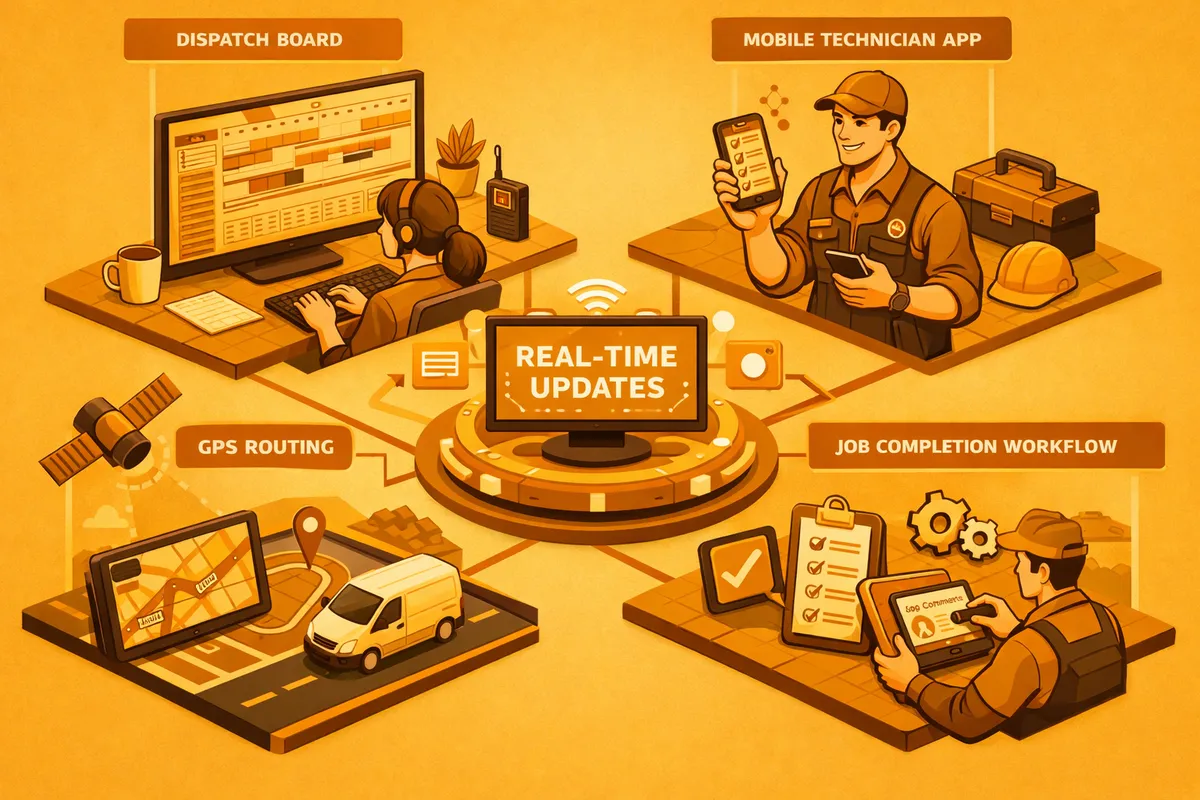
We integrate with QuickBooks and other accounting platforms to eliminate the manual data re-entry that costs small contractors hours per week. Job completion in the field triggers invoice creation. Parts used on the job update inventory records. Dispatch has real-time visibility into technician status across the Irving Park service territory.
Industries We Serve in Irving Park
HVAC and Heating Contractors: Irving Park's bungalow housing stock, concentrated on the residential blocks between Montrose Avenue and Irving Park Road, generates consistent heating season demand. HVAC businesses serving this territory need emergency dispatch for January cold snaps, route optimization for the bungalow-dense residential grid, and equipment history tracking for homes where the furnace has been serviced a dozen times over the years.
Plumbing Contractors: The older residential buildings near Gompers Park and throughout the Irving Park grid contain cast-iron drain systems, galvanized supply lines, and other infrastructure that generates regular repair demand. Plumbing contractors need work order systems that document building-specific configurations and service histories to maximize efficiency on return visits.
Electrical Contractors: Electrical upgrades are a steady line of business in a neighborhood where many homes were wired decades ago and are being updated for modern electrical loads. Electricians working Irving Park residential jobs need job costing tools, permit documentation support, and scheduling coordination when jobs span multiple days.
Property Management and Maintenance: Irving Park's rental two-flat inventory requires ongoing maintenance coordination between landlords, tenants, and contractors. Property management companies and maintenance contractors working this segment need multi-unit work order management, tenant notification tools, and building-specific access protocol documentation.
Landscaping and Exterior Services: Homeowners on the tree-lined blocks near Athletic Field Park and throughout the Irving Park residential grid maintain lawns and exterior landscaping through local contractors. Landscaping businesses need recurring maintenance scheduling, route optimization for dense residential routes, and seasonal transition planning tools for spring startup and fall closeout.
General and Remodeling Contractors: Irving Park's durable housing stock supports an active residential renovation market. General contractors managing kitchen and bath remodels, additions, and structural work in bungalows and two-flats need job costing, subcontractor scheduling coordination, and project milestone tracking to keep multi-week jobs on time and on budget.
What to Expect Working With Us
1. Discovery and Workflow Documentation: We start by understanding how your business dispatches jobs today. That means sitting with dispatchers, talking to technicians, and reviewing how calls get booked and assigned. For Irving Park contractors running on phone calls and spreadsheets, we document every step in the current process and identify the specific friction points before designing any solution. We pay attention to what works, not just what is broken.
2. Territory-Specific System Design: We design your FSM system around Irving Park Road, Montrose Avenue, Pulaski Road, Elston Avenue, and the residential grid between them. Route configurations account for neighborhood-specific traffic patterns. Dispatch workflows reflect how your business distinguishes emergency calls from scheduled maintenance. Customer communication sequences are written to match the voice of a neighborhood contractor, not a national service chain.
3. Field Testing Before Launch: Your technicians test the mobile application on real Irving Park jobs before we go live company-wide. That means running actual dispatches through the system, testing offline capability during Chicago tunnel and parking garage situations, and validating that GPS routing works correctly in the neighborhood's residential streets. We incorporate field feedback before launch so the system works as expected on day one.
4. Phased Launch and Ongoing Support: We phase the launch starting with scheduling and dispatch, then add features in sequence. Irving Park contractors who have built their business on personal relationships get transition support: onboarding calls, hands-on help during the first weeks of live operation, and a direct support contact for the questions that come up when you are running real jobs through a new system.