How We Build Employee Portals for Irving Park
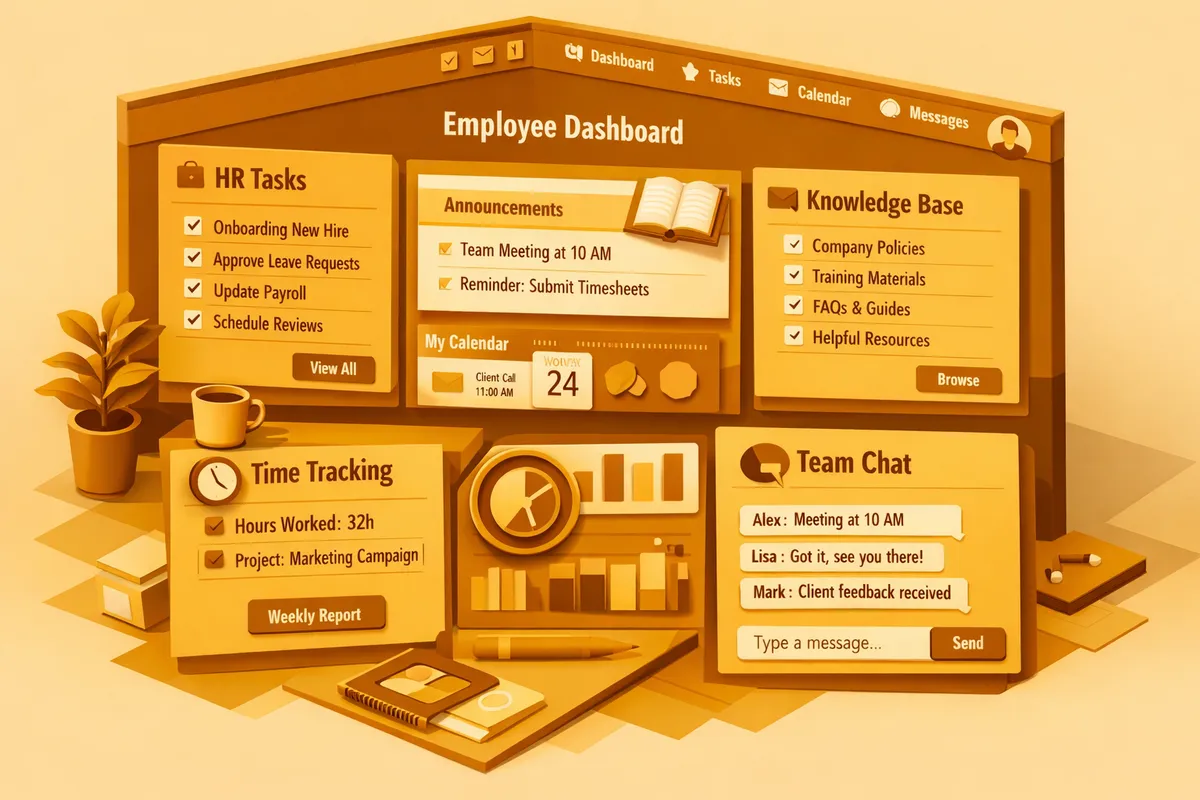
The first question we ask is: what does each role in your business need to access, and what should they never be able to see? An employee portal that shows everyone everything is not a portal. It is a confusion machine. We start with a role map that defines what information is relevant to each type of employee in your business, and we build access controls around that map.
For a contractor with office staff, project managers, and field crews, that means three different views of the same underlying system. The project manager sees job budgets, materials orders, and crew assignments. The field crew sees today's job details, site contacts, and safety documentation. The office administrator sees payroll records, HR documents, and company-wide announcements. Each view is built to show what that person needs without creating noise from what they do not.
The technology is secondary to the design. We can build on several platforms depending on your existing tools and hosting preferences. What matters more is that the interface makes the most common tasks fast. A field crew member checking their assignment for the day should see it in two taps, not navigate through four menus. A front desk coordinator pulling an employee's HR document should find it in seconds. We design for the real use case, then build the technology to support it.
Industries We Serve in Irving Park
Residential contractors and home service companies off Elston Avenue deploy employees and subcontractors across multiple active sites simultaneously. A portal that delivers daily job assignments, site-specific documentation, contact information, and safety checklists to each crew member's phone eliminates the morning call-around that consumes dispatcher time and introduces errors when information is relayed verbally.
Family restaurants and catering businesses on Irving Park Road manage part-time and full-time staff with rotating schedules, changing menu information, and event-specific assignments. An employee portal gives every staff member access to their current schedule, updated menu details, and event briefings without requiring the manager to relay information individually to each person before every shift.
Medical and dental offices near Gompers Park coordinate clinical staff, front desk administrators, and part-time support roles that have different documentation access needs. A portal with role-based document access means hygienists find protocol updates and licensing reminders without wading through billing records, and front desk staff access scheduling resources without entering clinical documentation systems.
Auto service centers along Irving Park Road employ technicians, service advisors, and sometimes part-time lot attendants who each need different operational information. A portal that delivers work orders to technicians, customer communication templates to service advisors, and shift schedules to all staff gives the shop a single communication layer rather than the combination of printed sheets, text messages, and verbal handoffs that currently fills that role.
Preschools and early childhood programs in Irving Park manage a particularly complex staffing picture: lead teachers, assistant teachers, substitute pools, and administrative staff all with different schedules, access needs, and document requirements. A portal that handles substitute notifications, schedule access, classroom assignment updates, and required certification tracking removes several categories of administrative overhead from the director's weekly workload.
Independent medical supply and home health businesses employing delivery drivers, customer service representatives, and administrative staff need a communication layer that handles route assignments, delivery documentation, and compliance records without requiring everyone to be in the same physical location. A portal with mobile-optimized driver views and document management for compliance records serves that workforce directly.
What to Expect Working With Us
1. Role mapping before any development. We document every role in your business, what information each role needs daily, what they need occasionally, and what should be completely off-limits. For a contractor on Pulaski Road with office staff and multiple field crews, that mapping session is foundational. If we build before we understand the access model, we build wrong.
2. Phased delivery starting with the highest-friction use case. The first portal release focuses on the single communication problem that costs your team the most time today. For most Irving Park service businesses, that is daily job assignments or schedule access. Getting that right and trusted by your team before adding HR documents, payroll access, and performance tracking keeps the project grounded and builds momentum.
3. Mobile-first design for field and part-time workers. The staff members in Irving Park's trades and service businesses are often not sitting at desks. The portal is designed to work from a phone in a truck cab, a break room, or a job site, not optimized for desktop and hoped to work on mobile.
4. Training with actual staff, not just managers. A portal that management knows how to use but that front-line staff find confusing has failed. We run training sessions with the people who will use the portal daily, in language appropriate for a mixed technical background, and we follow up 30 days after launch to address the friction points that real-world use reveals.