How We Build Document Management Systems for Irving Park
The intake process for Irving Park businesses focuses on three practical questions: what documents does the business have, where do they live, and what happens if someone needs one unexpectedly. The third question is the most revealing. When the answer is "we'd have to ask [owner name] and hope she remembers where she put it," the document management gap is clear.
For trades and contractor businesses along Elston Avenue and Irving Park Road, the taxonomy is project-centric. Every project is a container: the proposal, the signed contract, the change orders, the subcontractor agreements, the permit documentation, the inspection records, the closeout materials, and the client correspondence. The project file is complete from bid through final payment, and it is findable by client name, project address, or date without requiring knowledge of how any specific document was filed. For ongoing service businesses, the taxonomy follows the service record: every customer or vehicle or account is a container for its history.
For medical and dental practices near Gompers Park and Athletic Field Park, the architecture separates clinical documentation from operational documentation. Clinical records in the practice management system are the clinical record. The document management system covers the surrounding compliance documentation: HIPAA policies, business associate agreements, staff credentialing and licensing records, equipment calibration and maintenance logs, OSHA compliance documentation, and the operational agreements and insurance documentation that governs the practice. These categories are organized with the access controls and retention schedules that professional practice compliance requires.
Industries We Serve in Irving Park
Auto service and repair shops on Elston Avenue and Pulaski Road need document management for vehicle service records organized by customer and VIN, employee certifications and ASE credentials, equipment maintenance and calibration records, vendor invoices organized by supplier, OSHA safety compliance documentation, and business licensing and insurance records. When a dispute arises over prior service or a regulatory inspection requires documentation, the records need to be complete and retrievable.
General contractors and home improvement businesses serving the Irving Park residential market need project-centric document management with contracts and change orders organized by project, subcontractor agreements and insurance certificates, permit and inspection records, material invoices and supplier documentation, and project closeout files. Complete project records protect against disputes and support licensing requirements.
Family restaurants and food service businesses on Irving Park Road and Montrose Avenue need compliance-organized document management for health department inspection records and corrective action plans, food handler certifications, supplier contracts and invoices, liquor licensing documentation where applicable, employee records, and equipment maintenance and warranty documentation. The health department inspection that requires a complete compliance record is the moment that determines whether the document system works.
Pediatric and family medical practices near Horner Park and Independence Park need document management for clinical staff credentialing and licensing records, HIPAA compliance policies and business associate agreements, equipment maintenance and calibration documentation, OSHA safety compliance records, and the operational agreements, insurance policies, and lease documentation that governs the practice.
Preschools and early childhood programs in Irving Park need document management for child enrollment agreements and immunization records, staff certifications and background check documentation, facility licensing records, DCFS compliance documentation, emergency contact and allergy records, and the operational policies and parent communication records that govern a licensed childcare operation.
Specialty food shops and neighborhood retailers along Irving Park Road and Milwaukee Avenue need document management for supplier agreements, food safety certifications, health department compliance records, employee documentation, equipment warranties, lease and insurance records, and the business licensing documentation that governs retail food operations in Chicago.
What to Expect Working With Us
1. Document discovery and gap analysis. We spend two weeks with the business owner and key staff members locating every document category the business holds, identifying where each lives, confirming what is missing, and assessing the compliance obligations that govern each category. For Irving Park contractors and trades businesses, this includes reviewing the document requirements embedded in your client contracts and licensing obligations.
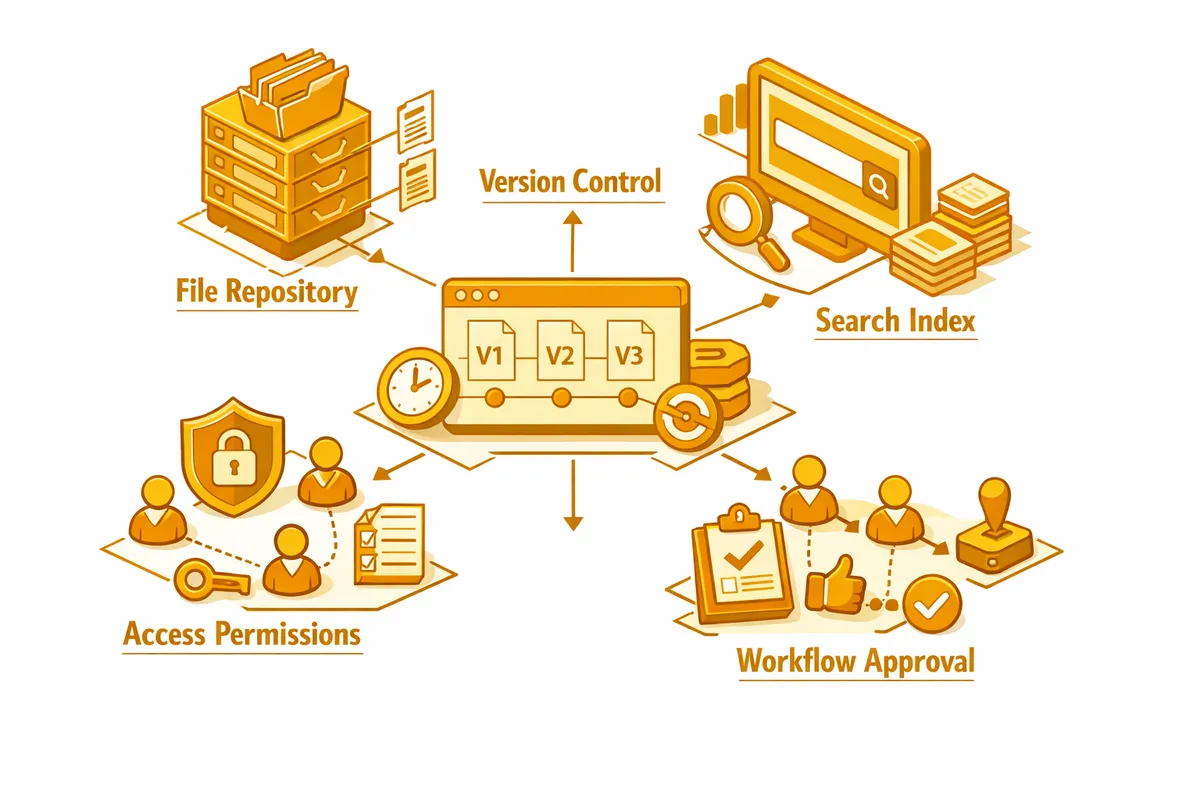
2. Taxonomy and architecture designed for your business. We design a document classification structure that matches the operational reality of your specific business type. A contractor and a preschool have different document universes. The system is designed for yours, not adapted from a generic template.
3. Implementation and migration. We build the system and migrate existing documents with consistent organization applied during the process. Paper files are scanned and indexed. Digital files are reorganized and metadata-tagged. For Irving Park businesses with long operational histories, we prioritize active and compliance-critical documents first and migrate historical records in a second phase.
4. Staff training matched to your team. Post-launch training designed for the Irving Park businesses reality: owners and staff who are practical, not tech-oriented, and who need a system they can use without ongoing support for routine tasks. We train on the specific workflows each role performs and stay available during the adoption period for questions.