How We Build for Hyde Park
Our process begins with research into the specific users, workflows, and contexts of your Hyde Park organization. For a Polsky Center startup, this means understanding the personas of both the enterprise buyer who evaluates the product and the end user who uses it daily, and recognizing that these are often different people with different needs and success criteria. For a healthcare application, this means understanding the clinical workflow context where the product will be used, the cognitive demands that context already places on users, and the specific failure modes that bad UX creates in clinical settings.
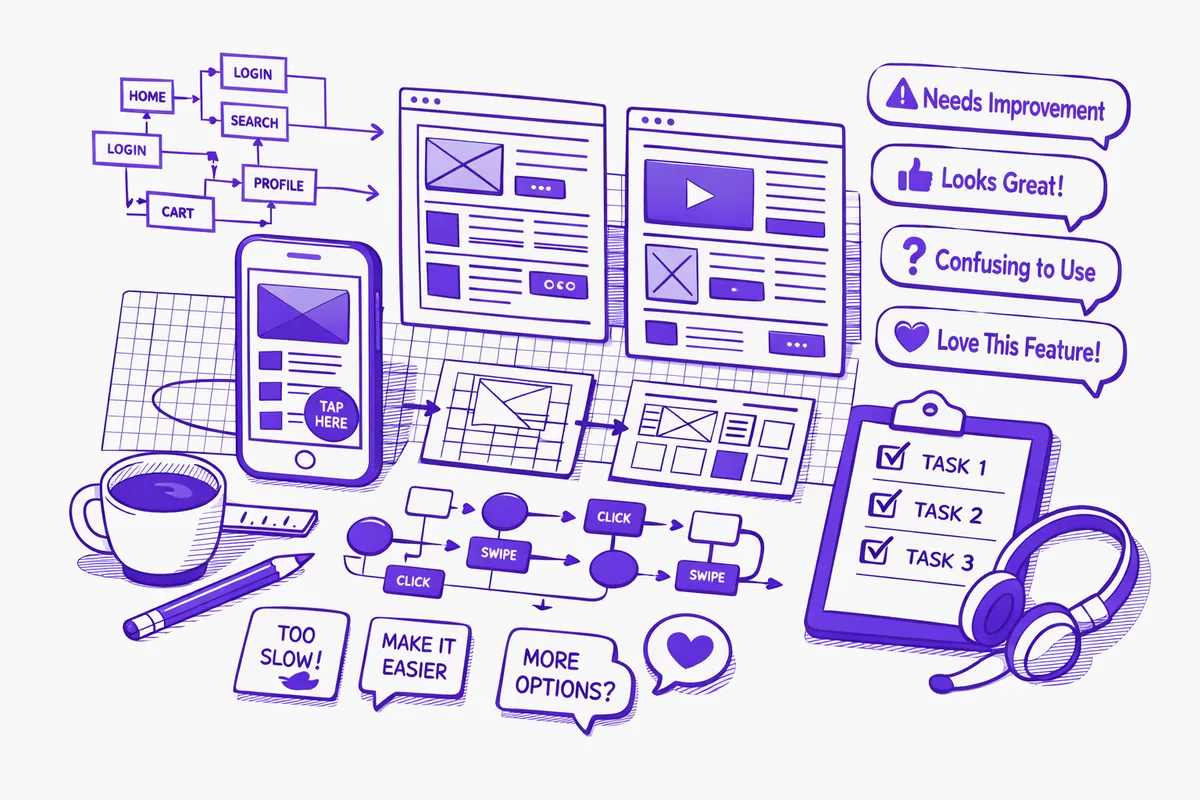
Wireframes establish the information architecture and user flow before any visual design begins. Showing wireframes to stakeholders and representative users at this stage is significantly more efficient than designing high-fidelity interfaces that require structural changes based on usability testing. For Hyde Park's academic and research clients who have institutional review processes, the wireframe stage is the right checkpoint for that review, not the high-fidelity prototype stage.
High-fidelity interface design follows approved wireframes, building design systems in Figma that document every component with the specifications developers need for accurate implementation. For Hyde Park's technically sophisticated development teams at Polsky Center ventures and research organizations, detailed design system documentation reduces implementation ambiguity that otherwise produces design drift.
User testing in Hyde Park benefits from proximity to the university population. We can recruit test users from the UChicago community for academic and research applications, from the hospital staff community for healthcare applications, and from the broader South Side neighborhood for community-facing applications. Testing with representative users rather than internal stakeholders catches usability issues that everyone familiar with the product cannot find because they know it too well.
Industries We Serve in Hyde Park
Polsky Center startups and UChicago academic ventures building software products for healthcare, legal, financial services, or research markets need UI/UX design that satisfies both the enterprise buyer's procurement evaluation and the end user's daily adoption test. We design for both simultaneously rather than treating them as separate problems.
Healthcare technology and patient-facing applications for practices adjacent to UChicago Medicine and for digital health ventures in Hyde Park require clinical-grade UX that balances compliance constraints with the usability standards that clinical adoption requires. HIPAA-compliant session management and access control design are built into the flow, not bolted on as friction.
Research tools and academic software for UChicago departments and affiliated centers need user interfaces designed for the specific cognitive context of research work: complex data relationships, precise terminology requirements, and workflows that must accommodate the non-linear nature of actual research practice.
Nonprofits and community organizations throughout Hyde Park need UX design that serves their community authentically, works for users across a full range of digital literacy levels, and reflects the quality of their mission in every interaction, from first website visit to ongoing staff tool use.
Local business and neighborhood service applications serving the Hyde Park community need UX calibrated to the neighborhood's mixed user base: the international academic, the South Side family, the hospital professional, and the longtime neighborhood resident, all of whom may use your product and all of whom bring different assumptions.
What to Expect Working With Us
1. Discovery and research. We understand your users, your business or mission context, and the specific failure modes that bad UX creates for your application. For Hyde Park's healthcare and academic clients, this phase includes compliance mapping and workflow analysis that shapes every subsequent design decision. We review existing analytics and interview representative users before making recommendations.
2. Information architecture and wireframing. We design the structure before the surface. Information architecture defines how features and content are organized. Wireframes establish flow and layout without visual design distraction. We conduct lightweight usability testing on wireframes before committing to high-fidelity work, which catches structural problems at the lowest-cost point in the design process.
3. High-fidelity design and prototype. We build complete interface designs in Figma with interactive prototypes that let stakeholders and test users experience the product before any code is written. Design systems document every component for developer handoff.
4. Testing and iteration. We test prototypes with real users drawn from your actual user population. For Hyde Park organizations, this often means recruiting from the university community, the hospital staff community, or the neighborhood's residential population depending on the application. Findings drive final design revisions before development handoff.