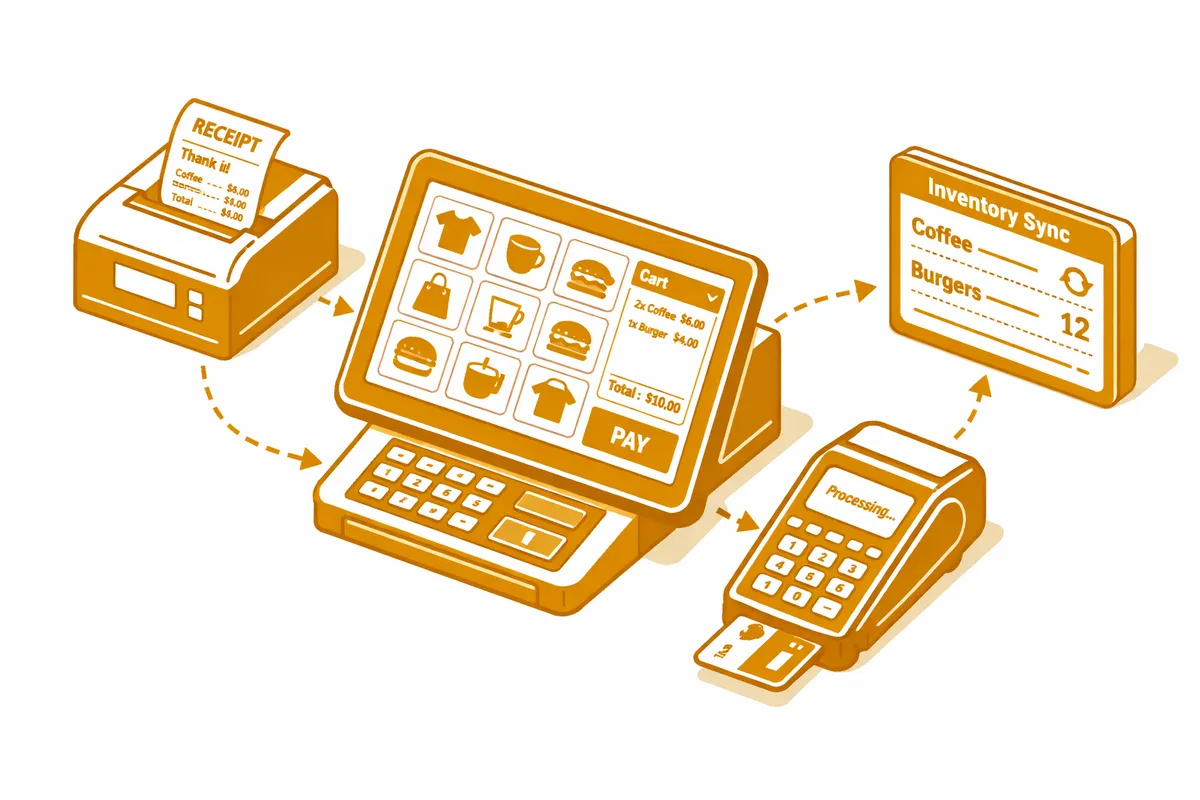
How We Build POS Systems for Hyde Park
We begin every POS engagement by observing the operation. We come to 53rd Street, to Harper Court, to the 57th Street commercial cluster, and we watch how the business actually runs: how customers queue, how staff moves between stations, how modifiers and special requests are handled, how split transactions occur, and where the current POS creates friction that staff has learned to work around without thinking about it. Those workarounds are the most important information in the discovery process. They tell us exactly where the current system fails to support the operation.
From that observational base, we design POS interfaces that match the workflow rather than requiring the workflow to match the interface. For a Hyde Park restaurant with a loyal regular customer community, we design customer lookup interfaces that surface purchase history quickly. For a cafe with complex modifier requirements for dietary accommodations, we design modifier logic that reflects the actual complexity of the menu rather than forcing staff into workaround sequences. For a retailer with consignment and variable pricing structures, we design pricing logic that handles those structures natively.
We build load testing scenarios that reflect Hyde Park's specific peak conditions: a Friday lunch rush during the academic year, a Saturday afternoon with MSI visitors in the neighborhood, a holiday weekend when the university community is smaller but the general neighborhood traffic increases. Reliability under actual peak conditions, not generic bench tests, is the standard we build to.
Industries We Serve in Hyde Park
Full-service and casual restaurants on 53rd Street, near the 57th Street cluster, and throughout Hyde Park's commercial corridors need POS systems that handle the neighborhood's diverse customer mix, manage academic-year versus summer volume patterns, and support the loyal regular customer relationships that define Hyde Park's neighborhood restaurant culture.
Cafes and coffee shops serving the academic community near the UChicago campus need POS interfaces that handle high-speed transaction volumes during class break rushes, support loyalty programs calibrated to the repeat-visit frequency of faculty and student regulars, and manage the complexity of customized beverage orders without slowing transaction times.
Independent retail businesses in Harper Court, along 53rd Street, and the bookstore corridors near Powell's and Seminary Co-op manage inventory, consignment arrangements, and customer relationship patterns that generic retail POS handles inconsistently. Custom POS built for their specific inventory and pricing structures eliminates the workarounds that currently consume staff time.
Food and specialty businesses including Hyde Park Produce and similar neighborhood staples manage inventory, pricing, and customer loyalty in ways that reflect the specific demands of a diverse neighborhood grocery and specialty food economy.
Service businesses including salons, studios, and personal service providers throughout Hyde Park use POS integrated with appointment scheduling, service upsells, and client relationship management in operational environments where the customer relationship is the core business asset.
What to Expect Working With Us
1. Discovery and operations review. We observe your operation in practice and conduct a detailed walkthrough with your team covering the workflows, pain points, and capabilities you need. We document requirements before recommending a technical approach, and we ask about the workarounds your staff has developed, because those are the most accurate guide to what the current POS cannot do.
2. System design and specification. We design the POS architecture covering screen flows, modifier logic, reporting structures, loyalty features, integration points, and hardware specifications for your environment. You review and approve the design before any development begins.
3. Build, configure, and load test. We build and configure the system, populate it with your actual menu and inventory data, and test under load scenarios that reflect Hyde Park's specific peak conditions. For businesses near the university, this includes academic-calendar-driven volume simulations.
4. Staff training, soft launch, and go-live. We train your team, run a soft launch period to identify operational refinements, and execute go-live with on-site support during the initial high-volume shifts. For Hyde Park businesses, we time launch windows to avoid the highest-volume periods, typically scheduling go-live for lower-traffic periods rather than during the academic year's busiest weeks.