How We Build No-Code Tools for Hyde Park
Our engagement begins with discovery that is honest about fit. We evaluate your specific use case against the capabilities of relevant no-code platforms and tell you clearly when no-code is the right answer and when custom development would actually serve you better. For Hyde Park's academic and nonprofit clients with limited budgets, this honesty is especially important: a no-code project that gets rebuilt six months later because the platform was wrong costs more than taking the time to choose correctly at the start.
Platform selection for Hyde Park clients typically follows clear patterns. Airtable for relational data management and operational workflow tools where the primary users are staff managing records and tracking program activity. Webflow for marketing sites and content-driven web presence that non-technical communications staff need to maintain. Bubble for authenticated web applications with user accounts, database logic, and multi-page workflows. Retool for internal dashboards and admin tools that need to query existing databases or APIs. We recommend the platform that fits the use case rather than the one we happen to prefer.
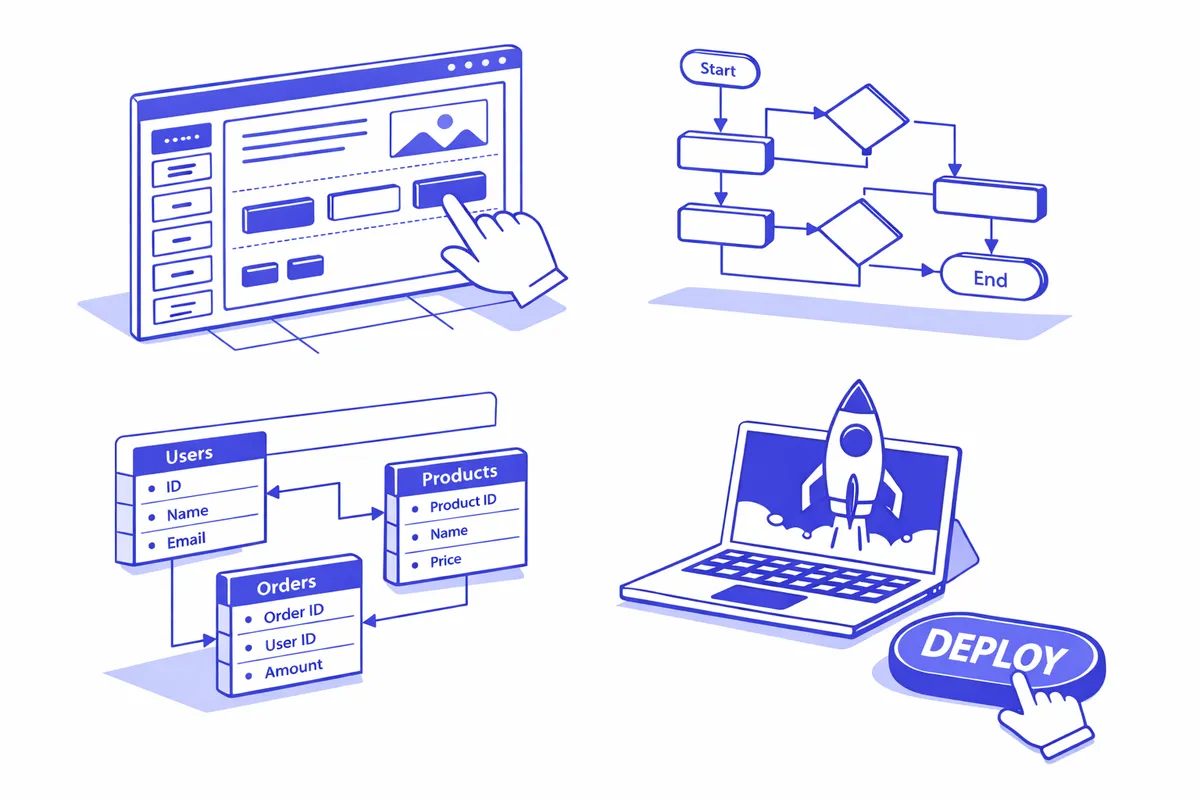
Data model design happens before any platform configuration begins. Getting the data model right from the start prevents the expensive rebuilds that happen when tables are structured in ways that cannot support the queries and automations the business actually needs. For Hyde Park's academic organizations, data governance requirements often shape the data model in ways that generic no-code tutorials never address. We build those requirements into the model from the beginning.
Implementation includes third-party integration with the systems Hyde Park organizations already use: Google Workspace for academic and nonprofit clients, Stripe for organizations collecting payments, Salesforce or HubSpot for those with existing CRM investments, and the various research and healthcare-specific platforms that UChicago-adjacent organizations manage. We connect no-code tools to existing systems rather than treating them as isolated replacements.
Industries We Serve in Hyde Park
Nonprofits and community organizations at the Experimental Station, Hyde Park Art Center, and throughout the neighborhood use no-code platforms for program management, donor tracking, volunteer coordination, grant reporting, and client case management within budgets that do not support custom development.
UChicago research centers and academic administrative offices use no-code tools for internal workflow management, research participant coordination, grant tracking, and the operational processes too specific to their unit's needs for enterprise software to serve well.
Medical practices and healthcare organizations near the UChicago hospital campus use no-code for patient communication coordination, referral tracking, scheduling management, and administrative workflows that clinical staff need to manage without depending on an IT department.
Polsky Center startups and early-stage ventures use no-code to build MVPs that validate product-market fit before committing to custom development investment, and to build operational tools that support founding team efficiency while engineering resources focus on core product.
Small businesses on 53rd Street and Harper Court use no-code for operational management: inventory tracking, appointment scheduling, customer communication, and the internal coordination tools that allow small owner-operated businesses to run efficiently without hiring a developer.
What to Expect Working With Us
1. Discovery and platform recommendation. We understand your specific operational problem, evaluate relevant no-code platforms against your requirements, and provide a clear recommendation with transparent reasoning. We also tell you honestly if custom development is actually the right answer for your use case, which matters for Hyde Park organizations where resources are finite and misallocated investment has real cost.
2. Data model and architecture design. We design the data model and application structure before configuration begins. For Hyde Park's academic and regulated clients, this phase includes data governance requirements review. You review and approve the architecture before we proceed to implementation.
3. Build, integrate, and test. We build the application according to the approved specification, configure integrations with your existing systems, set up automations, and test against your actual operational data and use cases rather than sample data that does not reflect your real complexity.
4. Training and handover. We train your team on managing and extending the application, document the data model and workflows, and deliver the application with everything your team needs to maintain it independently. For Hyde Park nonprofits with regular staff turnover, documentation quality is a critical deliverable, not an afterthought.