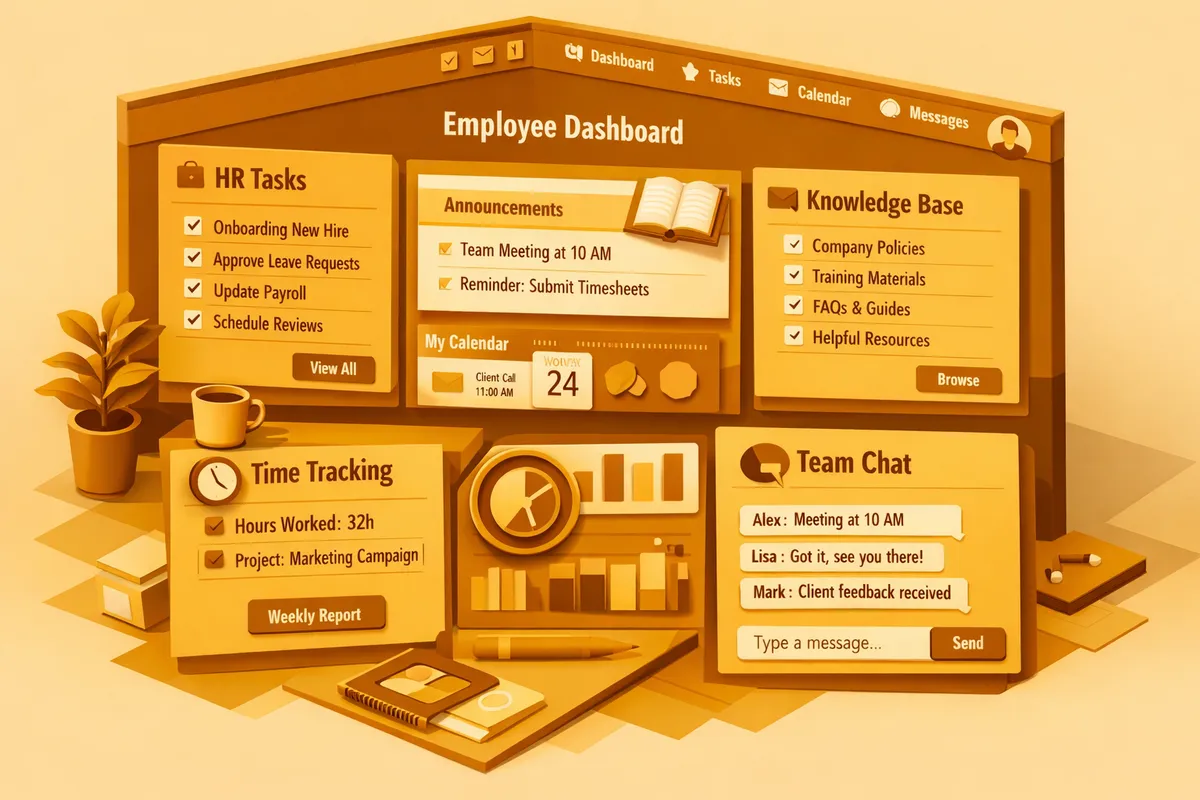
How We Build Employee Portals for Hyde Park
We begin with structured interviews across your employee population. Not just HR and management, but frontline staff, clinical employees, program workers, and the role types whose daily experience the portal will most directly affect. We map every HR process currently handled manually, identify which are strongest candidates for self-service, and understand which processes require custom logic for your organization's specific structure.
Role-based access is designed at the workflow level, not just the data access level. A clinical staff member in a Hyde Park medical practice needs different portal capabilities than an administrative coordinator in the same practice. A program staff member in a grant-funded nonprofit needs different time-tracking and expense reporting workflows than the development director who sits in the same organization. We design these distinctions into the portal architecture rather than treating all employees as a uniform user group.
Compliance workflows are designed into the portal from the beginning. Chicago and Illinois employment law requirements are mapped during discovery and embedded in the portal's operational logic rather than surfaced as manual reminders. Paid sick leave accrual and tracking happen automatically based on hours worked. Required training completion deadlines generate alerts before they arrive rather than after they pass. I-9 re-verification windows are tracked and flagged without requiring HR staff to maintain a separate calendar of compliance deadlines.
Industries We Serve in Hyde Park
Healthcare Practices and Clinical Organizations: Medical practices and specialty groups near UChicago Medicine manage clinical staff with credentialing, licensing, continuing education, and scheduling requirements that generic HR portals handle poorly. We build portals with clinical-specific modules that track license expiration, CME completion requirements, and credentialing documentation alongside standard HR self-service.
Nonprofits and Grant-Funded Organizations: Hyde Park nonprofits with grant-funded staff positions need portals that track position-level grant funding, connect employee time records to grant expenditure reporting, and manage the documentation that grant compliance requires. Position-level financial coding and time tracking that feeds grant reports automatically reduces the administrative burden that grant compliance currently places on program staff.
Educational Organizations and Training Providers: Educational service providers managing instructor relationships need portals that handle part-time employment, independent contractor classification, session-based scheduling, and the payment workflows specific to instructional work. The distinctions between employed and contracted instructors create HR complexity that custom portals handle cleanly.
Research Commercialization Startups: Polsky-backed companies and research spinouts need employee portals that provide onboarding automation, benefits enrollment, time-off management, and HR policy access from the first hire without requiring a dedicated HR hire to administer the infrastructure manually. A well-designed employee portal gives a small Hyde Park startup the operational HR infrastructure of a much larger organization.
Professional Services Firms: Attorneys, consultants, and advisors serving the Hyde Park professional community manage employee relationships with specific professional development, credential tracking, and compliance documentation requirements. Portals that handle these requirements alongside standard HR self-service reduce administrative burden on both HR and professional staff.
What to Expect Working With Us
1. Workforce and workflow mapping. We interview staff across roles and locations, map every HR process currently executed manually, and identify which are best automated through portal self-service, which require custom logic for your organizational structure, and which genuinely require human coordination. This mapping shapes every subsequent design decision.
2. Role architecture and compliance design. We design role-based access structures, compliance workflow logic, and integration architecture. Chicago and Illinois compliance requirements are explicitly mapped before design begins. Portal capabilities are designed around your specific organizational structure rather than a generic HR template.
3. Phased build with core self-service first. Core HR self-service capabilities, time-off requests, schedule access, benefits information, and policy documentation, are live within eight to twelve weeks. Compliance automation, advanced scheduling, and specialized modules for clinical or grant-funded staff follow in subsequent phases.
4. Launch, adoption support, and ongoing development. We train HR staff on portal administration and all staff on self-service capabilities. Usage analytics track adoption by feature and role type, identifying where additional training or interface improvements are needed. Ongoing retainers support compliance updates, new module development, and integration maintenance as your organization evolves.