How We Build Document Management for Hyde Park
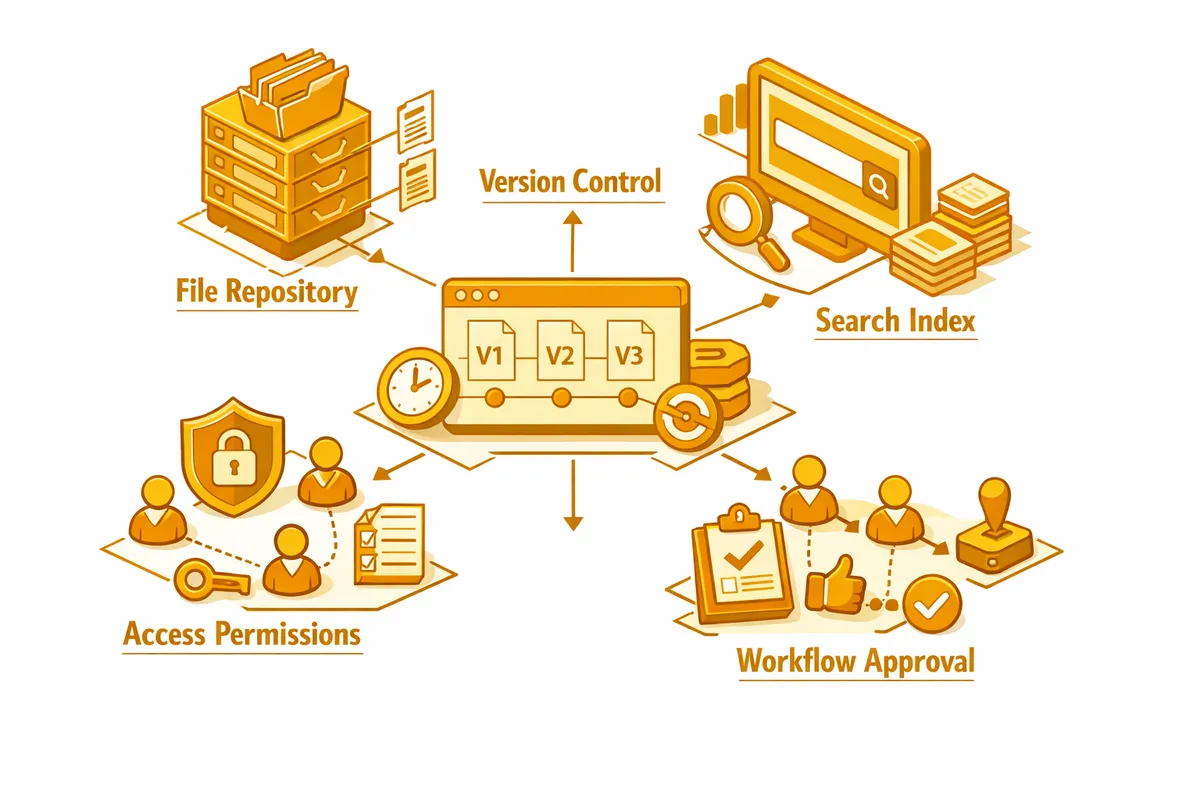
We begin with a document audit. We catalog your existing document types, volumes, and locations. We identify the compliance requirements that apply to specific document categories: HIPAA retention requirements for patient records, grant funder requirements for program documentation, bar association requirements for client matter records. We map who needs access to which document types and under what circumstances. This audit produces the design specifications for a document management system built around your actual requirements rather than a generic template.
Document taxonomy is the foundational design decision. The categories, subcategories, and metadata attributes that determine how documents are organized and retrieved must reflect how your organization actually thinks about its documents, not how a document management software vendor assumed a generic organization would think. For a Hyde Park nonprofit, the taxonomy might be organized around grant cycles, programs, and funder requirements. For a law firm, around client matters, practice areas, and document types. For a healthcare practice, around patient records, administrative documents, and compliance categories. We design the taxonomy through structured workshops with the staff who actually find and use documents day to day.
Access controls are designed document-category by document-category based on the roles that need access and the sensitivity of each category. For law firms, ethical wall enforcement that prevents staff on one matter from accessing documents for conflicting matters is a professional responsibility requirement. For nonprofits with multiple program areas and restricted grant funds, document access control prevents staff in one program from viewing financial documents that belong to a different grant. For healthcare practices, access controls that limit patient record visibility to treating providers are HIPAA technical safeguard requirements.
Industries We Serve in Hyde Park
Nonprofits and Grant-Funded Organizations: Grant compliance documentation, program records, board governance documents, donor correspondence, and policy documentation all benefit from organized, searchable, version-controlled storage. We build nonprofit document management systems that generate the documentation trail compliance audits require as a byproduct of normal document operations, rather than as a separate documentation effort at audit time.
Legal Services and Law Firms: Hyde Park-area law firms and legal service organizations managing client matters, intake documentation, pleadings, contracts, and correspondence need matter-centric document management with ethical wall controls, version control, and full-text search. Finding the right document in seconds rather than searching through email threads for twenty minutes is a productivity and risk management investment that pays back immediately.
Healthcare Practices and Clinical Organizations: Medical practices near UChicago Medicine need HIPAA-compliant document systems for patient consent forms, insurance authorizations, clinical correspondence, and administrative documentation. Access controls, audit trails, and retention policy enforcement are architectural requirements, not configuration choices.
Research and Academic Organizations: Research organizations managing IRB protocols, data use agreements, grant documentation, and scientific records need document management with the version control and access management appropriate to their regulatory context. Academic spinouts operating in multiple regulatory contexts simultaneously need systems that handle each context's requirements without creating separate document silos.
Educational Organizations: Test preparation companies, tutoring organizations, and educational service providers manage student records, curriculum materials, instructor agreements, and compliance documentation that organized document management makes accessible to appropriate staff at the right moment.
What to Expect Working With Us
1. Document audit and taxonomy design. We catalog your document environment, map compliance requirements, and design the organizational taxonomy through workshops with the staff who actually use documents. The audit reveals the specific gaps and risks in your current document practices that the new system addresses. Compliance requirements are documented before design begins so the system satisfies them from launch.
2. Access control and retention policy design. We design role-based access controls and retention policies appropriate to each document category. For healthcare clients, HIPAA technical safeguard requirements shape access control design. For nonprofits, grant funder requirements shape retention policy design. For law firms, professional responsibility rules shape both.
3. Implementation and migration. We build or configure the document management system and migrate your existing documents, reorganizing them into the new taxonomy during migration rather than simply copying existing disorder into the new system. Deduplication and format standardization happen during migration.
4. Training, adoption support, and ongoing maintenance. Every implementation includes training for all document users, not just system administrators. Adoption monitoring identifies which document types and which user groups are engaging with the new system and where additional training or interface improvements are needed. Ongoing maintenance retainers cover taxonomy adjustments, retention policy updates, and integration maintenance.