How We Build Business Intelligence for Hyde Park
Every engagement begins with a data audit. We map the systems your organization uses, catalog the data each system generates, assess data quality and update frequency, and document the specific decisions your leadership team needs to make that they currently cannot make well. For Hyde Park nonprofits, those decisions are often program allocation, donor retention, and grant compliance. For practices and health tech companies, they are utilization, revenue cycle performance, and product engagement. For Polsky startups, they are customer acquisition, retention, and unit economics. The audit tells us what to build and in what order.
We design a data warehouse appropriate to your data volumes and query patterns. Hyde Park organizations typically benefit from cloud-based data warehouses that scale without requiring IT infrastructure management. We design the data models that make each source system's data consistent and joinable, so a query crossing donor records, grant disbursements, and program outcomes in a nonprofit's unified database produces accurate results rather than logical inconsistencies that reveal modeling shortcuts.
Data pipelines automate the extraction, transformation, and loading of data from each source system into the unified warehouse on the appropriate schedule. When the pipeline runs successfully, the dashboard your executive director reviews Monday morning reflects data current as of the prior evening without anyone spending Sunday night pulling reports. For organizations that currently spend meaningful staff time on report assembly, this pipeline value alone often justifies the investment before the analytical capabilities are even considered.
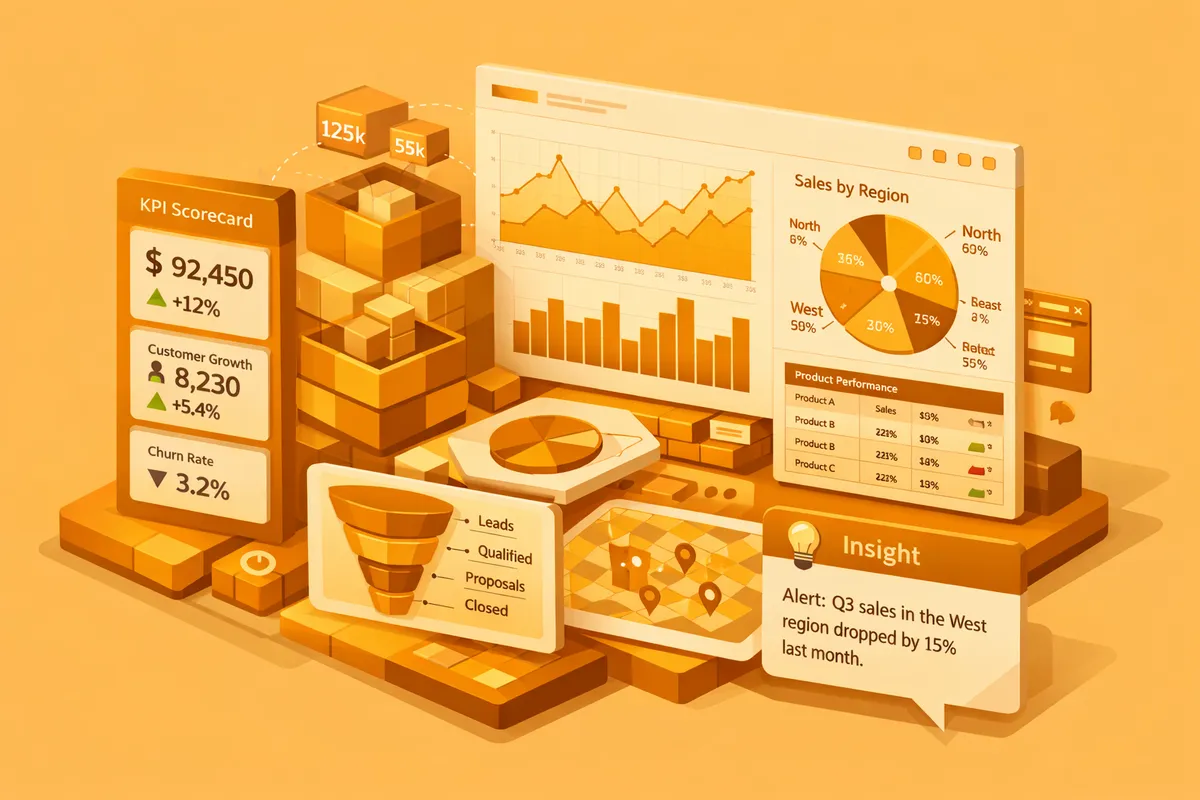
Dashboards are designed with your actual users in mind. The executive director of a Hyde Park nonprofit and the data analyst at a Polsky startup need different interfaces to access the same underlying data. We design role-appropriate views that surface the right level of detail for each user type, without requiring non-technical staff to construct queries or interpret raw data tables.
Industries We Serve in Hyde Park
Nonprofits and Social Impact Organizations: Hyde Park's concentration of mission-driven organizations depends on business intelligence that tracks program outcomes alongside financial performance. Grant funders want to see outcome data. Boards need financial visibility. Development teams need donor analytics. We build integrated nonprofit BI that connects these domains so every strategic conversation is grounded in current, accurate data rather than manual report assembly.
Healthcare Practices and Health Technology Companies: Medical practices clustered near UChicago Medicine and the health technology companies emerging from the medical campus's innovation programs need HIPAA-compliant analytics that separate protected health information from operational and financial analysis. We design healthcare BI architectures that surface clinical and operational insights within compliant frameworks.
Research Commercialization Companies: Polsky Center-backed companies bring exceptional intellectual rigor to their core disciplines, and their business analytics should match. We build BI for research commercialization companies that tracks the metrics critical to their growth: customer acquisition by channel, product engagement by cohort, revenue by customer segment, and the unit economics that determine whether the business model scales.
Independent Retail and Professional Services: The merchants and professionals along 53rd Street, Harper Court, and 57th Street operate in a competitive environment with slim margins. Business intelligence that accurately tracks inventory turn, customer retention, service utilization, and marketing channel effectiveness gives these businesses the operational precision that allows them to compete with larger operators who have internal analytics teams.
Academic Publishing and Educational Services: Hyde Park-based publishers, test preparation companies, and continuing education providers manage complex revenue recognition, content utilization, and student outcome data that requires purpose-built analytics to interpret meaningfully and act on strategically.
What to Expect Working With Us
1. Data audit and priority setting. We spend the first two weeks mapping your data environment, assessing data quality, and interviewing your leadership to understand which decisions are currently made with insufficient data. The output is a prioritized BI roadmap tied to specific organizational decisions, not a generic technical architecture.
2. Architecture design and review. We design the data warehouse structure, pipeline architecture, and dashboard framework before building anything. Hyde Park organizations with compliance requirements, especially healthcare and nonprofit grant compliance, review the data architecture before development begins to ensure every design decision meets their specific requirements.
3. Incremental delivery with working dashboards. We build in phases, delivering working dashboards at each milestone. Your executive director or operations lead is reviewing real dashboards built on real data within the first few weeks while the complete infrastructure is built alongside. This approach generates feedback that sharpens subsequent phases and produces a system shaped by actual use rather than theoretical requirements.
4. Training, documentation, and ongoing support. Every BI implementation includes training for the teams who will use the dashboards. For Hyde Park organizations where analytical sophistication varies across the team, we design training appropriate to each user group. Ongoing maintenance retainers cover pipeline monitoring, new metric additions, and dashboard refinements as the organization's data questions evolve.