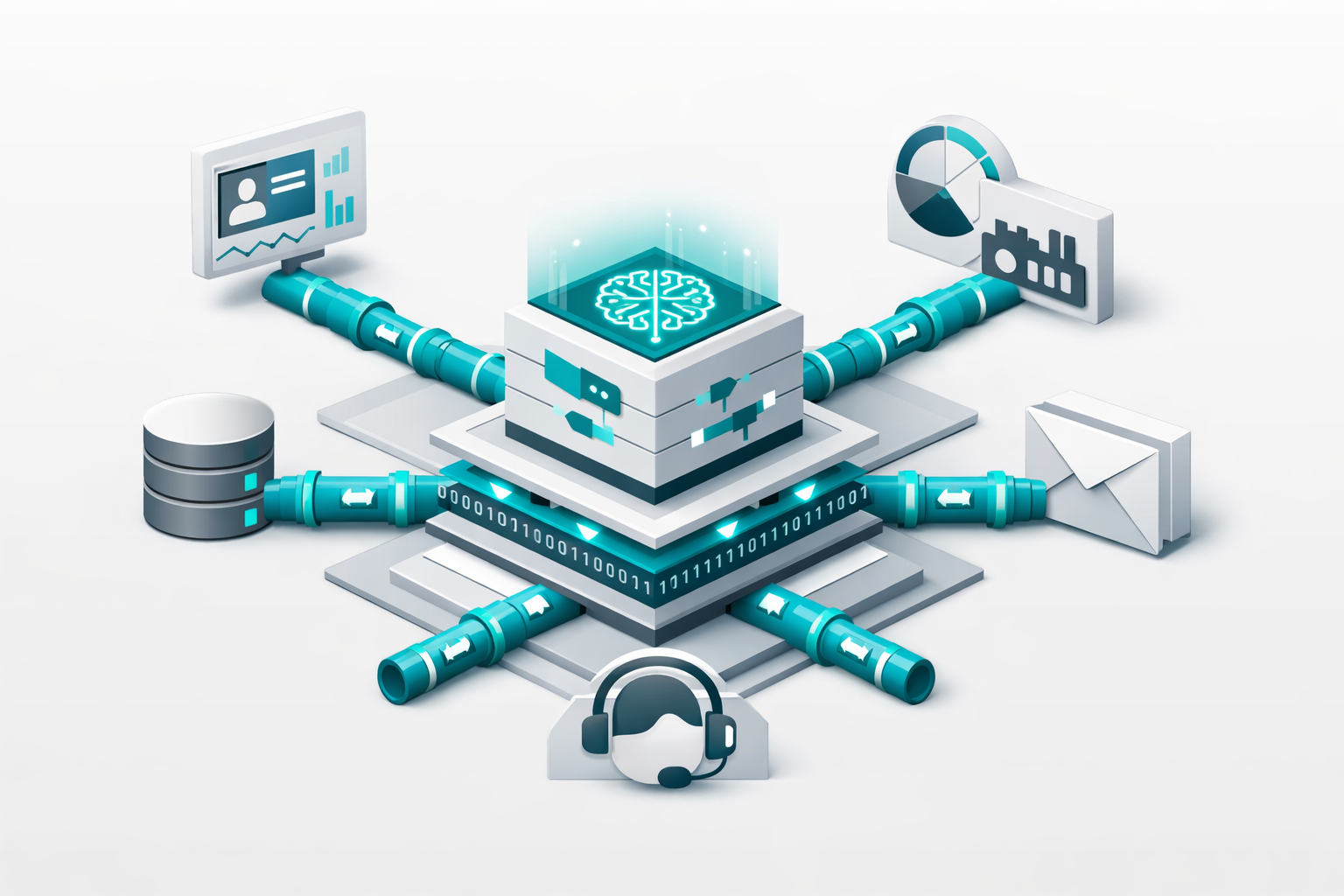
How We Build AI Integration for Hyde Park
Integration audit that maps the real handoffs. We observe how your team actually uses AI tools today and identify every point where humans are manually bridging AI capabilities and business systems. Each bridge point is an integration opportunity. For a UChicago Medicine-adjacent practice, that usually includes documentation transfer, patient communication, and administrative correspondence. For a nonprofit, that usually includes donor communications, grant reporting, and program documentation. For an academic publisher, that usually includes editorial review and production workflow.
Architecture grounded in the tools you already use. We build integrations around your existing technology stack. Epic and other EMR platforms for healthcare. Blackbaud and Salesforce for nonprofits and development organizations. Specialized editorial systems for academic publishers. Standard CRMs, project management tools, and content platforms for businesses across the neighborhood. We do not ask you to change your systems. We connect AI to them.
Security and compliance embedded from the start. For UChicago Medicine-adjacent healthcare clients, every integration respects HIPAA requirements, uses encrypted connections, and maintains audit trails that satisfy compliance review. For research clients, integrations respect IRB protocols and federal grant data handling requirements. For nonprofits with donor privacy obligations and grant-specific requirements, integrations maintain the data governance boundaries already in place. AI integration in Hyde Park is never just technical work. It is technical work that has to survive institutional review.
Error handling and observability. Every integration we build includes logging, monitoring, error handling, and rollback procedures. Your team sees what is flowing between systems, catches problems when they occur, and can disable or adjust integrations quickly if something needs attention. For regulated environments, the logging satisfies audit requirements. For operational environments, the observability supports ongoing optimization.
Documentation and handoff for long-term maintenance. We document every integration so your internal technical team can maintain it independently. For organizations without internal technical capacity, we offer ongoing support arrangements. Either way, the integration is built to be maintained, not as a custom artifact that only we can modify.
Industries We Serve in Hyde Park
UChicago Medicine-adjacent medical practices and specialty clinics integrate AI into Epic, EHR systems, practice management platforms, and patient communication channels. AI-assisted clinical documentation appears in provider inboxes, ready for review within the EHR. Patient communication drafts attach automatically to appointment workflows. Referral letter generation happens within the existing EHR workflow rather than in a separate AI tool. The AI becomes invisible infrastructure embedded in clinical practice rather than an additional application staff have to learn.
Research organizations and Polsky Center ventures integrate AI into research tools, data management platforms, collaboration systems, and custom applications. Research-commercial ventures often have unique integration requirements because their products themselves include AI, and the integration work is as much about embedding AI in their product as it is about embedding AI in their operational stack. We handle both.
Academic publishers and scholarly services integrate AI into editorial workflows, production systems, content management platforms, and author-facing interfaces. Editorial automation, peer review support, content discovery, and author onboarding all benefit from AI integration directly into the systems editorial staff and authors already use.
Nonprofits and community organizations across the South Side integrate AI into Blackbaud, Salesforce Nonprofit Cloud, DonorPerfect, program management tools, and grant reporting platforms. Donor communication, grant narrative drafting, program documentation, and volunteer coordination all accelerate when AI is embedded in the tools development and program staff already operate in.
Professional services firms along 53rd Street and Lake Park Ave integrate AI into practice management systems, billing platforms, document management tools, and client communication platforms. Document automation, client correspondence, and internal research work more efficiently when AI capability lives inside the same systems the firm already uses for matter management.
Retailers and restaurants on 53rd Street, 55th Street, and 57th Street integrate AI into POS systems, e-commerce platforms, email marketing tools, and social media management platforms. Product descriptions, menu updates, email campaigns, and customer service responses all accelerate with AI embedded in the systems the business already operates.
Cultural institutions integrate AI into membership platforms, ticketing systems, visitor databases, and educational program management tools. AI-assisted member communication, programming descriptions, and visitor engagement all happen within the existing institutional systems rather than in separate applications.
What to Expect Working With Us
1. Integration audit. We map current AI usage across your organization and identify every manual bridge between AI tools and business systems. Each bridge is a candidate integration. We document the systems involved, the data flows, and the triggers that initiate each workflow. The audit produces a prioritized list of integration opportunities with estimated impact and implementation complexity.
2. Architecture design. We design the integration architecture including which systems connect, what data flows between them, what triggers the AI, and where output lands. Architecture respects your existing security posture, regulatory obligations, and operational practices. Integration approaches use APIs, webhooks, and middleware layers that keep your existing systems intact.
3. Build, test, and deploy. Each integration is built with error handling, logging, and monitoring. We test with realistic data volumes and edge cases. Integrations deploy with rollback procedures in place. Documentation accompanies every deployed integration.
4. Launch and ongoing monitoring. Integrations go live with monitoring dashboards that track data flow, error rates, and AI performance. We provide documentation, troubleshooting guides, and a support period for questions that arise during the first weeks of operation. Monthly reviews identify optimization opportunities and new integration candidates as AI capabilities evolve and new business needs emerge.