How We Build AI Customer Service in Hyde Park
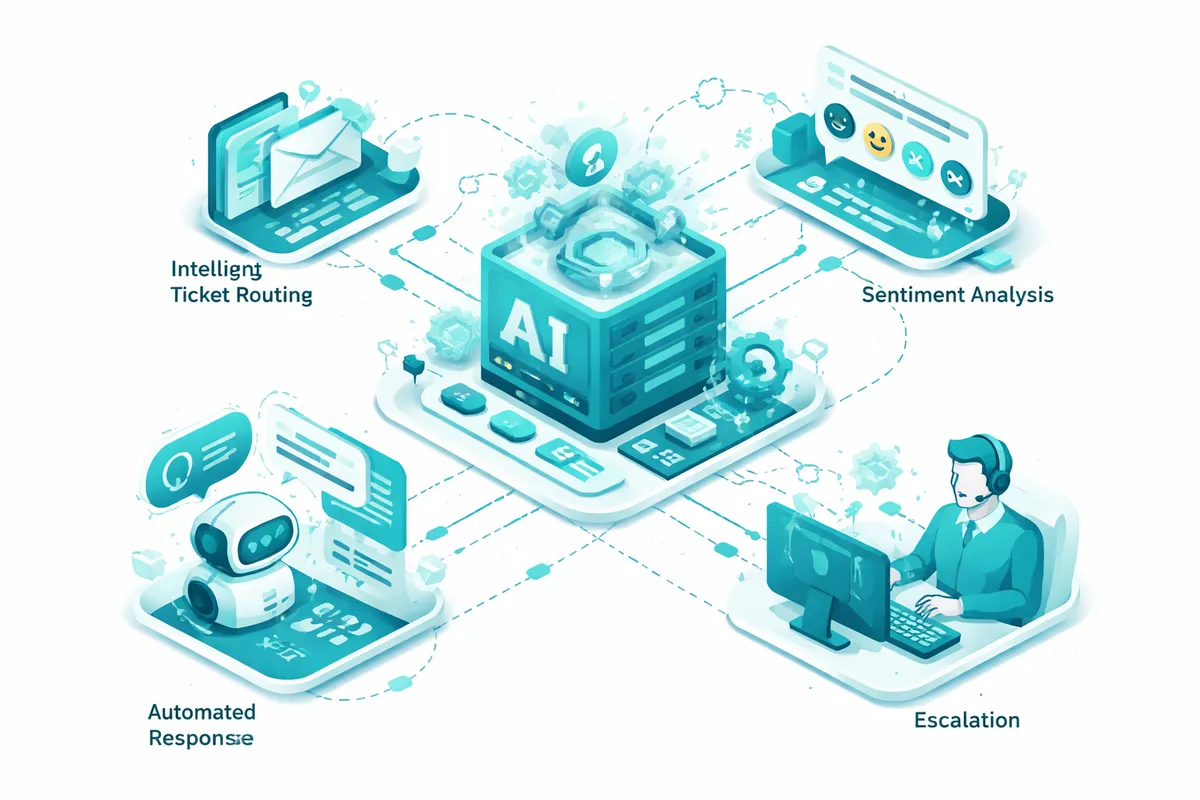
We start by auditing the actual questions your Hyde Park customers ask. Not the questions you assume they ask. We analyze your email threads, chat logs, voicemails, and social media inquiries to catalog real customer questions by category, complexity, and frequency. A bookshop near 57th Street Books gets a different knowledge base architecture than a restaurant on 53rd Street or a medical practice near UChicago Medicine. The knowledge base reflects your specific business and your specific customers.
For depth of knowledge, we go further than standard AI implementations. We ingest your complete product catalog, full policy documentation, FAQ archives, service descriptions, and any supplementary materials that help the AI answer with specificity. For businesses near the university, we configure multilingual support based on the language distribution of your actual customer base rather than a generic default list. Mandarin, Korean, Spanish, Arabic, and Hindi are common starting points for businesses serving UChicago's international community, and we configure based on your inquiry data rather than assumptions.
We integrate across every channel your customers actually use: web chat on your site, email inquiry management, social media DM handling for Instagram and Facebook, and phone-based AI for businesses with high call volume. Channel priority is set based on your inquiry data. A business on Dorchester Avenue that gets most of its questions through Instagram gets that channel configured first.
We align the system with the University of Chicago academic calendar so your AI is aware of the events and seasonal patterns that drive inquiry volume: orientation, quarter starts, finals, commencement, summer session, and the regular rhythm of conferences and visiting scholars that affect foot traffic throughout Hyde Park.
Industries We Serve in Hyde Park
Bookshops and specialty retailers near 57th Street and Seminary Co-op use AI customer service to handle the granular product inquiries that define this neighborhood's retail culture. A customer asking about a specific academic edition, a title availability by condition and format, or a special order process gets an accurate answer instantly rather than waiting for a staff member to check the system. The AI handles the volume of inventory questions during academic year peaks so your staff can focus on the high-value curation and recommendation work that distinguishes Hyde Park's independent bookstores from every alternative.
Restaurants and cafes along 53rd Street and near Harper Court automate reservation management, dietary accommodation inquiries, event booking for private dining, and the constant stream of questions that surge during university events. A restaurant near the Museum of Science and Industry fielding groups of convention visitors and Hyde Park regulars simultaneously manages both audiences through AI that routes complex requests to staff while handling routine inquiries automatically. The academic calendar creates predictable peaks around orientation and commencement that the AI absorbs without requiring additional staffing.
Professional service firms near campus, from legal practices to consulting firms to financial advisors serving the university community, use AI for initial client inquiry management. A prospective client who submits an inquiry at 9 PM on a Wednesday receives a substantive response and a scheduling prompt rather than a wait-for-business-hours message. The AI collects intake information before the first meeting, so the human conversation starts at a higher level and the client's first impression of the firm reflects a service standard that matches their professional expectations.
Medical practices and healthcare providers affiliated with or near UChicago Medicine on the 55th Street and Woodlawn Avenue corridor use AI to handle appointment scheduling inquiries, insurance and coverage questions, new patient intake processes, and the high volume of administrative questions that consume clinical staff time. A medical practice that handles these interactions through AI reduces the administrative burden on its front desk and delivers faster responses to patients who are often in the middle of a health situation that makes waiting frustrating.
Cultural institutions and nonprofits near the Museum of Science and Industry and along the lakefront use AI customer service to handle visitor inquiries about hours, accessibility, programming, group booking, and event registration. A cultural nonprofit that serves both the Hyde Park community and the broader South Side manages two distinct audience types through AI configured to distinguish between them, providing neighborhood context for local inquiries and orientation information for visitors coming from outside the area.
Academic publishers and research service firms embedded in the Hyde Park intellectual ecosystem use AI to manage correspondence from researchers, authors, and institutional clients across time zones and languages, ensuring that international partners and collaborators receive responses that reflect the organization's standards even when staff are not available.
What to Expect Working With Us
1. Deep inquiry audit and knowledge architecture. We analyze your complete incoming communication history to map the full range of questions your Hyde Park customers ask, their complexity distribution, and the language patterns present in your inquiries. The knowledge base is architected for depth, not just breadth. We go beyond FAQs to ingest your complete operational documentation, catalog data, policy details, and service specifics so the AI can answer the granular questions this neighborhood actually sends.
2. Multilingual knowledge base development. We configure multilingual support based on the actual language distribution in your customer base, drawing on UChicago's international enrollment data and your own inquiry history. Each language variant is trained to the same depth standard as the English base. A question asked in Mandarin receives the same quality of answer as the same question asked in English.
3. Academic calendar alignment and channel integration. We deploy across your priority channels and configure the system's seasonal awareness to the University of Chicago academic calendar. The AI understands that September and June drive different inquiry patterns than February, and that Finals Week generates a different volume and timing distribution than a standard week. Channels are prioritized by your inquiry volume data and launched in sequence to ensure each is stable before adding the next.
4. Ongoing depth optimization. We run monthly reviews of conversation logs, flagging questions where the AI underperformed and updating the knowledge base to address gaps. As the university calendar cycles and your business evolves, the system updates to stay current. New product lines, policy changes, and seasonal offerings are incorporated into the knowledge base through a structured update process rather than accumulating as gaps.