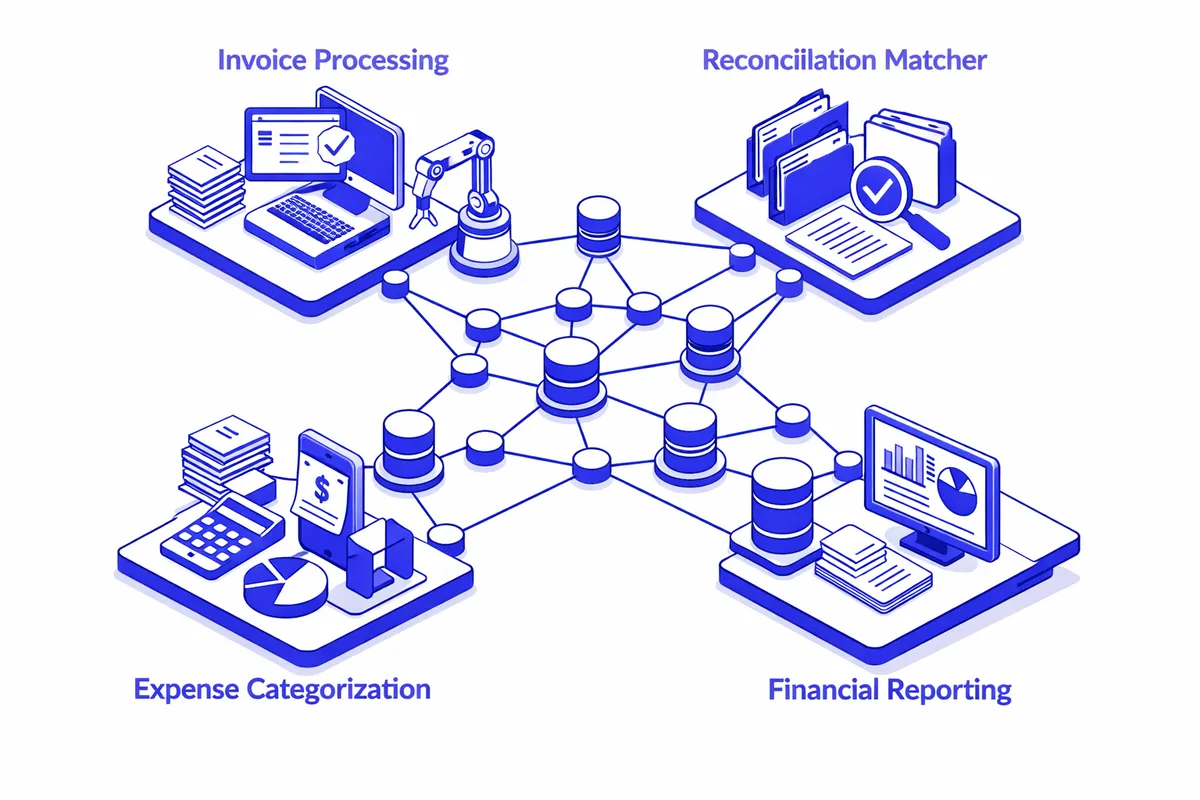
How We Build Accounting Automation for Humboldt Park
Discovery is relational, not transactional. We meet with owners or executive directors in their space when possible, often at a neighborhood coffee shop or the business itself if we can work around operational hours. We want to understand the actual reality of how the books are kept today. For a Humboldt Park restaurant, this might mean walking through the current end-of-day process with the owner, seeing where the POS reports get printed, where receipts go, and how the weekly bank reconciliation actually happens. For a community organization near the park, it might mean sitting with the executive director as she walks through the last three grant reports she assembled and pointing out where the data came from for each line.
From discovery, we identify the specific automation candidates with the highest impact for the specific business. For a family restaurant, we often start with daily sales reconciliation across POS, credit card processing, and delivery platforms. For a nonprofit, we often start with grant-level fund accounting and automated reporting. For a retailer, we often start with inventory receipts and vendor invoice processing. The starting point reflects where the pain concentrates, not a template assumption about what every business needs first.
Tooling choice is driven by your existing setup and budget. QuickBooks Online is the most common starting platform for Humboldt Park small businesses, and its native automation capabilities handle many use cases without additional tooling. Dext or Hubdoc add receipt capture and document management. Tools like LiveFlow or G-Accon handle custom reporting and Google Sheets integration for clients who still work in spreadsheets for specific workflows. For more complex needs, we layer custom integrations using Make or custom scripting. We do not push platform changes unless the business case is clear.
Implementation runs in phases to avoid disrupting an operation that is already functioning. We usually run the automation in parallel with your existing manual process for a period of two to four weeks, allowing you to verify the results match before cutting over fully. This parallel running is particularly important for restaurants and retailers during busy seasons when a broken reconciliation process would create real operational problems.
Training is hands-on and usually bilingual if that serves the team. We provide documentation in the language your team prefers. We train the people who will actually use the automation on how to handle the exceptions that require human judgment: the unusual invoice, the delivery platform chargeback, the grant expenditure that needs special coding. The automation handles ninety percent of the volume, and we make sure your team knows how to handle the ten percent that automation appropriately flags for human review.
Industries We Serve in Humboldt Park
Restaurants and food businesses along Paseo Boricua, on Division Street, and in the pockets of food commerce around the neighborhood benefit from daily reconciliation automation, vendor invoice processing, and the inventory cost accounting that eats hours of owner or manager time in operations that already run long days. Chicago's famously complex sales tax environment gets handled systematically rather than approximately.
Community nonprofits and cultural organizations rooted around the historic park, the Paseo Boricua flag arches, and the neighborhood's long history of community institutions benefit from grant-level fund accounting automation, automated funder reporting, and the compliance documentation that funders increasingly require. Nonprofits that automate their administrative reporting redirect executive director attention to program work.
Family-owned retailers along Division Street, particularly the businesses that have served generations of Humboldt Park families, benefit from vendor invoice automation, inventory receipt processing, and the sales tax handling that covers the intricacies of Chicago, Cook County, and Illinois rates correctly without requiring the owner to track rate changes manually.
Small service businesses including bilingual professional service firms, neighborhood health and wellness practices, and the independent contractors who serve the Humboldt Park community benefit from client invoicing automation, expense categorization, and the financial reporting that helps solo practitioners and small firms understand their actual profitability by service line or client.
Creative and cultural businesses including the artists, musicians, and event production professionals who are significant parts of the Humboldt Park creative ecosystem benefit from project-based accounting automation that tracks revenue and expense by engagement and produces the tax documentation that self-employed creative workers need without manual assembly.
Housing and community development organizations working in and around Humboldt Park manage complex fund accounting, compliance reporting, and tenant or participant financial tracking that automation handles at scale far better than manual spreadsheet approaches ever have.
What to Expect Working With Us
1. Discovery at your space. We meet in your restaurant, your office, or your shop when possible. We want to see how the books actually get kept, not just the summary version. This step typically runs two to three hours across one or two visits.
2. Automation roadmap with estimated hours saved. We produce a prioritized roadmap with specific estimates of how much time each automation will save monthly, what it will cost to build, and when you will see the benefit. You decide where to start based on what matters most to your operation.
3. Phased implementation with parallel running. We implement in phases and usually run the new automation in parallel with your existing process for two to four weeks so you can verify the results match. This approach prevents disruption during implementation.
4. Training and ongoing availability. We train your team on the automation and the exception handling it requires. We remain available for questions and for additional automation work if and when the business is ready for the next phase.