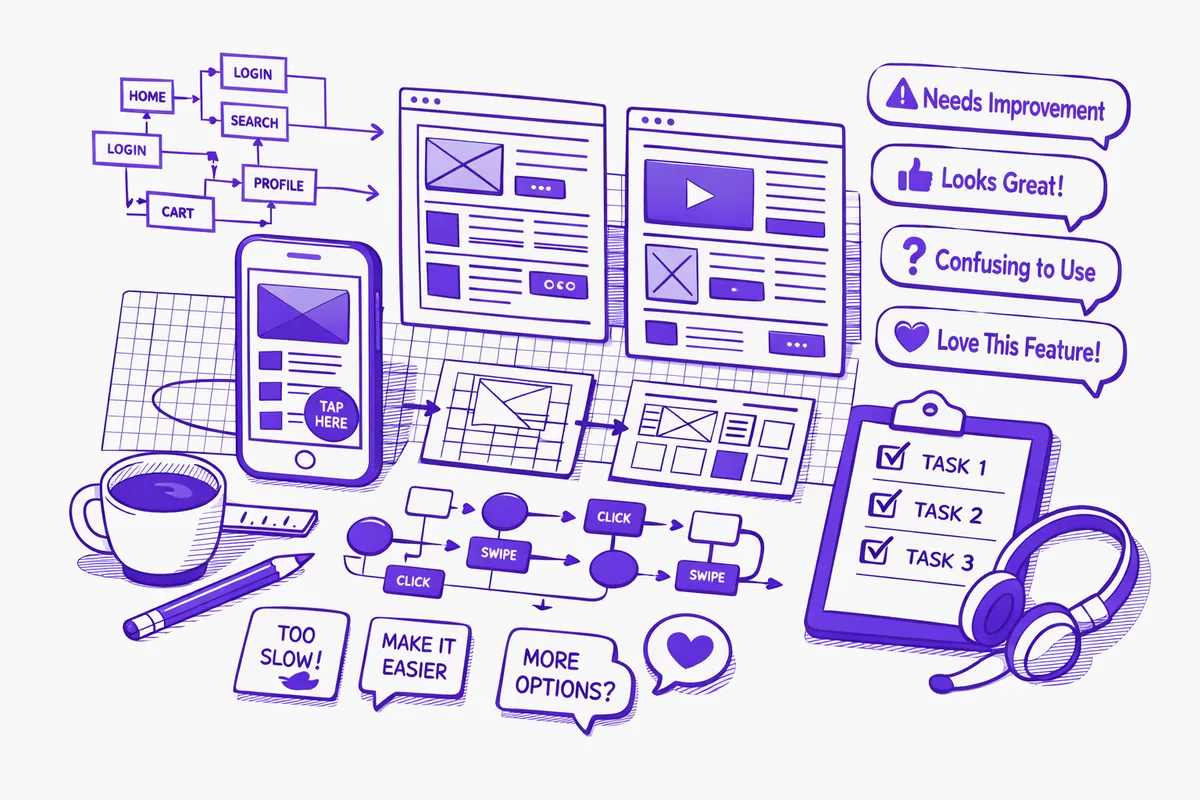
How We Build UI/UX Design for Hermosa
Hermosa's bilingual character shapes our entire design process, starting with research. We conduct user research with Spanish-primary and bilingual participants from the neighborhood, not just English-fluent early adopters who are more comfortable in research sessions. This means research materials in Spanish, sessions conducted in Spanish where participants prefer it, and analysis that accounts for the linguistic context of the responses. The insights from genuinely bilingual research are different from the insights produced by testing only with English-fluent participants, and those differences show up in design decisions that matter.
Our information architecture process for Hermosa clients examines terminology with particular care. Categories and navigation labels that are clear in English may have multiple Spanish translations with meaningfully different connotations. Form field labels that are standard in English may be confusing when translated literally. Error messages that are appropriately direct in English may feel harsh in Spanish. We work through these decisions deliberately, with native Spanish speakers reviewing label choices and error message wording before finalizing the information architecture.
Mobile design is especially important for Hermosa. The neighborhood's economic profile means that smartphones, often Android devices, are the primary and sometimes only digital access point for a significant portion of residents. Designs that degrade on lower-end Android devices, that require fast connections, or that are built around iOS interaction patterns are not well-suited to Hermosa's actual user context. We design for the real device range that Hermosa residents use.
Industries We Serve in Hermosa
Family Medical and Dental Practices. The family medicine, dental, and specialty health practices serving Hermosa near Pulaski Road and Armitage Avenue work with a patient population that benefits from genuinely bilingual digital tools. We design patient portals, appointment systems, and health communication interfaces in both Spanish and English, with each language fully designed rather than machine-translated.
Salons and Personal Care. The salons along Armitage Avenue and Fullerton Avenue serve a loyal clientele through appointment scheduling that currently happens by phone and in person. We design scheduling tools and customer communication platforms that are as easy to use for a Spanish-primary customer on a budget phone as they are for anyone else.
Taquerias and Food Businesses. Hermosa's family-run taquerias and food businesses near North Avenue and Pulaski Road serve regulars who know the menu and newcomers discovering the business for the first time. We design online ordering systems, digital menu platforms, and catering inquiry tools that serve both audiences in both languages.
Auto Repair and Trades. The auto repair shops and trades businesses that serve Hermosa's working households need scheduling, estimate, and communication tools designed for their customer base. A Hermosa auto shop's customers are often Spanish-primary; their digital tools should be too.
Community Organizations and Health Clinics. The community health organizations and social service nonprofits near Kelvyn Park and Our Lady of Grace Parish serve Hermosa's residents across a wide range of circumstances. We design accessible, bilingual digital tools for community organizations that need to reach every resident, not just those with strong English literacy and high-end devices.
Churches and Religious Organizations. Our Lady of Grace Parish and the churches that anchor Hermosa's community life increasingly need digital tools for community communication, event management, and member services. We design communication platforms and community engagement tools for religious organizations whose members communicate primarily in Spanish.
What to Expect Working With Us
1. Discovery and Bilingual Research. Research for Hermosa clients uses a participant pool reflecting the actual community: Spanish-primary, bilingual, and English-primary users from near Kelvyn Park High School, the Hermosa branch library, and Kelvyn Park itself. Sessions are conducted in the participant's preferred language. Findings are analyzed for patterns specific to each language community, not averaged across them.
2. Bilingual Information Architecture and Wireframes. Structure is designed simultaneously for both Spanish and English, not designed in English and translated. Navigation labels, form fields, error messages, and category names are reviewed by native speakers of both languages before wireframes are finalized. Low-fidelity wireframes are tested with bilingual and Spanish-primary participants before advancing to visual design.
3. High-Fidelity Bilingual Design and Prototyping. Precise visual design built in Figma for both languages, with interactive prototypes in each language that Hermosa clients and test participants can navigate. Design systems include both English and Spanish label sets, ensuring that switching between languages does not require rebuilding the interface.
4. Testing, Iteration, and Handoff. Prototypes are tested with Spanish-primary, bilingual, and English-primary participants separately, because usability findings often differ by language community. Issues found in Spanish testing are addressed before handoff. Developer documentation includes both language sets and specifies the expected behavior when users switch between languages.