How We Build RAG Systems for Hermosa
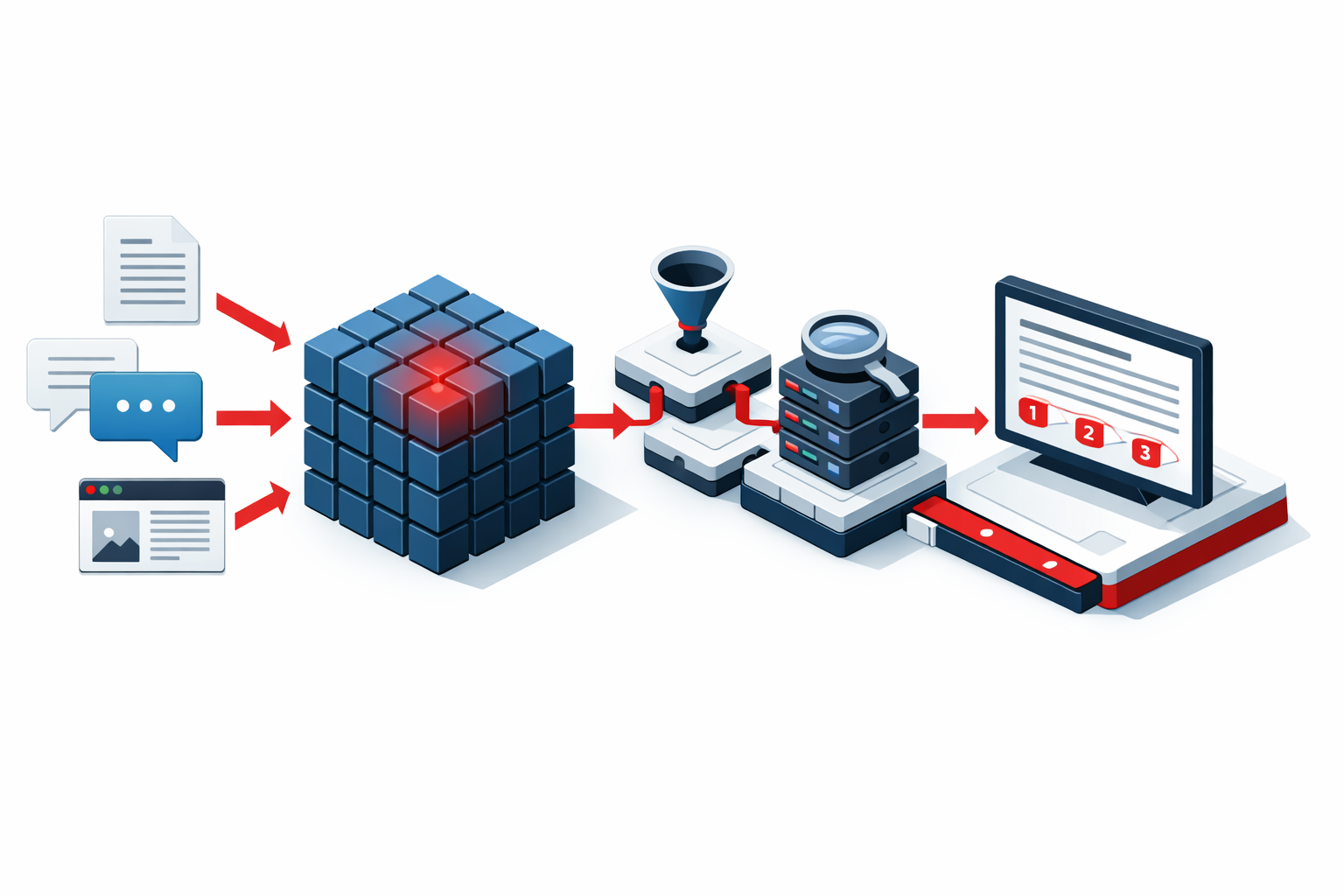
We start by identifying the knowledge assets the business actually holds. For an auto shop on Pulaski Road, that includes service pricing for common jobs, vehicle-specific notes about recurring issues, warranty and guarantee policies, and the shop's diagnostic process for different service categories. For a salon on Kostner Avenue, it is the full service menu with pricing by stylist experience level, product line information, appointment and cancellation policies, and the common client questions with standard answers. We document what already exists before determining what needs to be created.
We then structure that knowledge for accurate retrieval. Raw information captured from interviews, documents, and existing files needs to be organized so an AI can find and use it reliably. A question about insurance acceptance should retrieve the current payer list and accepted plan details, not a general statement about billing philosophy. Structure at the right level of specificity is what makes retrieval accurate.
The retrieval layer is built and tuned against real question patterns from the specific Hermosa business. We collect actual questions customers ask, questions staff ask internally, and questions new employees typically need answered in the first weeks. We test retrieval accuracy against those real patterns, not against hypothetical queries. A question phrased in Spanish should retrieve the same information as the same question in English.
We deploy the system in the channels where the business's customers and staff actually need it. For customer-facing use, that might be a chat interface on the website, a WhatsApp Business integration, or a phone-connected interface for after-hours inquiries. For internal staff use, it might be a simple query interface accessible from a tablet at the front desk.
Industries We Serve in Hermosa
Auto repair and mechanic shops on Pulaski Road and Kostner Avenue use RAG systems to make accumulated service knowledge accessible to front desk staff handling customer inquiries, to give customers self-service pricing and availability information after hours, and to accelerate new technician onboarding by making the shop's accumulated diagnostic knowledge about specific vehicle makes and years immediately queryable.
Family medical practices and clinics near Pulaski Avondale Medical and along the Kelvyn Park corridor use RAG systems for patient-facing knowledge about services, insurance plans, appointment policies, and practice procedures in Spanish and English. Front desk staff get consistent, accurate answers to common patient questions without needing to interrupt the physician or practice manager during appointments.
Salons and beauty businesses on Kostner Avenue use RAG systems to make service menu knowledge accessible to staff fielding booking calls, to give prospective clients a self-service way to understand services and pricing before they commit to an appointment, and to capture the style consultation knowledge experienced stylists have accumulated so it does not remain entirely person-dependent.
Carnicerias and specialty grocers near Fullerton Avenue and North Avenue use RAG systems to capture product knowledge about cuts, cooking methods, preparation recommendations, and seasonal availability. New staff have immediate access to the same knowledge the experienced owner holds. Customers can query cooking recommendations in Spanish without waiting for the owner to step away from the counter.
Community organizations and parish-connected groups near Our Lady of Grace Parish use RAG systems to make program information, registration procedures, eligibility requirements, and community resource knowledge accessible around the clock. Community members can query program details, event schedules, and registration requirements in Spanish or English without requiring staff availability.
Small professional offices near Armitage Avenue in legal, financial, or insurance services use RAG systems to capture service documentation, frequently asked client questions, and compliance reference information in a queryable format. Client service consistency improves and new staff training time decreases when institutional knowledge is accessible rather than locked in one person's experience.
What to Expect Working With Us
1. Knowledge audit and scope definition. We document the knowledge assets the business holds, identify the highest-priority use cases for a RAG system, and define the knowledge domains the system will cover in the first phase. We also identify what new knowledge needs to be captured through structured interviews before the system can be built, which is the situation for most Hermosa businesses where significant institutional knowledge has never been formally documented.
2. Knowledge collection and structuring. We collect knowledge through document review, owner and staff interviews, and existing materials like service menus, policies, and procedural documentation. We structure and organize the knowledge base for accurate retrieval across both Spanish and English queries before building the technical system. This phase is often where the most valuable discoveries happen for owners who have never systematically examined what they know.
3. System development and bilingual accuracy tuning. We build the retrieval and synthesis layers, test against real question patterns from the business, and tune accuracy against the specific query types the system will handle. Bilingual retrieval is configured, tested, and refined at this stage until Spanish and English queries produce equivalent quality results.
4. Deployment, staff training, and handoff. We deploy the system in the channels where it will be used, train staff on how to query it effectively and how to update the knowledge base when information changes, and document the process for keeping knowledge current as the business evolves. Most Hermosa businesses find the system most valuable in the first six months as new staff learn to rely on it rather than on the owner.