How We Build Document Management Systems for Hermosa
Discovery for a Hermosa engagement starts with a document audit that is frank about the reality of how small businesses actually operate. We are not looking for a clean baseline. We are mapping the actual state: what document types exist, where they live (paper, email, phone photos, shared drives, a single computer), who needs to access them, and what happens when they cannot be found. For an auto shop on Armitage Avenue, that audit typically reveals work orders in paper format, parts invoices mixed across email and paper, and customer records distributed across a shop management app, sticky notes, and memory. Making that visible is the first step toward building something better.
From the audit, we design the taxonomy specific to your business type. For a Hermosa auto shop, documents are organized around vehicles and customers, with sub-categories for work orders, parts documentation, warranty records, and customer authorizations. For a salon on Fullerton Avenue, the structure centers on supplier contracts, employee records, and service agreements. For a clinic serving Hermosa's families, organization follows patients and document types: intake, insurance, clinical notes, billing. The taxonomy is built around how your staff actually think about documents, not around what is standard in an enterprise software manual.
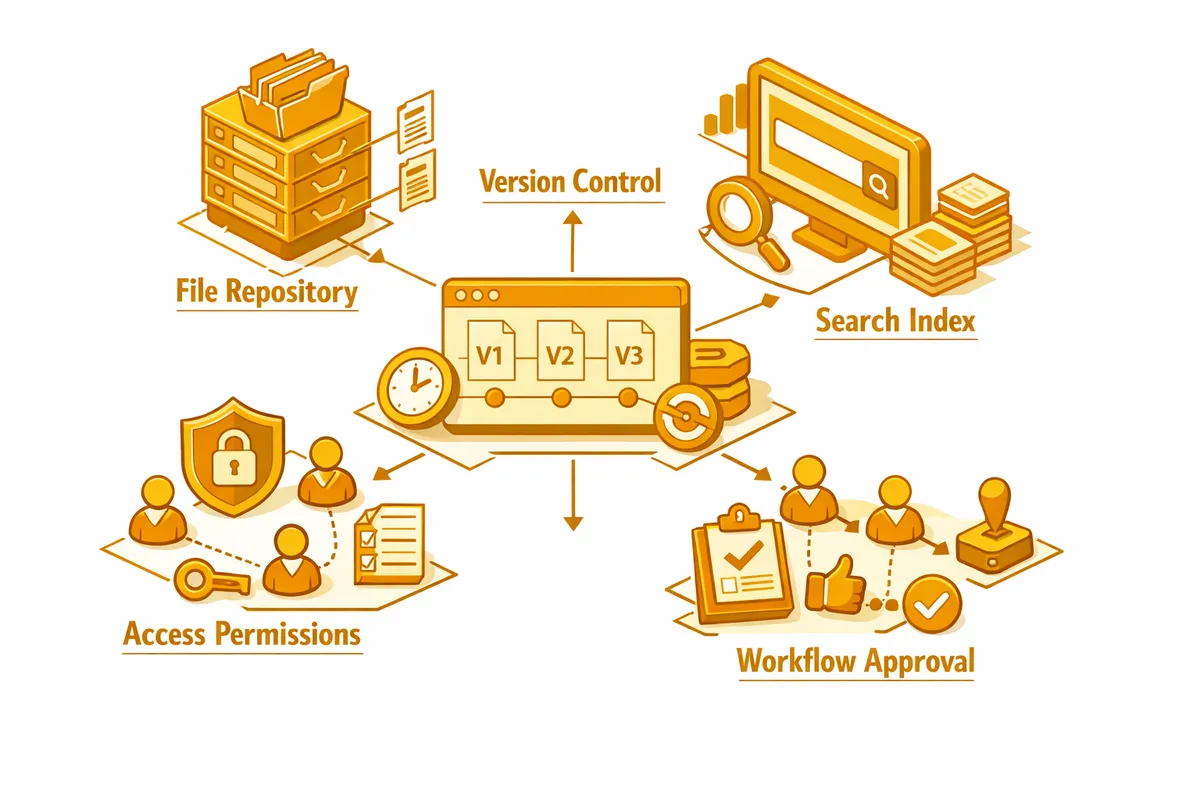
Implementation is designed for small teams without technical administrators. We build the system, migrate existing documents from paper and digital sources into the new structure, train your team on how to use it, and make sure it works on the devices your staff actually have. A Hermosa shop owner working from a phone and a tablet gets a system that works on both. We do not build solutions that require dedicated IT to maintain.
Industries We Serve in Hermosa
Auto repair shops and mechanics on Pulaski Road, Armitage Avenue, and throughout Hermosa need vehicle-centric document management for work orders, customer authorizations, parts invoices, and warranty documentation, with rapid retrieval by vehicle, customer, or date range so that any record can be produced in response to a customer inquiry or insurance request within minutes.
Taquerias, panaderias, and food businesses along Armitage Avenue and Fullerton Avenue need supplier contract management, vendor invoice organization, health permit documentation, and employee records maintained in a structure that survives staff turnover and keeps compliance documents findable when a health inspector arrives or a permit renewal comes due.
Salons and personal care businesses near Kelvyn Park and along North Avenue need product purchase records, supplier agreements, employee documentation, and service records organized so that a business owner can answer questions about any supplier relationship, employee record, or product history without searching through email and paper files for thirty minutes.
Family medical practices and clinics serving Hermosa's residential population need patient-centric document management with HIPAA-compliant access controls, retention policies that enforce Illinois and federal record-keeping requirements automatically, and audit trails that document who accessed which records and when, making compliance reviews manageable for a small practice without a dedicated compliance team.
Churches and community organizations near Our Lady of Grace Parish and throughout Hermosa manage donor records, grant documentation, program files, and board materials across volunteer leadership that changes regularly. A document management system built for nonprofit and community organization workflows keeps institutional knowledge from walking out the door when a volunteer coordinator moves on.
Small grocery stores and bodegas in the neighborhood manage vendor invoices, delivery records, employee documents, and regulatory permits across inventory that changes frequently. Organized document systems reduce the time spent on administrative tasks that pull owners away from running the store.
What to Expect Working With Us
1. Discovery and document audit. We catalog every document type your Hermosa business creates and receives, map where documents currently live, identify who needs access, and surface any compliance requirements specific to your industry. For clinics and medical practices, this includes an assessment of your current document practices against HIPAA and Illinois record-keeping standards.
2. Taxonomy and system design. We design the document organization structure, metadata fields, access controls, and retention policies specific to your business. For small Hermosa businesses, we prioritize simplicity: a system your staff can use without training every time someone new joins the team.
3. Implementation and migration. We build the system and move your existing documents into the new structure, converting paper records where needed and reorganizing digital files according to the new taxonomy. Core document types are live within six to twelve weeks for most small business implementations.
4. Training and ongoing support. We train your team in person or remotely, monitor adoption in the weeks after launch, and provide support during the adjustment period. Optional maintenance retainers are available for businesses that want ongoing help as their document environment grows.