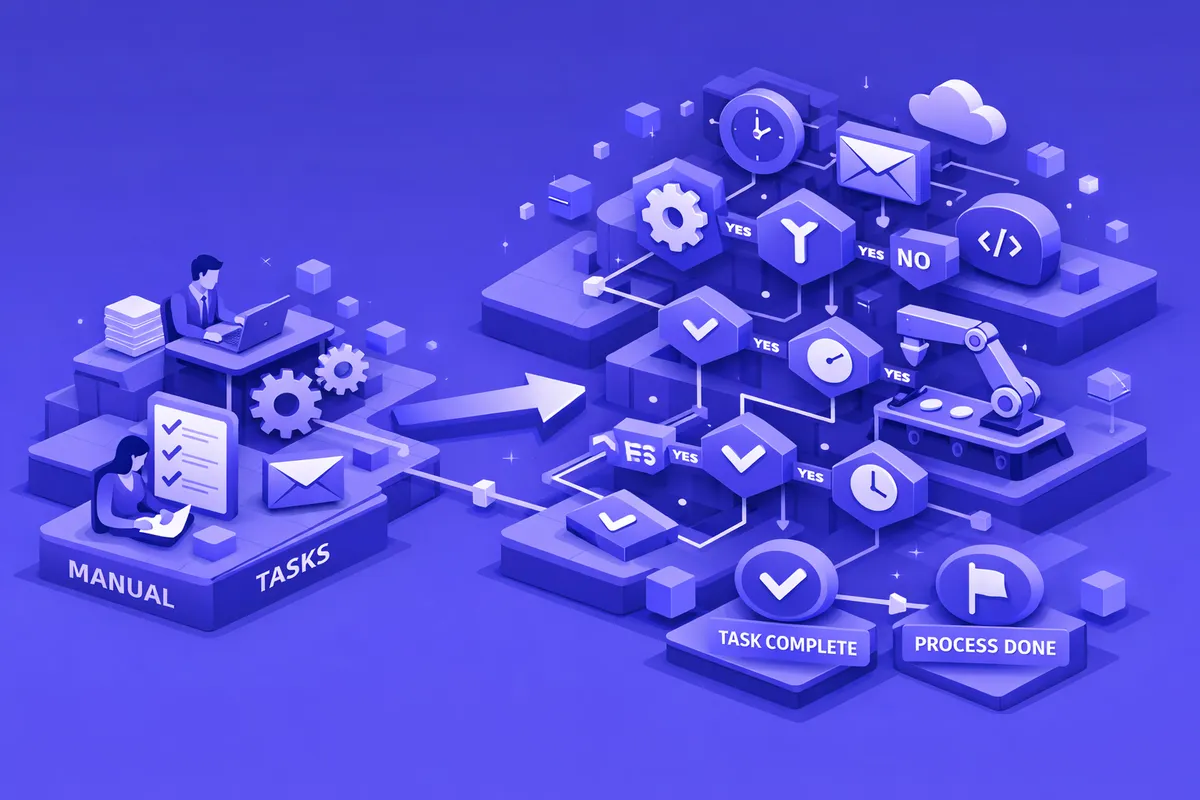
How We Build Business Process Automation for Hermosa
We start with a process audit that maps every recurring task in the business. Not the interesting creative work, but the work that happens the same way every time: the daily open and close procedures, the weekly ordering, the monthly billing run, the follow-up call after a service is completed. For a business near Kelvyn Park High School that serves students, families, and community members, that map might look very different from an auto shop on Pulaski Road. The audit is specific to the business in front of us.
From the map, we score every process on two dimensions: how often it occurs, and how much human judgment it actually requires. A task that occurs daily and requires no judgment is an immediate automation candidate. A task that occurs rarely and requires significant judgment stays human. Everything between those poles gets evaluated for partial automation, where a system handles the routine part and flags the exception for human review.
We then build the automation in phases, starting with the highest-frequency tasks that will recover the most time immediately. For most Hermosa businesses, that first phase involves appointment or scheduling automation, customer follow-up sequences, and report generation. These three categories typically recover 5 to 8 hours per week in the first 30 days.
The technical platform depends on what the business already uses. We do not require a complete software overhaul. Most automation can be built on top of existing tools using workflow automation platforms, or by adding lightweight automation scripts to whatever systems are already in place.
Industries We Serve in Hermosa
Taquerias and caterers along Fullerton Avenue handle catering inquiries through a process that currently involves multiple phone calls, manual quote preparation, and back-and-forth scheduling that consumes hours for each booking. Automation builds a catering inquiry workflow that captures customer requirements through a digital form, generates a preliminary quote automatically based on headcount and menu selection, and schedules a follow-up call only when the customer is ready to confirm, eliminating the phone tag.
Salon owners on Armitage Avenue run businesses where appointment confirmations, product reorder reminders, and birthday promotions to loyal clients happen manually or not at all. Automated appointment reminders reduce no-show rates measurably. Automated product reorder triggers prevent the out-of-stock moments that send clients to competing salons. Automated birthday offers keep clients engaged between appointments without requiring the owner to remember anyone's birthday.
Auto repair shops on Pulaski Road benefit from automating the customer communication cycle around repair orders: the intake acknowledgment, the estimate notification, the completion alert, and the post-service follow-up requesting a Google review. Each of these currently happens through a manual phone call or gets skipped entirely. Automation makes the full cycle consistent without adding to the service advisor's workload.
Small grocery and tienda owners serving the residential blocks near Kostner Avenue manage vendor ordering through a manual process that is frequently reactive: ordering when something runs out rather than based on consistent inventory monitoring. Automated reorder triggers that fire when inventory drops below a threshold level eliminate stockout situations and reduce the emergency orders that carry premium pricing.
Family medical practices near Pulaski Avondale Medical run appointment reminder systems that are often the single highest-value automation available to a healthcare practice. A well-designed automated reminder sequence (initial confirmation, 48-hour reminder, day-of reminder) reduces no-show rates by 30 to 50% in most practices, which translates directly to revenue that was previously being left on the table.
Churches and community organizations near Our Lady of Grace Parish coordinate volunteers, events, and donor communications through processes that currently involve significant manual coordination. Automated event registration and volunteer sign-up workflows reduce the administrative burden on staff and volunteers, while automated donor acknowledgment sequences ensure every contribution receives a timely, personal-feeling response.
What to Expect Working With Us
1. Process mapping session. We spend 2 to 3 hours with the business owner walking through a typical week, identifying every recurring task, and noting which ones have clear triggers and predictable outputs. By the end of this session, we have a prioritized list of automation candidates with estimated time-recovery values for each.
2. Phase 1 build: high-frequency tasks. We automate the 3 to 5 processes that will recover the most time in the shortest window. For most Hermosa businesses, this phase takes 2 to 3 weeks and delivers results that are immediately measurable. The business owner starts the following week with a noticeably lighter administrative load.
3. Phase 2 expansion. Once Phase 1 is running cleanly, we return to the automation map and address the next tier of processes. This phase often includes more complex workflows, like automated customer follow-up sequences with conditional logic or multi-step approval workflows for vendor payments. Timelines vary by complexity.
4. Monthly performance review. Automation that is running saves time, but automation that is being measured improves over time. We review the key metrics monthly for the first quarter: how many tasks the automation completed, how many exceptions required human review, and whether any new process has emerged as an automation candidate. Most businesses add 1 or 2 new automations per quarter as they identify new patterns.