How We Build Accounting Automation for Hermosa
We start by mapping every point where financial data enters the business: the POS system at the counter, the vendor invoices that come in by email and paper, the payroll platform or manual payroll process, the bank account. For a salon near Kelvyn Park, that map might be simple. For an auto repair shop on Pulaski Road that manages parts purchasing from multiple suppliers alongside labor invoicing, it requires more careful work.
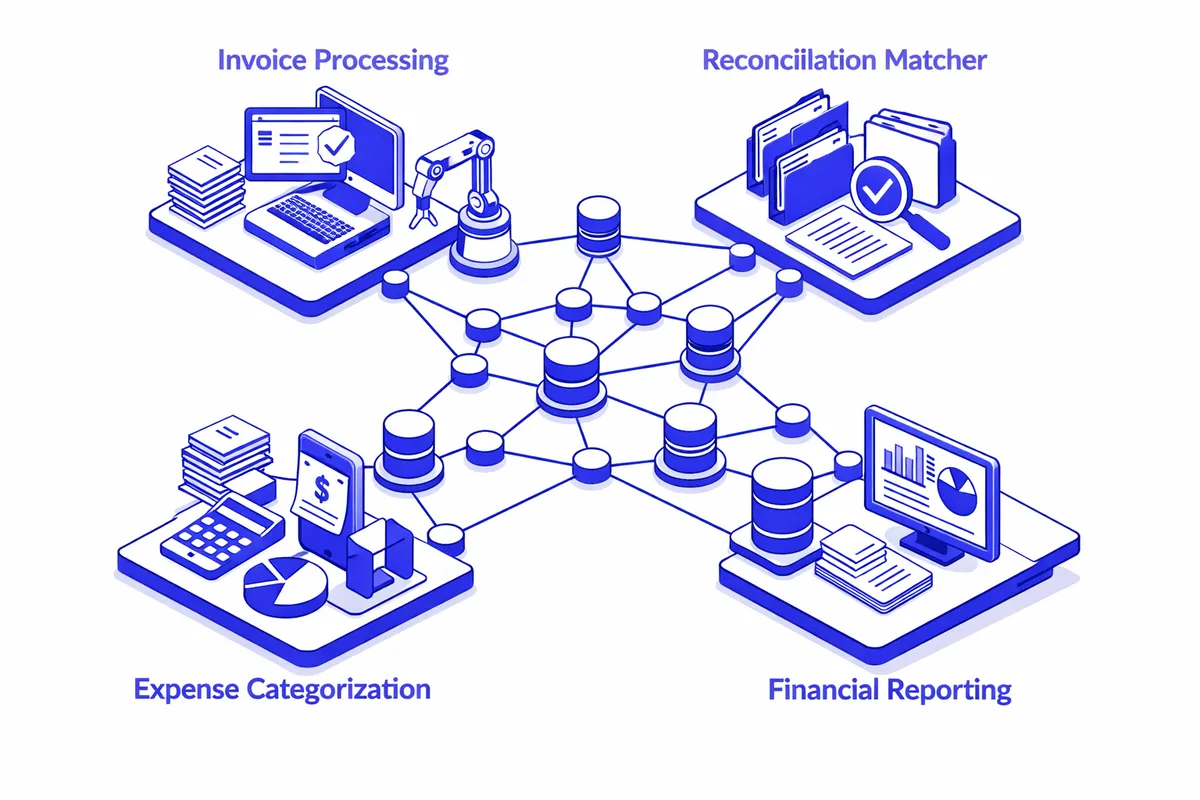
From that map, we identify the highest-friction points and build the automation layer around them. Most businesses benefit most from three things: automated transaction categorization that handles 80% of bookkeeping without human review, automated invoice processing that captures vendor bills from email and routes them for approval, and automated reconciliation that matches transactions to bank records and flags exceptions rather than requiring manual review of every line.
We connect these systems to whatever accounting software the business already uses, whether that is QuickBooks, Wave, or a spreadsheet system the owner built over the years. We do not require a platform switch. The automation layer fits on top of what already exists, which means the business owner does not have to learn a completely new system alongside the automation changes.
The final step is training. We spend time with the business owner and anyone else who touches the books, walking through what the automation handles and what still requires a human decision. The goal is confidence: a Hermosa business owner who understands exactly what their books look like at any given moment without having to spend a Sunday afternoon figuring it out.
Industries We Serve in Hermosa
Taquerias and family restaurants along Fullerton Avenue manage daily cash and card volume alongside weekly vendor invoices for produce, proteins, and supplies. Our automation captures every transaction category, reconciles daily against the POS, and produces weekly P&L summaries that give the owner a clear picture of food cost and margin without manual calculation.
Salons concentrated on Armitage Avenue operate a mix of service revenue, retail product sales, and booth-rental income from independent stylists. Each revenue stream has different tax implications and different reconciliation requirements. Accounting automation separates these streams automatically, so the owner's books reflect the true picture of each part of the business.
Auto repair shops on Pulaski Road manage complex parts purchasing alongside labor billing, often with a mix of customer-pay and insurance-pay invoices. Automating the accounts payable side alone can recover 5 to 8 hours per week for a shop owner who currently matches supplier invoices to purchase orders manually before approving payment.
Small grocery stores and tiendas serving the residential blocks near Kostner Avenue handle high transaction volume with small ticket sizes. Automating daily reconciliation and weekly inventory cost accounting removes the most tedious part of running these businesses and gives the owner accurate margin data without a bookkeeper on staff.
Family medical and dental practices near Pulaski Avondale Medical manage insurance billing, patient copays, and vendor invoices across a system that is already partially automated through practice management software. We connect that software to the accounting layer so revenue recognition, insurance reimbursements, and expense tracking happen automatically rather than requiring staff to key data between systems.
Churches and community organizations anchored around Our Lady of Grace Parish manage donations, program expenses, and vendor relationships on tight administrative capacity. Accounting automation simplifies donation tracking, produces the reports required for annual filings, and makes it easier for volunteer treasurers to hand off accurate records to paid accountants at year end.
What to Expect Working With Us
1. Financial data audit. We spend the first week mapping how money moves through the business: where transactions originate, how they currently get recorded, what the reconciliation process looks like, and where time is being lost. For a Hermosa business that has been running for years on a combination of spreadsheets and good memory, this audit often surfaces gaps that the owner knew existed but did not have time to address.
2. Automation design and system connections. We build the automation around the specific financial flows the audit identified. This includes setting up transaction categorization rules, connecting vendor invoice processing, and wiring the reconciliation logic to the business's bank feeds and accounting software. We handle the technical setup so the owner does not need to become an accounting software expert.
3. Testing against real data. Before we call anything live, we run the automation against 30 to 60 days of actual transaction history to verify that the categorization is accurate and the reconciliation logic handles the edge cases specific to this business. A Pulaski Road auto shop has different edge cases than a Fullerton Avenue taqueria. We test for the actual business, not a generic template.
4. Handoff and monthly check-ins. Once the automation is live, we train the owner on what to review and what to ignore. The first 90 days include monthly check-ins to refine categorization rules as new transaction types appear. After that, the system runs with minimal oversight, and the owner's relationship with their books shifts from weekly dread to monthly review.