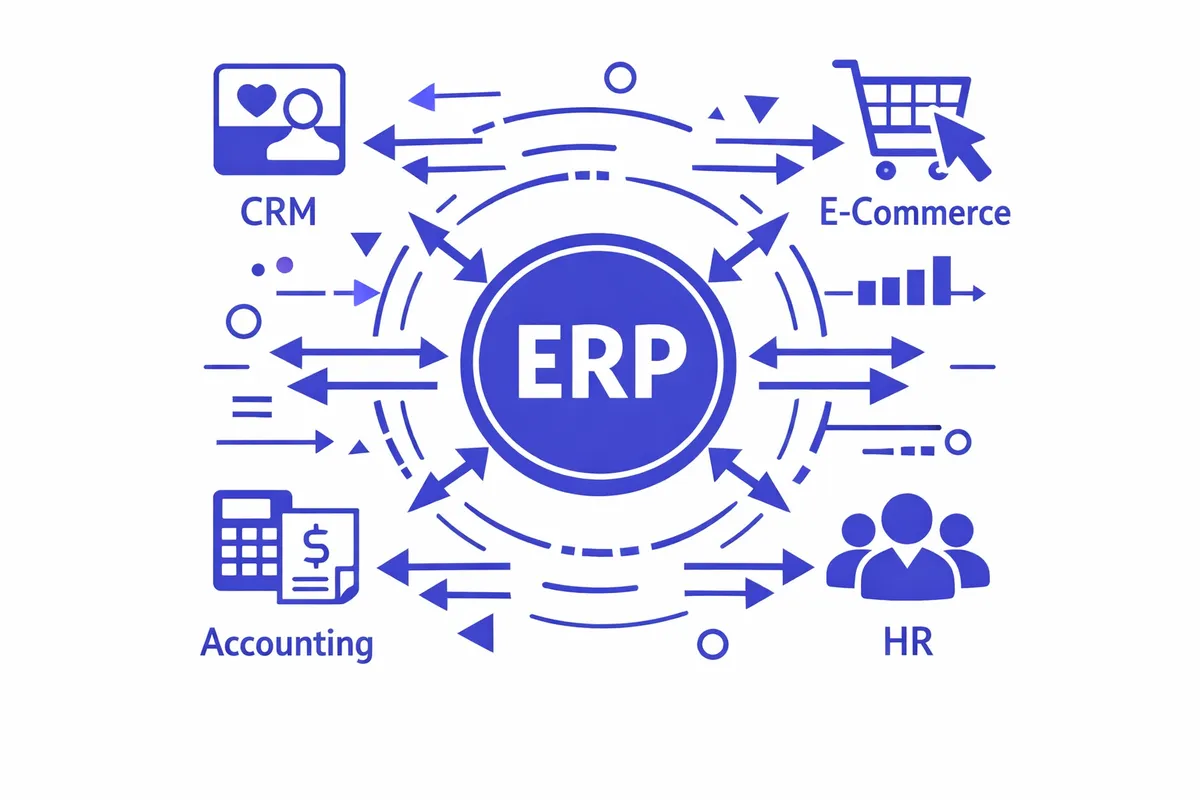
How We Build ERP Integration for Evanston
ERP integration starts with a business process audit, not a software selection. Before we recommend a platform, we need to understand every operational flow in your business: how clients are onboarded, how projects are scoped and tracked, how purchasing happens, how payroll is managed, and how financial reporting currently works. That audit maps the gap between your current state and the functionality an ERP needs to provide.
Platform selection follows the audit. For professional services firms with project-centric billing, we often evaluate NetSuite, Sage Intacct, or Microsoft Dynamics 365 Business Central. For smaller businesses with simpler operations, a platform like Acumatica or Odoo may fit better at a lower total cost of ownership. We present options with honest tradeoffs rather than defaulting to the platform we know best.
Implementation is the longest phase. We configure the ERP to your business model: chart of accounts, project structures, billing rules, approval workflows, and reporting hierarchies. For a professional services firm on Sherman Avenue, that means setting up the service lines, staffing roles, and billing rate structures that drive project profitability analysis. For a multi-location business, it means configuring the entity structure that lets you see consolidated reporting while maintaining location-level detail.
Data migration brings your historical records into the new system. Client records, project histories, financial records, and vendor relationships all move across with data integrity validation at each step. We never migrate data without verifying that the mapped fields match the target structure and that the total values reconcile to your prior system's records.
Industries We Serve in Evanston
Professional services firms on Chicago Avenue and Sherman Avenue with project-based revenue need ERP to model the full project lifecycle: scoping, staffing, time tracking, billing, collections, and profitability analysis. ERP integration gives partners and managing directors a real-time view of utilization rates, project margins, and pipeline, all from a single system rather than a manually assembled spreadsheet.
Wealth management and financial services organizations near Central Street managing complex billing arrangements, compliance reporting, and multi-advisor client portfolios benefit from ERP that integrates their advisory billing, operational accounting, and compliance documentation into a single platform with the audit trail and access controls their regulatory obligations require.
Academic and research-adjacent organizations operating near Northwestern University with grant funding, contract research revenue, and institutional purchasing requirements need ERP to manage fund accounting, grant reporting, and purchasing approval workflows that general-purpose accounting software cannot accommodate. ERP platforms with fund accounting modules handle these requirements natively.
Multi-location independent businesses in the Evanston area, whether a restaurant group with locations near Dawes Park and on Davis Street or a fitness studio group expanding from a single Sherman Avenue location, need consolidated financial visibility that independent systems per location cannot provide. ERP integration creates that consolidated view while maintaining location-level operational data.
Architecture and design firms with project portfolios spanning multiple years need ERP for project cost tracking, subconsultant management, billing against construction phases, and profitability analysis by project type. These firms often outgrow project management tools that lack financial integration and need a platform that models projects and finances together.
Healthcare and wellness practices near Northwestern University's medical-adjacent community managing multiple providers, complex billing codes, supply purchasing, and payroll need ERP integration that handles all of those operational dimensions in a single system with the compliance controls that healthcare billing requires.
What to Expect Working With Us
1. Business process audit and gap analysis. We spend the first two to three weeks mapping your current operations in detail: every system you use, every workflow that spans multiple systems, and every report your leadership team relies on that currently requires manual assembly. That map becomes the requirements document for ERP configuration.
2. Platform selection and architecture design. We present ERP platform options with honest cost, capability, and complexity comparisons, and recommend one based on your specific requirements. We design the ERP architecture before any configuration begins: chart of accounts, module selection, integration points with any systems that will remain outside the ERP, and a phased rollout plan if your organization requires a staged implementation.
3. Configuration, testing, and parallel operation. We configure the ERP in a test environment and validate it against your real business scenarios before any live data migration. After migration, we run your new ERP in parallel with your existing systems for 30 to 60 days, depending on complexity. Parallel operation lets you verify the new system's outputs against the ones you already trust before cutting over fully.
4. Cutover, training, and post-launch support. We manage the cutover from your existing systems to the ERP, train each user group on their specific workflows, and provide active support through the first full monthly close cycle. The first close in a new ERP always surfaces questions and edge cases that training did not cover. We are available to resolve them as they arise.