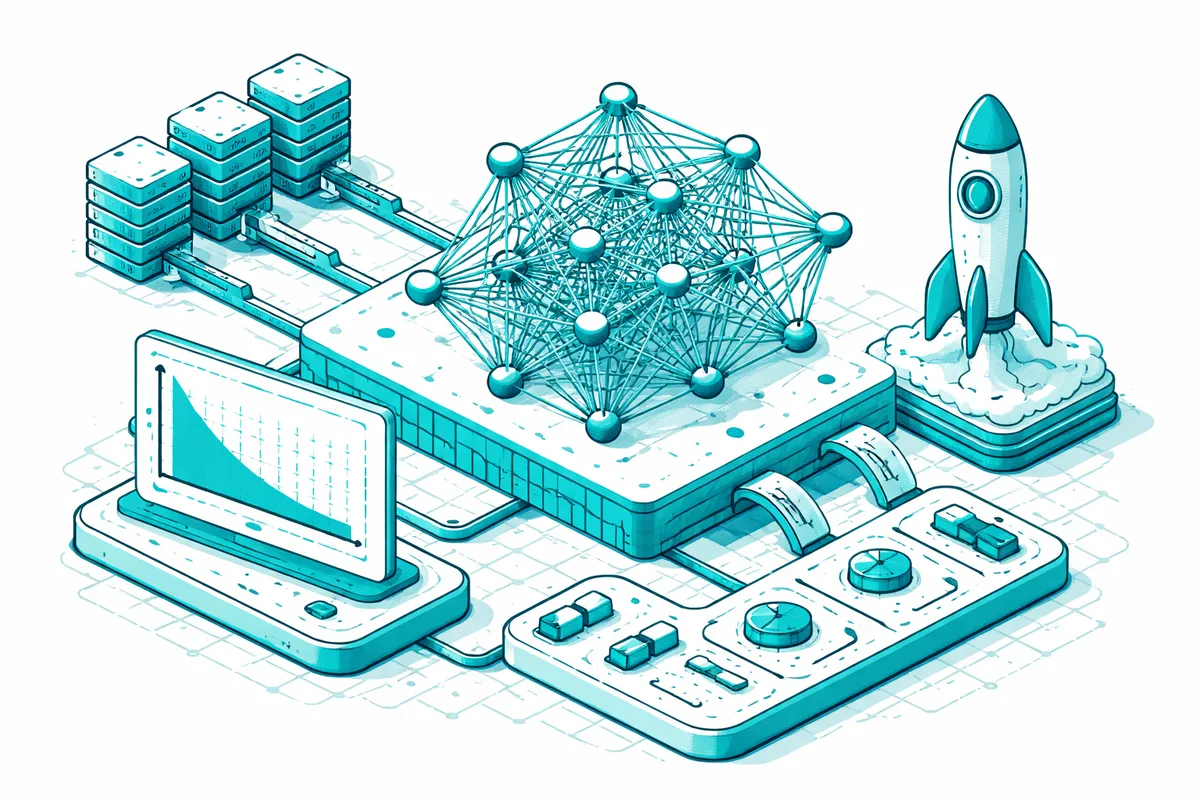
Model Training Capabilities We Bring
Fine-tuning of foundation models is the most common form of custom model training. Large language models from providers including OpenAI, Anthropic, Meta (Llama), and others can be fine-tuned on domain-specific data to improve their performance on specialized tasks. Fine-tuning requires significantly less compute and data than training from scratch, and produces models that retain general capability while specializing for the target domain.
Classification model development for specific labeling tasks: document classification, sentiment analysis, intent classification, and similar discrete prediction problems. These models are often smaller, faster, and more cost-efficient than large language models for well-defined classification tasks with adequate labeled training data.
Embedding model fine-tuning for organizations that use vector search and similarity matching in their AI systems. Embedding models trained on domain-specific text produce representations that capture domain semantics more accurately than general embeddings, improving the performance of search, recommendation, and retrieval-augmented generation systems built on top of them.
Computer vision model training for Evanston organizations with image-based applications: document analysis, medical imaging support, quality inspection, or visual search. Vision models trained on domain-specific image datasets outperform general vision models for specialized visual tasks.
Training data curation and preparation, because model quality is bounded by training data quality. We help organizations assess their existing data for training suitability, build labeling workflows for organizations that need human annotation of training examples, and structure data pipelines that produce the clean, consistent training datasets that model training requires.
The Northwestern Research Connection
Evanston organizations have an unusual asset in their proximity to Northwestern's AI research community. The university's Computer Science and Electrical Engineering programs produce graduate students and postdoctoral researchers with deep AI expertise who pursue consulting, collaboration, and commercial opportunities. Several Northwestern-affiliated AI research centers actively partner with commercial organizations on applied research projects.
We help Evanston organizations navigate these connections productively. Not every commercial AI problem is interesting to academic researchers, and not every academic AI research project translates usefully to commercial application. We assess which commercial AI model training needs might benefit from Northwestern research partnerships, and which are better served by commercial AI engineering without academic involvement. When partnerships make sense, we help structure them in ways that protect both the organization's commercial interests and the university's research independence.
Our Model Training Process
Every model training project begins with a use case assessment: what the model will do, what performance the organization requires, what training data exists, and whether custom training is genuinely the right answer. We conduct honest build-versus-use analysis that sometimes concludes that a general-purpose API is adequate and that custom training would not produce sufficient performance improvement to justify the investment.
When custom training proceeds, we build the training data pipeline first: collecting, cleaning, and structuring the training examples that will determine model quality. This phase often takes longer than expected because data quality problems are rarely visible until you try to use data for model training.
Model training and evaluation follows established machine learning engineering practices: training and validation data splits, evaluation metrics aligned with the actual use case rather than general benchmarks, error analysis that identifies specific failure modes rather than just overall accuracy, and comparison against baseline models to quantify the actual improvement from custom training.
Production deployment addresses the engineering requirements that separate a trained model from a reliable production system: inference infrastructure, API design, latency optimization, monitoring, and model versioning for future updates.