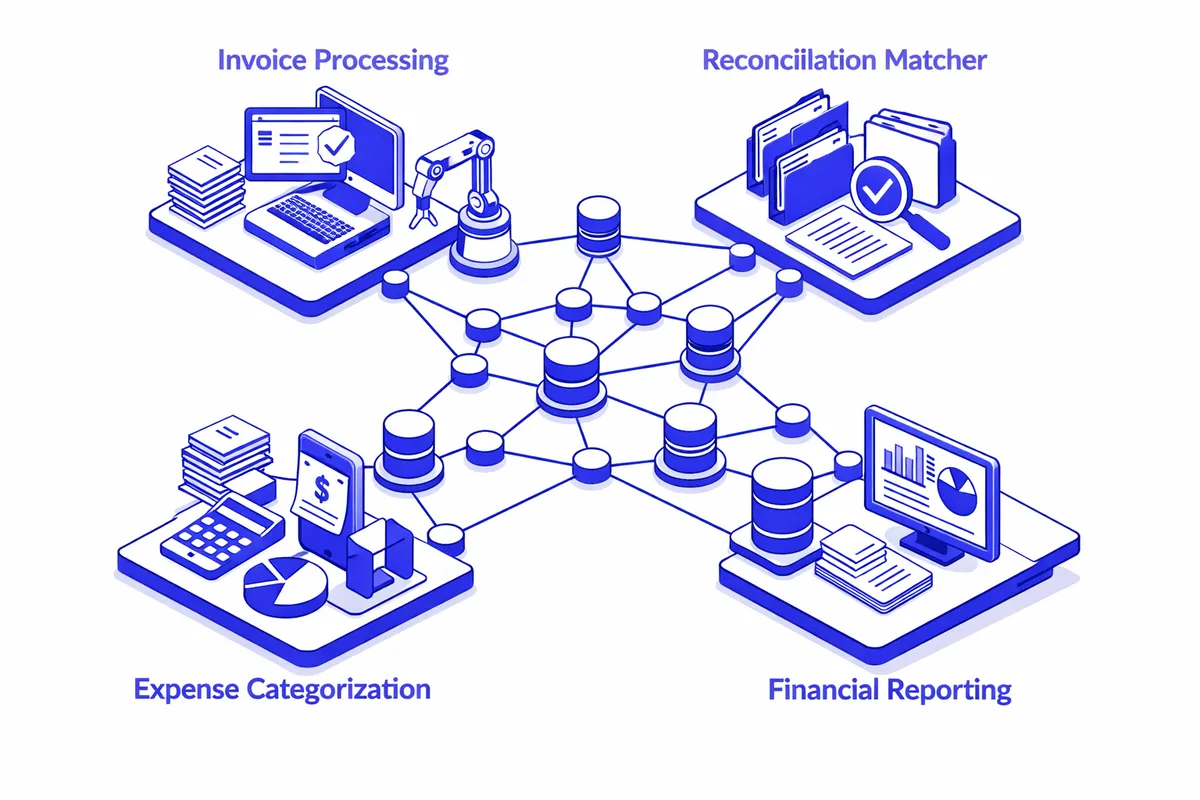
How We Build Accounting Automation for Evanston
Discovery starts with a complete picture of your current financial data flows. We map every place revenue enters your system, every platform through which you pay vendors or employees, and every reconciliation task your team performs manually. For a fitness studio on Sherman Avenue, that might be Mindbody for class revenue, Stripe for online sales, Gusto for payroll, and a manual spreadsheet for retail inventory. Each of those is a connection we can automate.
We then build the integration layer. For most Evanston businesses, that means connecting your existing platforms to QuickBooks Online, Xero, or whatever accounting platform you are already using, with configured rules that categorize transactions automatically based on vendor, amount, and source. We set up bank feed connections that reconcile daily rather than monthly, accounts payable automation that routes vendor invoices through an approval workflow, and payroll integration that posts labor costs to the right expense categories without manual journal entries.
Reporting is the final layer. Raw automation is only useful if you can see what it is telling you. We build a set of management reports tailored to your business: a weekly cash position summary, a monthly P&L with year-over-year comparisons, and a revenue variance report that flags when your actuals diverge from your forecast. For businesses near Northwestern, we add academic-calendar benchmarking so you can see how each month's performance compares to the same month in prior years.
Industries We Serve in Evanston
Independent restaurants and food service businesses near Dawes Park and along Davis Street deal with daily POS reconciliation, multiple vendor invoices per week, and labor costs that fluctuate with staffing. Automation connects their POS system directly to accounting, categorizes food and beverage costs automatically, and builds a daily cash position report that owners can read in 60 seconds.
Wealth management and financial advisory firms on Ridge Avenue and throughout Evanston's residential professional corridors have compliance reporting obligations that require precise record-keeping. We automate their client billing, fee tracking, and expense categorization, and build the management reports that their compliance officers need without requiring a separate manual pull each quarter.
Fitness studios and wellness businesses on Sherman Avenue collect revenue through memberships, class packs, private sessions, and retail sales, often on three or four different platforms simultaneously. Accounting automation consolidates all of those revenue streams into a single ledger view with proper categorization, eliminating the weekly reconciliation that otherwise consumes an hour of a manager's time.
Professional services firms serving the Northwestern University community, from consulting to legal to architecture, often operate on milestone billing tied to project phases. We automate their time-tracking to invoicing connection, configure revenue recognition rules for retainer contracts, and build a WIP (work-in-progress) report that tracks unbilled hours by client and project.
Independent bookstores and specialty retailers near the Evanston Public Library deal with inventory, sales tax categorization, and vendor payables simultaneously. Automation connects their point-of-sale to accounting, applies the correct Illinois sales tax treatment to each product category, and reconciles inventory costs against revenue on a daily basis rather than a quarterly manual count.
Tutoring and academic services businesses near Northwestern University and Evanston's high schools invoice on a semester-by-semester basis with variable rates for different subject areas and student levels. We automate their invoicing workflow, build automated payment reminders for outstanding balances, and connect collections to accounting so their revenue ledger reflects actual cash received rather than billed amounts. For businesses that run summer intensives or test-prep programs on separate fee schedules, we configure distinct revenue categories so those programs are tracked against their own cost structure.
What to Expect Working With Us
1. Flow mapping and gap analysis. We document every financial data flow in your business: where revenue enters, how expenses are tracked, how payroll is processed, and where reconciliation currently happens manually. This typically takes one working session with your owner or office manager and surfaces the three or four integrations that will eliminate 80% of your manual work.
2. Integration build and testing. We connect your platforms and configure your automation rules in a staging environment before touching your live accounting data. For Evanston businesses with multiple revenue streams, this phase includes a full test cycle against a prior month's actual transactions to verify that the automation categorizes everything correctly before it goes live.
3. Parallel run and validation. For the first 30 days after launch, we run your automated system in parallel with your existing process and compare results. This catches edge cases and miscategorizations before they affect your books. For businesses near Ryan Field with irregular game-day revenue spikes, this phase also validates that those high-volume days reconcile correctly.
4. Handover and monthly reporting setup. We deliver your management reporting dashboard, train your team on the automation rules, and provide documentation for your accountant or CPA. You will have a system your bookkeeper can monitor and your accountant can trust for tax prep without requiring manual cleanup.