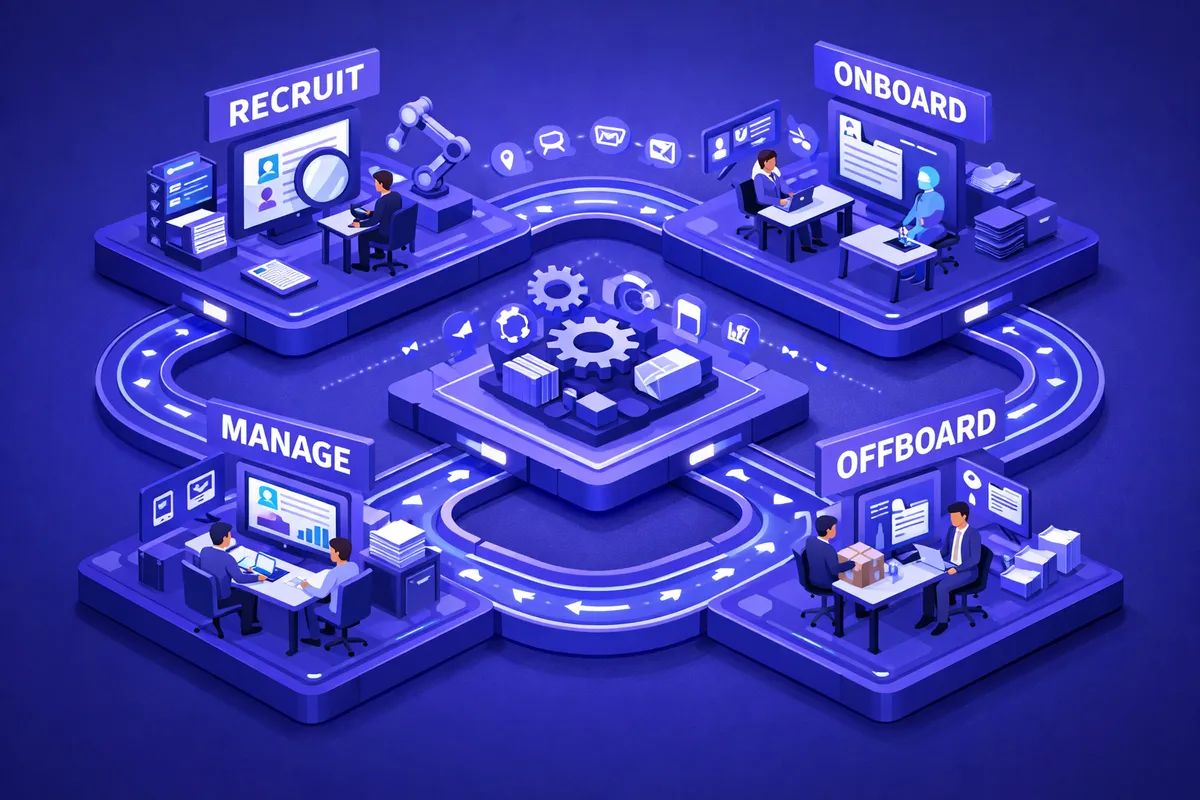
How We Build HR Automation for Englewood
The starting point is your current hiring and management workflow. We do not assume what the bottlenecks are. For a food business that started at Growing Home and has grown to six employees, the primary constraint might be time tracking and payroll integration. For a home care agency on Racine Avenue managing thirty-five active aides, it might be certification tracking and compliance documentation. We map the workflow, identify where manual processes create the most friction, and build automation around those points first.
Platform selection matters. We work with HR systems that fit the scale and budget of Englewood-sized businesses: platforms that do not require a full HR department to administer, that have mobile interfaces for workers who do not sit at desks, and that handle the specific compliance requirements of Illinois healthcare and service employers. The right platform for a five-person catering business is different from the right platform for a twenty-person care agency.
Implementation is phased. We start with the highest-friction processes: typically scheduling, time tracking, and onboarding documentation. We get those running reliably before adding complexity. For organizations on Garfield Boulevard managing both volunteers and paid staff, we configure role-based access carefully so each person sees only what they need without administrative overhead for every interaction.
Training is practical and designed for the actual users. The care coordinator on Ashland Avenue who manages scheduling for a team of aides needs to know how to use the scheduling tool effectively, not how the software's architecture works. We train to the specific tasks, not to the full feature set.
Industries We Serve in Englewood
Home healthcare and personal care agencies operating across the Englewood residential grid need HR systems that handle care aide certification tracking, scheduling coordination, time and attendance, and compliance documentation. The agencies on Ashland Avenue and Halsted Street that manage distributed care workforces have HR complexity that demands automation; doing it manually is the single largest source of administrative cost in these organizations.
Food businesses and caterers that grew from the Growing Home commercial kitchen network into larger operations need scheduling tools for production staff, onboarding systems for new kitchen workers, and time tracking that integrates with payroll. The food business scaling from a farmers market operation to a wholesale and catering operation has new HR requirements that appear quickly once the team grows past a handful of people.
Along 63rd Street, barbershops and multi-chair salons that have crossed from sole proprietor to employer need simple but real HR systems: offer letters, payroll setup, scheduling for booth renters versus employees, and the documentation that protects the business when employment disputes arise. Owners who have never had employees often underestimate the administrative requirements until they are in the middle of them.
Community organizations and nonprofits on Garfield Boulevard managing mixed teams of paid staff, interns, and volunteers need HR systems that handle each category appropriately. Grant-funded positions have different documentation requirements than fee-based program staff. Volunteer management requires different tools than employee management. The right HR automation handles all three without forcing everything into the same box.
Workforce development programs and training organizations near Kennedy-King College place graduates in employment and need placement tracking, employer communication systems, and outcome documentation to satisfy program reporting requirements. Automation that captures placement data, 90-day retention rates, and wage outcomes without requiring manual data collection makes these programs more effective and easier to report on.
Near Hamilton Park, small property management and home services businesses that hire seasonal or part-time workers for maintenance, landscaping, or building management need simple scheduling, onboarding, and time tracking tools that seasonal workers can use on mobile devices without a training investment.
What to Expect Working With Us
1. HR workflow mapping. We document your current hiring, onboarding, scheduling, and compliance processes step by step, including all the workarounds and manual steps that have accumulated over time. For organizations on Racine Avenue or Ashland Avenue with years of informal systems, this mapping often surfaces compliance gaps that need to be addressed alongside the automation work.
2. Platform configuration and integration. We configure the HR platform to match your organization's specific structure: role definitions, pay types, scheduling rules, compliance documentation requirements, and integrations with your payroll provider. We do not use the platform's default configuration and hand it to you; we build it around your actual operation.
3. Process migration and parallel testing. We migrate your existing employee records, run the new system in parallel with your old processes for two to four weeks, and confirm that everything is working correctly before you cut over. For home care agencies on Halsted Street whose operations cannot absorb a scheduling failure, this parallel period is not optional.
4. Administrator training and documentation. The person who manages HR at your organization gets hands-on training in the specific tasks they will perform. We document every process in plain language specific to your configuration. When a new employee joins a month after implementation, the onboarding checklist is already built and the training documentation is ready.