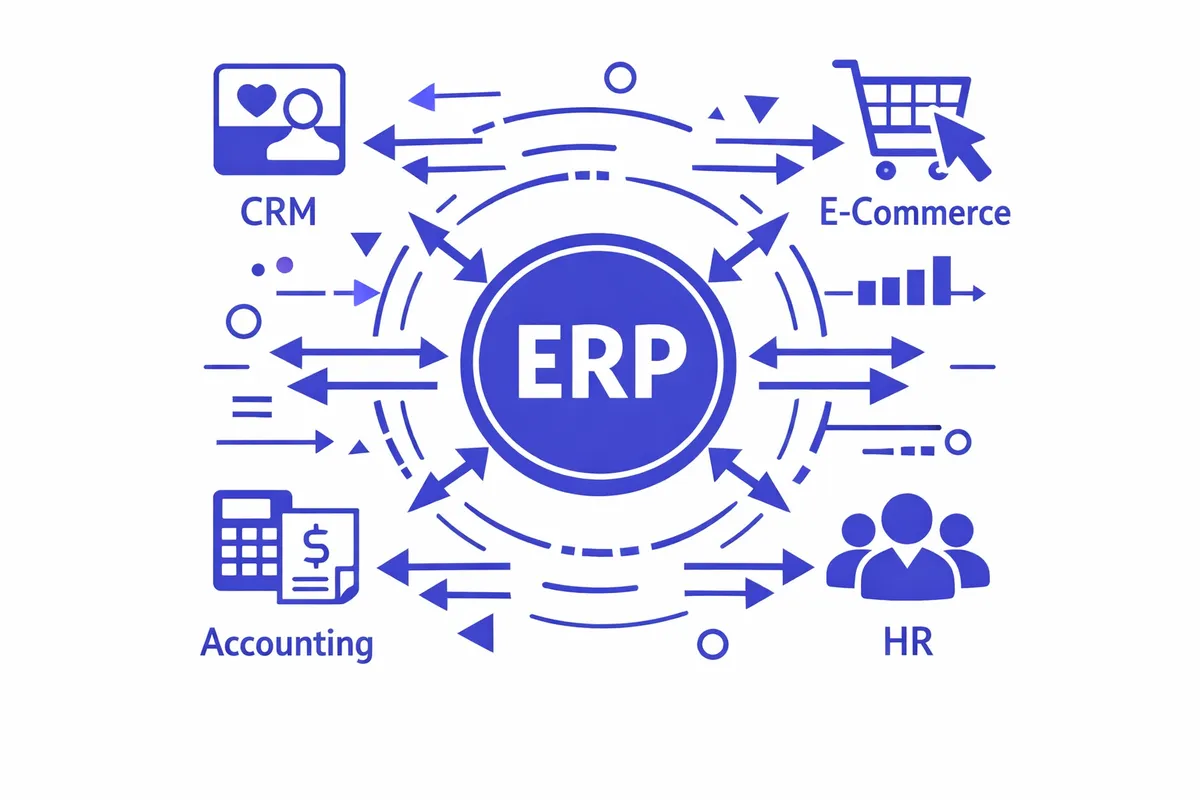
How We Build ERP Integration for Englewood
The first step is an honest inventory of what you are currently using and why. Some businesses arrive with a clearly specified platform they want to implement. Others have a problem to solve and need guidance on which ERP platform actually fits their operation. For a home healthcare agency on Ashland Avenue, that conversation covers scheduling complexity, compliance requirements, billing workflows, and the size of their team. The right ERP for a five-person care agency is different from the right ERP for a thirty-person operation.
Once we have selected or confirmed the platform, we map the integration points: what data lives where today, what needs to flow where after integration, and what the migration path looks like for existing records. For businesses on Racine Avenue or Garfield Boulevard with years of operational history, data migration is often the most sensitive part of the project. We handle this carefully, validating data integrity at every step.
Implementation is phased. We do not turn off your existing systems and flip on the new one on a Monday morning. We run parallel operations during a transition period, confirm that the new system is producing the same outputs as the old one, and only cut over once everyone on the team is trained and confident. For businesses that cannot afford a week of operational disruption, this phasing is not optional; it is the only responsible way to do the work.
Post-integration, we document the system configuration, train your administrators, and establish the monitoring that catches problems before they become crises.
Industries We Serve in Englewood
Home healthcare and personal care agencies operating across the Englewood residential grid between Ashland Avenue and Halsted Street need ERP systems that integrate scheduling, care documentation, billing, and HR into a single platform. The regulatory complexity of healthcare billing makes disconnected systems particularly costly; errors and reconciliation failures translate directly into revenue loss and compliance risk.
Along 63rd Street, barbershop and salon chains or multi-location operators that have grown past a single location need integrated booking, inventory, payroll, and financial reporting. The owner who is manually pulling numbers from three apps to prepare monthly financials is losing time they cannot recover. An integrated system makes that reporting automatic.
Food businesses and caterers who graduated from the Growing Home commercial kitchen network into larger operations need job costing, inventory management, recipe scaling, and accounts receivable connected. Food businesses that cannot accurately cost their jobs price either too high to win work or too low to stay profitable. ERP integration makes the cost data visible in real time.
Community-based organizations running commercial programs along Garfield Boulevard need systems that separate their grant-funded and earned-revenue streams while giving leadership a unified view of organizational finances. Generic accounting software forces manual workarounds for grant accounting; the right ERP handles fund accounting, program tracking, and operational budgets in one place.
Small food businesses operating in commercial kitchen incubators near Kennedy-King need production scheduling, ingredient procurement, and sales order management that work together. The business growing from farmers market to wholesale to retail needs systems that can handle all three sales channels without a manual reconciliation step between each one.
Urban agriculture operations connected to the Growing Home network face the specific challenge of managing variable production, multiple buyers, and seasonal revenue in a single system. ERP integration brings together harvest tracking, CSA subscriptions, wholesale order management, and financials so growers can actually see if the operation is financially viable, not just running at a high volume.
What to Expect Working With Us
1. Systems audit and platform recommendation. Before we touch any configuration, we document your current tools, workflows, and data. If you have already selected an ERP platform, we validate that choice against your actual operation. If you are still evaluating options, we give you a clear recommendation with the reasoning behind it. Organizations on Halsted Street running complex care operations have different needs than a food business on Garfield Boulevard.
2. Integration architecture and data migration plan. We map every data flow: what moves from your old systems, what gets reconfigured, what gets built from scratch. Data migration from years of operational history in spreadsheets and legacy tools is often the most time-consuming part of ERP work, and we scope it honestly rather than treating it as a line item.
3. Phased implementation with parallel operations. We implement in phases, maintain parallel operations during the transition, and confirm data integrity before cutting over. Your Ashland Avenue operation cannot go dark for a week while systems are being switched. We engineer around that constraint, not through it.
4. Staff training and administrator certification. Every person who uses or administers the system gets training specific to their role. We do not deliver a generic platform training; we build training around your organization's specific configuration, your workflows, and your reporting needs. Administrators get the technical depth to handle common configuration changes without our involvement.