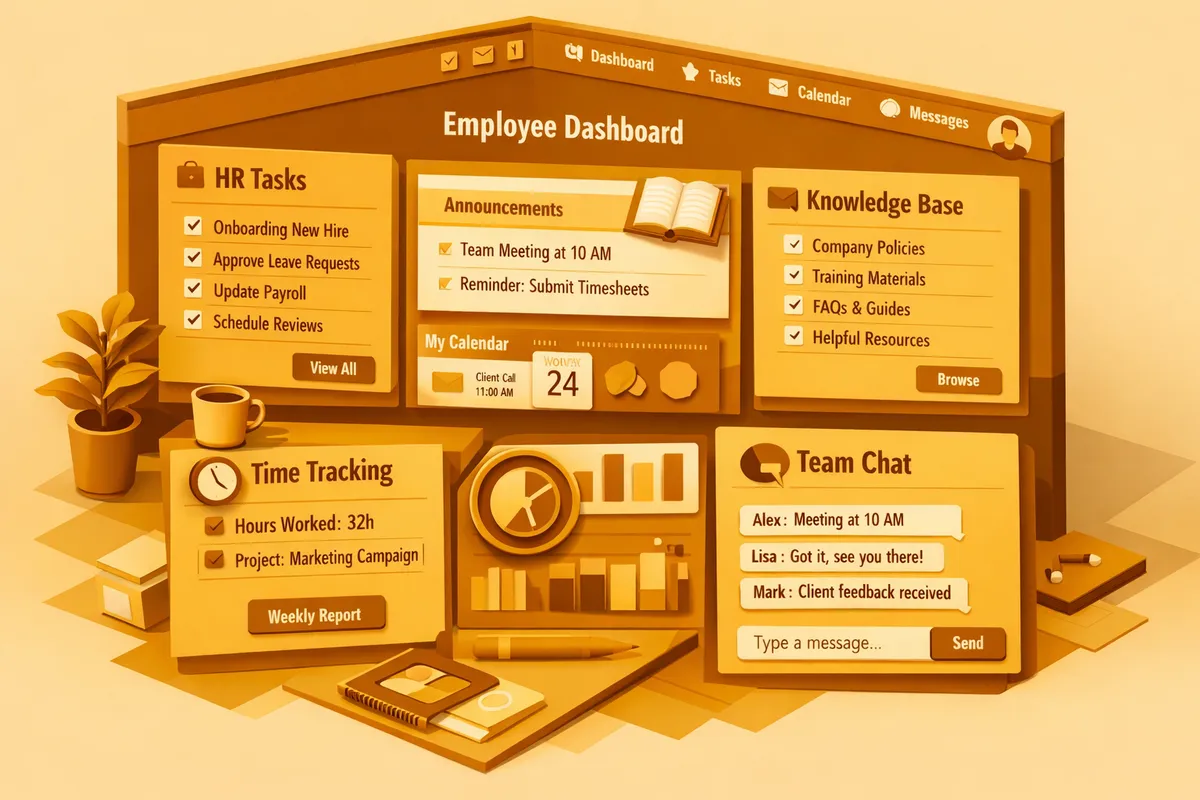
How We Build Employee Portals for Englewood
We begin every Englewood engagement by mapping the organization's actual workforce structure before designing anything. For a home healthcare agency, this means understanding how care coordinators assign aides to clients, how field staff communicate schedule changes, and where compliance documentation currently lives. For a nonprofit operating out of Kennedy-King College's surrounding neighborhood, it means mapping grant-funded program structures, volunteer tracking requirements alongside paid staff management, and the reporting cadences that funders expect. For a small food business near Englewood Square, it means understanding the owner's daily routine, how scheduling currently works, and what administrative tasks consume the most time each week.
From that baseline, we design portals around three functional layers that match Englewood organizational realities. The self-service layer gives employees direct access to their schedules, pay stubs, PTO balances, and benefit documentation from any device, removing the manager as an intermediary for routine information requests. The compliance layer automates the tracking obligations that create risk when managed manually: Illinois sick leave accrual, certification expiration dates, I-9 re-verification schedules, and required training completions. The manager layer provides scheduling tools, approval workflows for leave and shift changes, and performance documentation capabilities sized for the lean management structures that most Englewood employers operate with.
Integration with existing payroll systems is central to every build. Most Englewood small employers use Gusto, ADP, or QuickBooks Payroll. The portal connects to those systems so data flows automatically, eliminating duplicate entry. For organizations that track grant-funded time separately from general operations, we build project-coding into time entry so the portal produces funder-ready reports as a byproduct of normal daily use rather than a separate reconciliation task.
Mobile access is not optional for Englewood's workforce. Home health aides moving between client sites on Halsted Street do not return to a central office to check schedules or submit paperwork. Field staff for urban agriculture operations at Growing Home work across multiple sites. The portal must work on a smartphone as reliably as on a desktop, including schedule checking, time entry, and document submission.
Industries We Serve in Englewood
Home Health and Social Services: Home healthcare agencies, social service organizations, and community health providers across Englewood manage credentialed field staff with complex compliance requirements and dispersed work sites. We build portals that track certification status, automate expiration alerts, and give field employees mobile access to their schedules and documentation without requiring office visits.
Nonprofit and Community Organizations: Community development corporations, workforce training programs, church-affiliated service organizations, and grassroots nonprofits in Englewood operate with grant-funded staffing structures and funder reporting obligations that generic HR software handles poorly. We build portals that code time to programs, automate required reporting outputs, and track the compliance documentation grantors audit.
Food and Urban Agriculture: Small food businesses at Englewood Square, urban farm operations like Growing Home, and neighborhood food enterprises manage variable staffing and tight margins where administrative simplicity directly affects viability. We build portals that handle seasonal workforce fluctuations, track volunteer contributions alongside paid staff, and give owner-operators HR visibility without requiring dedicated administrative staff.
Personal Care and Barbershops: Barbershops and salons along 63rd Street and the surrounding Englewood commercial corridors employ commission-based stylists and booth renters with distinct payroll and scheduling arrangements. We build portals that handle mixed compensation structures, track booth rental agreements alongside W-2 employment, and give chair-side staff mobile schedule access that fits their working day.
Education and Workforce Training: Organizations affiliated with Kennedy-King College and the broader workforce development ecosystem in Englewood manage instructional staff, program coordinators, and administrative personnel with credentialing and continuing education requirements. We build portals that track professional development completions, manage certification renewal schedules, and support the documentation workflows that institutional funders require.
Small Retail and Services: Independent retailers, service businesses, and commercial tenants along Garfield Boulevard and Racine Avenue manage small teams where each employee's availability directly shapes the business's operating capacity. We build portals that give owner-operators scheduling visibility, automate the compliance tasks that create liability when missed, and scale appropriately for organizations of 5 to 25 employees.
What to Expect Working With Us
Workflow Discovery: We interview managers and front-line staff at your Englewood organization to map every HR process currently executed manually or through workarounds. We identify the workflows that belong in the portal, the compliance obligations that create risk in their current form, and the integrations that will eliminate duplicate administrative work.
Design and Role Configuration: Before development begins, we design portal interfaces and access structures for each role in your organization. Englewood employers typically need configurations for owner-operators or executive directors, front-line managers, full-time staff, part-time or variable-hour staff, and in some cases tracked volunteers. Each role sees only what it needs to do its work.
Phased Build: Core self-service features launch first so your team gains value during the build. Compliance automation, manager workflows, and system integrations follow in defined phases. We test with real employees from your Englewood team before each phase goes live, not just with internal QA.
Training and Post-Launch: We train your management team on daily portal operations, compliance dashboards, and how to handle the configuration changes that come up as your organization evolves. Sixty days of post-launch support catches adoption issues and operational edge cases before they become habits.