How We Build Document Management for Englewood
Discovery in Englewood typically reveals a mix of paper and digital records that have been reorganized multiple times by different staff members without a consistent taxonomy. The physical filing cabinets in a community organization's back office often hold records from two or three program eras, organized by the conventions of whoever last touched them. The shared Google Drive has folders created by four different program coordinators with overlapping names and no clear hierarchy. Email is carrying a significant portion of the actual record-keeping.
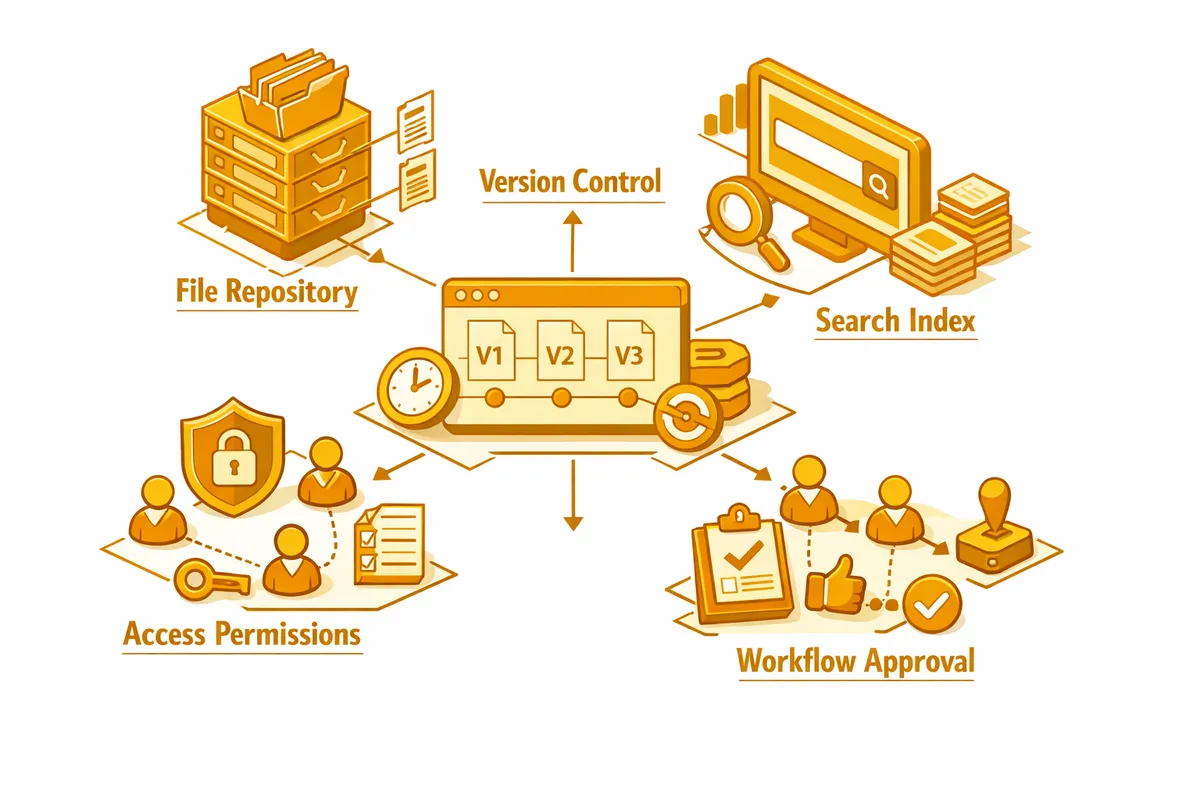
We map all of it in the discovery audit. Document types, volumes, locations, access patterns, and the compliance requirements that apply to each type. For Englewood nonprofits operating on multiple grants with different reporting cycles and retention requirements, the audit typically reveals that not everyone knows which funder requires what, and that retention schedules are not being applied systematically. For home healthcare providers, the audit surfaces whether clinical records are organized in a way that supports licensing inspection, or whether the organization would need a scramble to prepare for an unannounced visit.
The taxonomy we design follows the organizational logic of your specific operation. For an Englewood workforce development nonprofit, that means organizing by grant cycle and program, with participant records, expense documentation, and outcome data nested under each program and funder. For a home healthcare agency, that means organizing by client, with care plan, visit records, and medication logs maintained as a coherent record for each client rather than scattered across document types. For a barbershop on 63rd Street, that means a simple structure: staff records, licensing documentation, supplier contracts, and inspection records, each findable in under a minute.
Industries We Serve in Englewood
Community nonprofits and social service organizations operating near Ogden Park, Hamilton Park, and throughout Englewood need grant documentation systems that organize by funder and program cycle, participant record management that supports outcome reporting, board and governance records that survive leadership changes, and document retention policies that meet funder requirements across multiple concurrent grant relationships.
Barbershops and salons along 63rd Street, Halsted Street, and Ashland Avenue need staff licensing documentation, inspection record management, supplier contract organization, and equipment maintenance records maintained in a way that supports state board inspections and keeps the business owner from spending an afternoon searching for a document that should take thirty seconds to find.
Home healthcare providers and social support services serving Englewood families need client record management that supports IDPH licensing requirements, care plan documentation organized by client and updated with each visit, incident report management, and staff certification tracking that ensures licensed personnel records are current and accessible during inspections.
Urban farms and food businesses connected to the Growing Home ecosystem and operating along Garfield Boulevard need agricultural contract management, food safety documentation, produce buyer agreements, and certification records organized to support institutional sales and food safety compliance without requiring the owner to maintain a paper trail that does not scale.
Churches and faith-based community organizations anchored throughout Englewood manage congregation records, facility rental agreements, community program files, and donor relationships. Document systems built for faith-based community organizations keep these records organized through pastoral transitions and across volunteer-led administrative teams.
Small food businesses and restaurants on 63rd Street and Halsted Street need vendor invoice management, supplier contract organization, health permit records, and employee documentation maintained in a structure that handles the rapid staff turnover common in food service without losing the institutional record of what was agreed with suppliers and what inspectors found.
What to Expect Working With Us
1. Discovery and document audit. We spend time understanding your actual document environment before recommending anything. For Englewood nonprofits, this means mapping grant documentation across multiple funders. For home healthcare agencies, this means reviewing current record-keeping practices against IDPH licensing standards. The audit is specific to your organization and your compliance obligations.
2. Taxonomy and system design. We design the document classification structure, access controls, and retention policies specific to your organization. For nonprofits with multiple concurrent grants, we design grant-centric structures that keep each funder's documentation clearly separated and retrievable. For small businesses with simpler document environments, we design lean structures that are easy to maintain with limited staff.
3. Implementation and migration. We build the system and migrate existing documents into the new structure. Paper records are scanned and organized. Email attachments are extracted. Shared drive chaos is reorganized into the new taxonomy. Core implementations are live within eight to fourteen weeks.
4. Training and support. Post-launch training for your team, a warranty period, and optional ongoing support for retention policy updates, staff access changes, and document taxonomy adjustments as your programs and business relationships evolve.