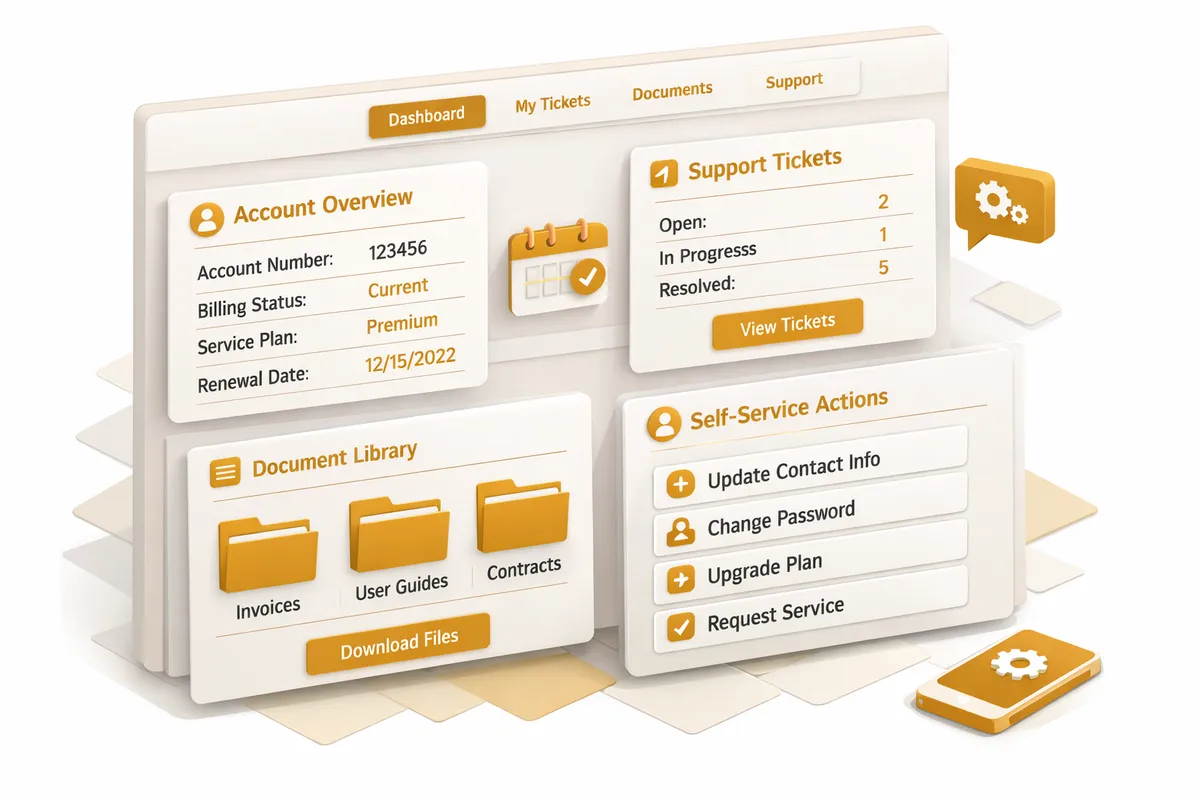
How We Build Customer Portals for Englewood
Community organization portals for Englewood begin with a clear-eyed assessment of the technology access landscape. Smartphone use is the primary digital access point for many Englewood residents. Computer and broadband access at home is less consistent. Every portal we build for Englewood organizations is designed mobile-first, tested on lower-cost Android and iOS devices, and optimized for cellular data connections rather than assuming broadband.
Simplicity is a design requirement, not a preference. A portal that requires four taps to find a scheduled appointment time is worse than a phone call for a resident who is not comfortable with digital interfaces. We design the most important functions, the ones participants use most often, to be reachable in two taps from the home screen. Session schedule, attendance record, messaging the care coordinator, downloading documentation: all of these are front-line functions.
Language access for Englewood portals reflects the community's demographic reality. Spanish-language access is standard for organizations serving the neighborhood's Latino residents. For organizations serving significant populations with other language needs, we assess translation requirements during discovery.
Privacy and data security receive particular attention in portals serving Englewood's community organizations. Many participants are navigating sensitive circumstances: unemployment, housing instability, health challenges, involvement with the justice system. Data handling for these populations must meet the highest applicable standards, and the portal's privacy communication must be clear enough that participants understand exactly what is stored and who can access it.
We integrate with the case management, donor management, and program tracking platforms commonly used by community nonprofits. For organizations on platforms like Salesforce Nonprofit Success Pack, Little Green Light, or agency-specific case management systems, integration paths are available. For organizations without established digital infrastructure, we can design a simpler portal that functions as a standalone participant record and communication system.
Industries We Serve in Englewood
Workforce development and job training organizations near Kennedy-King College and along Halsted Street build participant portals that provide program schedule access, attendance tracking, assignment status, completion documentation, and employer verification letters. For organizations whose graduates need documentation for employment or further education, a portal that produces verified completion records immediately on request is both a service improvement and an administrative time-saver.
Urban agriculture and food access organizations like Growing Home near Halsted Street and Garfield Boulevard use portals for volunteer and worker participant management, CSA or produce box subscription access, wholesale customer invoicing, and donor engagement. For food businesses with dual charitable and commercial operations, the portal can serve both the program participant side and the commercial customer side within a single organized system.
Faith-based community service organizations along 63rd Street and Garfield Boulevard use portals for emergency assistance recipient record management, volunteer coordination, event registration, and congregational giving history. For churches running multiple service programs alongside regular congregational functions, a portal organizes the service relationships that would otherwise require separate tracking systems for each program.
Community health organizations and social service agencies along Ashland Avenue and Racine Avenue provide client portals for service enrollment, care coordination appointment management, referral tracking, and case communication. For organizations providing wraparound services that coordinate housing, health, and employment support, the portal is the communication infrastructure that keeps participants informed about their full service picture.
Neighborhood nonprofits and advocacy organizations active near Ogden Park and Hamilton Park build donor portals for giving history, tax receipt download, volunteer opportunity access, and program impact reports. For organizations rebuilding donor bases after years of neighborhood disinvestment, a portal that presents a professional, organized face to donors signals that the organization is managed well and worthy of sustained investment.
Youth-serving organizations and after-school programs near Englewood Square build youth and family portals for program registration, attendance notification, progress tracking, and parent or guardian communication. For youth programs that need to report outcomes to funders, a portal that maintains accurate program records in a format suitable for reporting is simultaneously a service tool and a grant compliance infrastructure.
What to Expect Working With Us
1. Mobile-first design with low-bandwidth performance testing. We design and test all Englewood portals on the device types and connection speeds common in the community. Performance on a mid-range Android device on a 4G connection is part of the acceptance criteria for every portal build. A portal that works beautifully on a MacBook and slowly on the devices participants actually use has not met its purpose.
2. Participant-centered privacy architecture. We design data access controls that give each participant access only to their own records and make the privacy practices visible to participants in plain, accessible language. For organizations serving populations with sensitivity concerns, we consult with your program staff on the right approach to communicating data practices before finalizing the portal's privacy information.
3. Integration with nonprofit program management platforms. We assess your current program management, donor management, and case management systems and design integration that keeps portal data current automatically. For organizations without established systems, we recommend and can implement lightweight solutions appropriate for Englewood organizations' scale and budgets.
4. Community-informed launch and staff training. We involve your program staff and a small group of current participants in testing the portal before launch. Program staff learn to support participants in setting up and using their portal accounts. We provide bilingual portal introduction materials formatted to your organization's identity.